

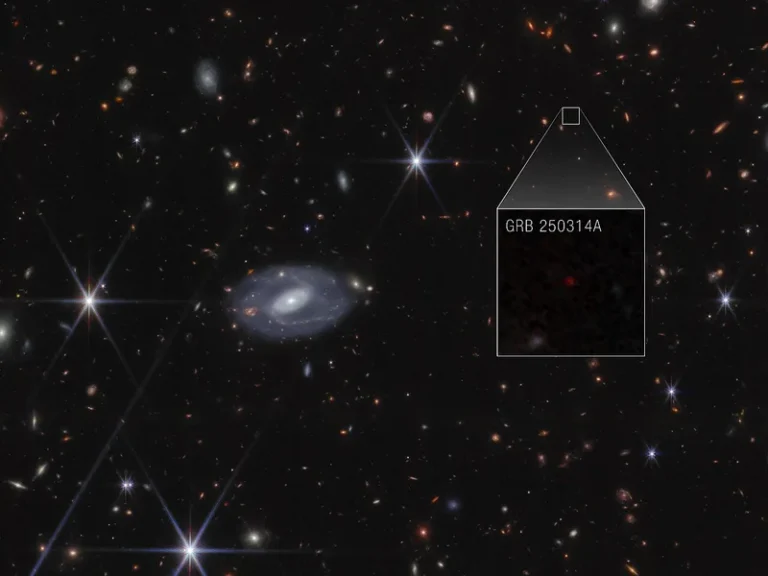

Astronomical investigations into the cosmic dawn have crossed a historic threshold, enabled by the unrivaled sensitivity of the James Webb Space Telescope (JWST). Analyzing the fading afterglow of a high-energy gamma-ray burst, the James Webb telescope earliest supernova captured the dying light of a massive stellar explosion that occurred when the universe was merely 730 million years old—roughly 5% of its present age. An international astrophysics consortium confirmed that this landmark discovery, designated GRB 250314A, shattered all prior distance records and revealed that massive stars in the infant cosmos behaved with startling modernity.
Gazing Across 13 Billion Years: Webb’s Cosmic Time Machine
A foundational objective driving the construction of the James Webb Space Telescope was the detection of first-generation cosmic explosions and primeval stars. Over cosmological distances, the expansion of spacetime stretches light, shifting optical emissions from the early universe deep into the near- and mid-infrared spectrum.
In March 2025, the French-Chinese SVOM satellite registered an extraordinarily bright, high-redshift gamma-ray burst designated GRB 250314A. Rapid follow-up by ground-based observatories in Chile established a redshift of z ≈ 7.3, confirming that the photons had traveled more than 13 billion years across expanding space.
Astronomers quickly mobilized JWST’s NIRCam and NIRSpec instruments to monitor the fading coordinates across multiple epochs. The observations revealed a distinct rise in the light curve characteristic of radioactive nickel-56 decay—the unambiguous signature of a massive stellar core-collapse supernova.
The Physics of GRB 250314A: Black Hole Genesis in the Infant Cosmos
For decades, theoretical astrophysicists debated how the first stars died. In pristine cosmological gas devoid of ‘metals’ (elements heavier than hydrogen and helium), models predicted that stars would grow to hundreds of solar masses and explode via pair-instability, leaving no compact remnants behind.
JWST’s spectroscopy shattered these preconceptions. The event was definitively classified as a broad-lined Type Ic supernova (Type Ic-BL)—an explosion resulting from a stripped-envelope Wolf-Rayet star that had shed its outer hydrogen and helium envelopes. The collapse of its dense iron core triggered the formation of a rapidly spinning stellar-mass black hole or millisecond magnetar.
This discovery demonstrates that by 730 million years after the Big Bang, stellar nucleosynthesis was progressing far more rapidly than conventional models assumed. Chemical enrichment had already advanced enough to strip massive star envelopes prior to core collapse.
The explosion occurred at a cosmological redshift of z ≈ 7.3, as the universe was emerging from the Epoch of Reionization.
Initially flagged by the Franco-Chinese SVOM spacecraft in March 2025 as the extreme high-energy prompt burst GRB 250314A.
Webb’s NIRCam camera resolved the faint parent dwarf galaxy, exhibiting an estimated stellar mass of merely 1% of the Milky Way.
Contrary to expectations of pristine primordial hydrogen, the progenitor star was already heavily enriched with synthesized metals.
The Primeval Host Galaxy and the Birth of Planetary Building Blocks
Beyond the stellar blast, JWST successfully imaged the diminutive host galaxy harboring the explosion. With a stellar mass of only 10 million solar masses, it represents an ancient dwarf galaxy—a pristine building block of future spiral galaxies like our own.
Spectral analysis of the surrounding gas revealed prominent emission lines of carbon, oxygen, and neon, proving that prior generations of stars had already enriched the interstellar medium. The explosion of GRB 250314A injected vast quantities of newly forged iron, silicon, and magnesium into the cosmos.
These findings establish that the rocky materials necessary to assemble terrestrial planets and support complex chemistry were widespread in the universe far earlier than previously believed.
«This is a momentous scientific milestone: we have directly obtained the spectrum of an individual supernova at redshift z = 7.3. What is profoundly surprising is that the explosion physics in this primordial, low-metallicity epoch mirrors modern broad-lined Type Ic supernovae.»
Dr. Andrew Levan, Professor of Astrophysics at Radboud University
Cosmological Frontiers: JWST as an Empirical Engine
The confirmation of GRB 250314A solidifies JWST’s role as the preeminent astronomical time machine. While previous telescopes were restricted to observing supernovae dating back only to when the universe was 2 to 3 billion years old, Webb has pushed the observational frontier directly into the heart of the Epoch of Reionization.
Through ongoing deep-field surveys like JADES, astronomers anticipate compiling a statistical sample of early-universe supernovae. This data will allow scientists to cross-calibrate cosmic expansion rates and test the standard Lambda-CDM cosmological model against unprecedented empirical benchmarks.
The discovery of GRB 250314A represents an enduring milestone in astronomy, providing humanity with a front-row view of the primordial stellar explosions that illuminated the cosmic dawn and seeded our universe with the elements of life.
- Uncovered through collaborative multi-messenger observations by SVOM, JWST, the Very Large Telescope, and Swift.
- Shatters Webb’s previous earliest detailed supernova record, which dated to 1.8 billion years post-Big Bang.
- Classified as a core-collapse broad-lined Type Ic event (Ic-BL), culminating in stellar black hole formation.
- Confirms that heavy elements essential for terrestrial planet formation emerged extraordinarily early in cosmic history.
Pair-Instability Paradigms vs. Stripped Core-Collapse Reality
For decades, theoretical models posited that Population III stars in the pristine early universe swelled to 140–260 solar masses and detonated via pair-instability supernovae (PISN), leaving zero compact remnants behind.
JWST’s definitive detection of broad-lined Type Ic signatures for GRB 250314A fundamentally disproves this assumption for early cosmic epochs. The blast was produced by the core-collapse of a stripped-envelope Wolf-Rayet progenitor, yielding a central stellar-mass black hole and confirming accelerated metal enrichment across early galaxies.
Cosmological Benchmarks: Probing Dark Energy at High Redshift
Type I core-collapse and thermonuclear supernovae serve as standard cosmic candles for calibrating the cosmic distance ladder and probing dark energy acceleration. Prior to JWST, empirical constraints were limited to moderate redshifts (z < 1.5).
Observing an individual supernova at z = 7.3 establishes an empirical anchor in the infant universe, offering an unprecedented opportunity to test Hubble parameter evolution and cosmological dark energy models when the universe was under a billion years old.
Primordial Nucleosynthesis and the Astrobiological Blueprint
Every ancient core-collapse supernova functioned as a cosmic enrichment engine, injecting freshly forged carbon, oxygen, and refractory metals into the pristine intergalactic medium. Without these cooling agents, subsequent generations of solar-type stars and terrestrial planets could never have condensed.
Studying GRB 250314A allows astronomers to reconstruct the cosmic lineage of matter, tracing how primeval stellar explosions created the elemental building blocks that would eventually coalesce into our Solar System and life itself.