

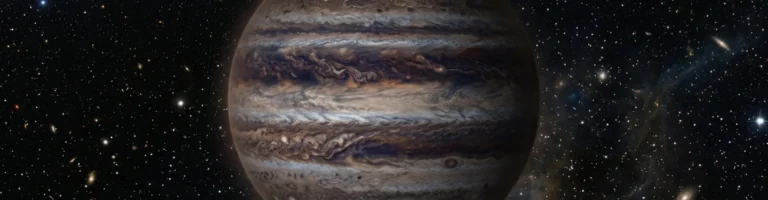

Drifting a mere 7.5 light-years from our solar system lies one of the most enigmatic astrophysical frontiers in the local interstellar neighborhood: the cold brown dwarf WISE 0855−0714. Classified as a “failed star” harboring between three and ten times the mass of Jupiter, this celestial body has cooled over billions of years down to Earth-like temperatures hovering around the freezing point of water. Utilizing the revolutionary sensitivity of the James Webb Space Telescope, astrophysicists have pierced the twilight veil of this lonely wanderer, securing the first time-resolved detection of shifting water clouds and blurring the boundary between giant exoplanets and stellar bodies.
The Substellar Paradox: How Brown Dwarfs Defy Traditional Classification
Within the celestial hierarchy, brown dwarfs occupy the ambiguous frontier separating the most massive gas giant planets from the least massive hydrogen-burning red dwarf stars. Ranging roughly between 13 and 80 Jupiter masses, their gravitational core temperatures fail to achieve the critical thresholds necessary for sustained nuclear fusion of ordinary hydrogen into helium. While they briefly fuse deuterium and lithium during their nascent youth, they rapidly exhaust these modest fuels, spending subsequent eons undergoing perpetual thermal cooling.
Discovered in 2014 by NASA’s Wide-field Infrared Survey Explorer (WISE), WISE 0855−0714 represents an extraordinary cosmological outlier. With an estimated mass between 3 and 10 Jupiter masses, it sits at the absolute minimum mass threshold permissible for formation via the direct gravitational collapse of molecular gas clouds. In physical radius and gravitational profile, it mirrors a Jovian exoplanet, yet it wanders completely unattached to any host star across the Orion Arm of the Milky Way.
Most astonishingly, infrared observations determined that its effective atmospheric temperature sits between −13°C and +5°C (260 to 280 Kelvin). This establishes WISE 0855 as the coldest known substellar entity beyond our solar system. In its atmosphere, iron vapors and silicate dust cannot condense; instead, thermodynamic conditions correspond intimately with the temperate parameters found in planetary tropospheres.
Characterizing such rogue worlds provides invaluable insights into the evolution of exoplanetary atmospheres, allowing researchers to study atmospheric chemistry and storm dynamics free from the blinding glare of an adjacent parent star.
Spectroscopic Breakthrough: NIRSpec and MIRI Unveil Atmospheric Chemistry
Owing to its frigid surface temperature, WISE 0855 emits zero optical photons: it remains entirely invisible to optical telescopes, radiating solely within mid- and far-infrared wavelengths. Prior to the commissioning of the James Webb Space Telescope (JWST), ground-based observatories such as the Very Large Telescope and W. M. Keck struggled valiantly to collect even faint infrared signals, as Earth’s own moist atmosphere introduced overwhelming infrared interference.
Operating in the pristine thermal vacuum of the Sun-Earth Lagrange point L2, JWST revolutionized the observational field. Astronomers directed its Near-Infrared Spectrograph (NIRSpec) and Mid-Infrared Instrument (MIRI) toward WISE 0855, utilizing passively and cryogenically cooled detectors to measure photon absorption spectra between 3 and 15 micrometers at unprecedented signal-to-noise ratios.
The spectral data decisively demonstrated the presence of gaseous water ($H_2O$), methane ($CH_4$), and ammonia ($NH_3$). Crucially, the observations uncovered unambiguous spectroscopic absorption features attributable to condensed water ice particles. This marks the definitive detection of atmospheric water ice clouds on a substellar object outside the confines of our solar system.
Whereas Jupiter’s upper deck is famously shrouded in white ammonia ice crystals because of its cooler upper atmospheric inversion, WISE 0855 possesses a thermal lapse rate that allows water vapor to reach its dew point near its visible photosphere, forming towering convective clouds of water droplets and ice.
WISE 0855 is located just 7.5 light-years from Earth, maintaining an Earth-like temperature near the freezing point of water.
JWST spectra revealed definitive absorption signatures of water ice crystals and vapor outside our solar system.
Periodic brightness variations confirm dynamic cloud breaks and Jovian-scale cyclonic storms rotating every 8 to 12 hours.
Studying the isolated weather on WISE 0855 refines climate models required to discover habitable exoplanets.
Deep-Space Meteorology: Patchy Cloud Decks and Planetary-Scale Vortices
JWST’s monitoring campaign extended beyond static chemical inventorying: the telescope conducted prolonged photometric monitoring over dozens of contiguous hours. By analyzing periodic brightness modulations across multiple infrared filters, astronomers successfully derived the object’s rotational velocity, establishing an axial rotation period between 8 and 12 hours.
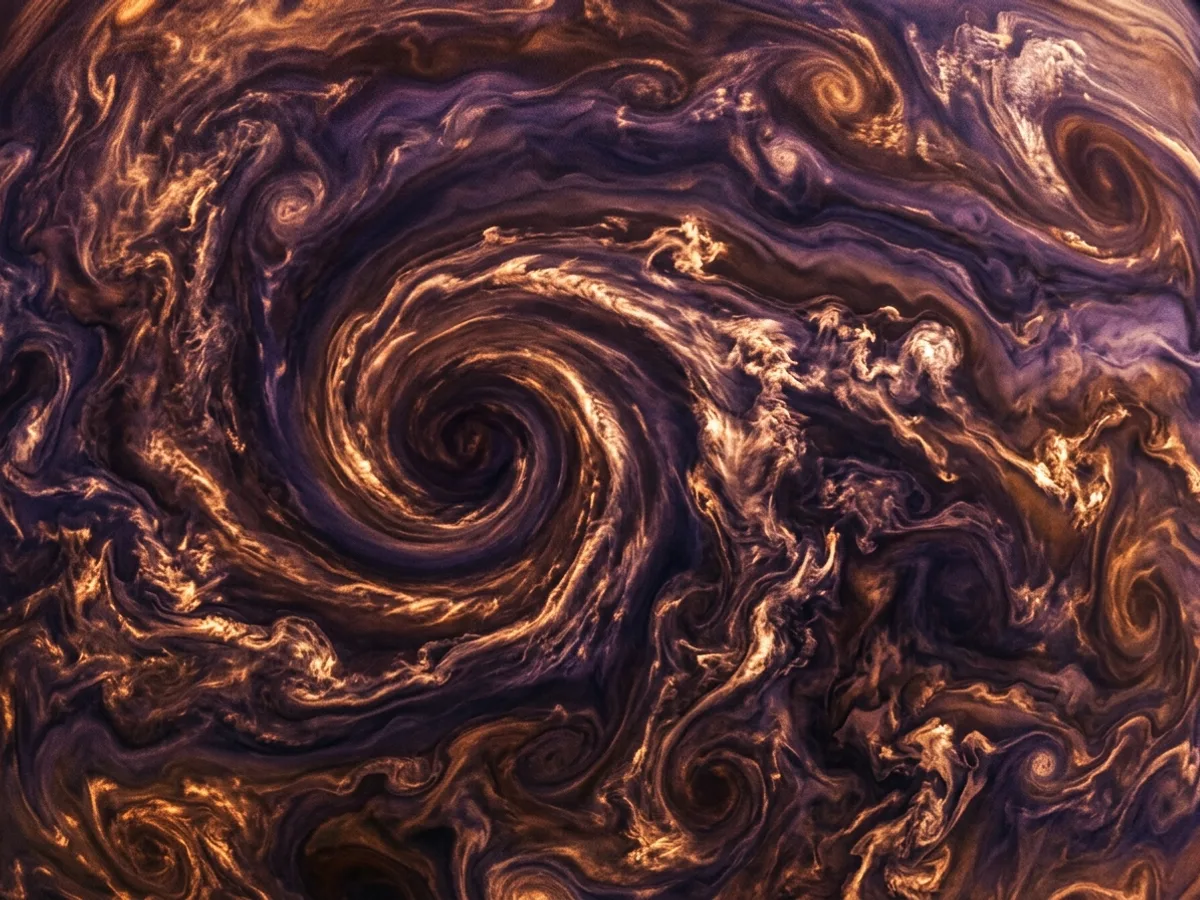
The resulting light curves exhibited substantial flux variations ranging between 5% and 8%. This modulation provides compelling physical evidence for a heterogeneous, “patchy” cloud landscape. Rather than a featureless, uniform shroud, WISE 0855 features dynamic cloud belts and massive atmospheric rifts, through which thermal infrared emissions from hotter, deeper interior layers intermittently escape into space.
Meteorological fluid-dynamic simulations reveal vigorous vertical convection. Residual primordial heat leaking from the dwarf’s slowly contracting interior drives moist parcels of warm gas upward into the frigid upper troposphere, triggering rapid condensation into ice microcrystals. Comparable to Jupiter’s Great Red Spot, WISE 0855 hosts long-lived anticyclonic storms spanning thousands of kilometers, propelled by supersonic zonal jet streams.
«WISE 0855 serves as a paramount astrophysical bridge connecting stellar astrophysics with planetary meteorology. We are witnessing for the very first time an active hydrological cycle and Earth-like water clouds operating on a free-floating world wandering through interstellar space.»
Dr. Jacqueline Faherty, Senior Astrophysicist at the American Museum of Natural History
The Blurring Frontier: Distinguishing Free-Floating Planets from Brown Dwarfs
The detection of shifting water cloud decks on WISE 0855 has reinvigorated a long-standing astronomical debate: where lies the definitive dividing line between giant gas planets and low-mass brown dwarfs? Astronomers historically segregated them based on genesis: planets coalescing via core accretion within circumstellar protoplanetary disks, and brown dwarfs collapsing directly from turbulent interstellar gas clouds.
At a mass of merely 3 to 5 Jupiter masses, WISE 0855 defies simplistic taxonomical boundaries. Its atmospheric structure, chemistry, and cloud dynamics are virtually indistinguishable from those expected on cold super-Jovian exoplanets orbiting distant suns. Increasingly, astrophysicists classify WISE 0855 as a “planemo” (planetary-mass object) or an interstellar rogue planet ejected from its birth cluster via chaotic dynamical scattering.
Writing in the journal Science, researchers highlighted the transformative value of studying WISE 0855 in isolation, demonstrating that unilluminated substellar targets serve as ideal astrophysical testbeds for calibrating exoplanet atmospheric models prior to next-generation direct-imaging missions.
- WISE 0855−0714 is the fourth-closest known system to the Sun, behind Alpha Centauri, Barnard’s Star, and Luhman 16.
- With a mass between 3 and 10 Jupiter masses, it blurs the boundary between brown dwarfs and rogue gas giant planets.
- Thermodynamic pressures and temperatures allow water vapor to condense into clouds rather than ammonia ice.
- Data from JWST NIRSpec and MIRI instruments conclusively confirmed methane, ammonia, and shifting cloud decks.
The Future of Exoclimatology: From ELT to the Habitable Worlds Observatory
JWST’s characterization of WISE 0855 signals the dawn of spatially resolved exoclimatology. For decades, the weather on alien worlds remained confined to mathematical conjecture, but modern infrared spectroscopy now delivers empirical meteorological observations of extraterrestrial cloud patterns and vertical thermal structures.
In the coming decade, ground-based mega-observatories will enter the fray, spearheaded by the European Southern Observatory’s Extremely Large Telescope (ELT) in Chile, featuring a 39-meter primary aperture. Equipped with advanced laser-guide-star adaptive optics, the ELT will track the advection of individual storm vortices across WISE 0855 with exquisite angular resolution in real time.
Looking further ahead, these analytical methodologies form the cornerstone for NASA’s prospective Habitable Worlds Observatory (HWO). Mastering the spectroscopic identification of water clouds, relative humidity profiles, and hydrological cycles on cold worlds will empower astronomers in the 2040s to recognize temperate Earth-sized exoplanets harboring liquid surface oceans and genuine biospheres.