

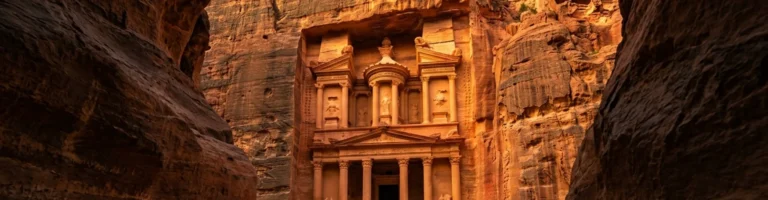

The iconic rock-cut monument of Al-Khazneh (The Treasury) in the ancient rose-red city of Petra has long captured the imagination of travelers, historians, and filmmakers: in Steven Spielberg’s cinematic masterpiece *Indiana Jones and the Last Crusade*, its subterranean chambers were envisioned as the sanctuary of the Holy Grail. Now, archaeological reality has remarkably mirrored cinematic lore. Utilizing state-of-the-art ground-penetrating radar, an international team of researchers discovered a sealed burial chamber concealed beneath the monument’s courtyard, yielding the skeletal remains of twelve individuals, grave goods, and an exquisite ceramic chalice strikingly reminiscent of the legendary relic.
Ground-Penetrating Radar Breakthrough: Seeing Through Bedrock
Carved directly into the towering rose-red sandstone cliffs of the Siq gorge during the 1st century AD, Al-Khazneh stands as one of the New Seven Wonders of the World. However, centuries of surface investigations had left archaeologists with lingering enigmas: virtually every major rock-cut tomb throughout the ancient Nabataean capital had been thoroughly ransacked during the late Roman period, the Byzantine era, or by local nomadic tribes during the Middle Ages.
The breakthrough was spearheaded through a collaborative initiative involving the Department of Antiquities of Jordan, the American Center of Research (ACOR), and geophysicists from the University of St Andrews led by Professor Richard Bates. The team deployed advanced high-frequency Ground-Penetrating Radar (GPR) and electrical resistivity tomography, capable of mapping subsurface electromagnetic anomalies dozens of meters beneath the stone pavement without disturbing a single ancient block.
The geophysical surveys revealed pronounced dielectric anomalies beneath the southwestern plaza of the monument. The radar profiles clearly resolved subterranean geometric voids, indicating man-made underground chambers buried under metres of compacted alluvium deposited by flash floods over millennia.
These non-destructive sub-surface techniques, combined with rigorous skeletal isotopic analyses, parallel advances in paleogenomics and ancient DNA extraction, allowing scholars to reconstruct kinship ties among long-lost historic dynasties.
Descent into the Undisturbed Tomb: 12 Skeletons and Rare Grave Goods
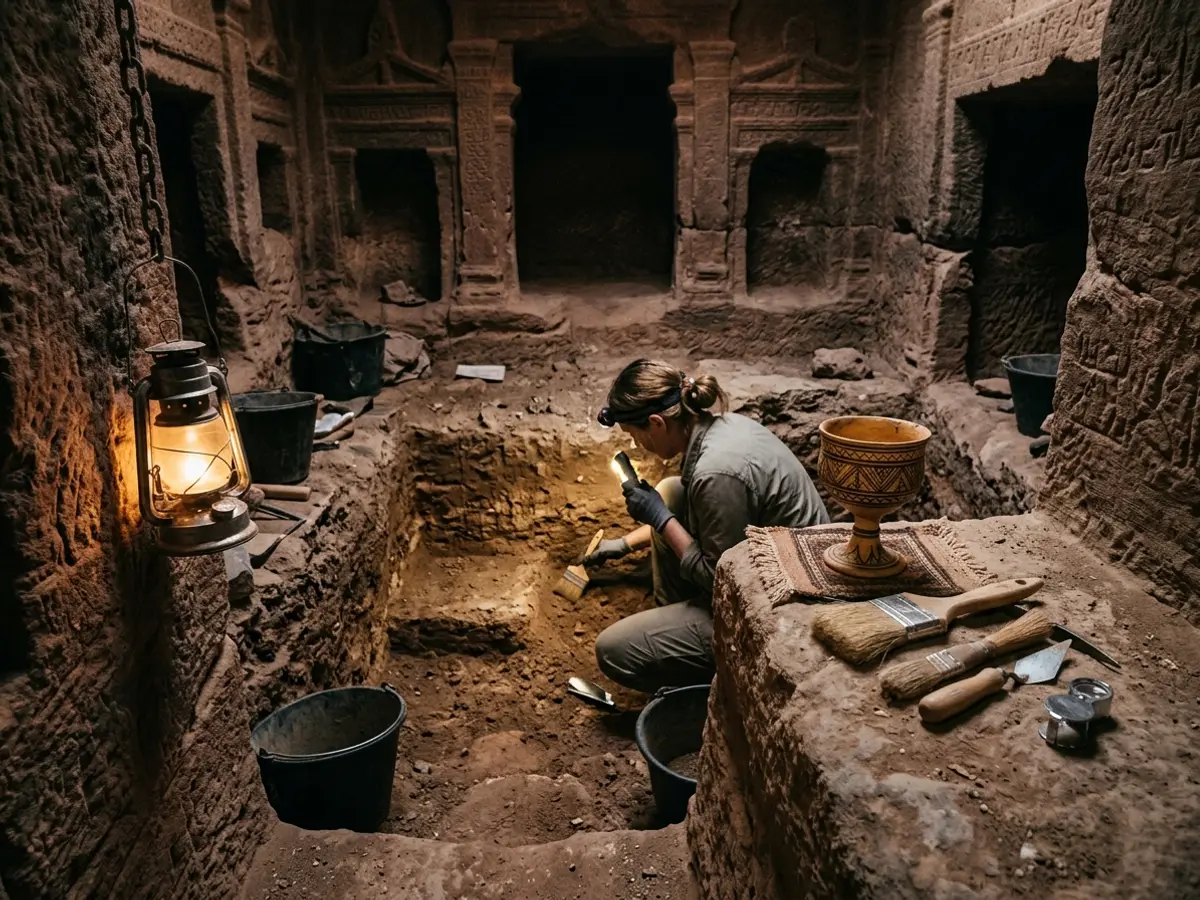
Securing authorization from Jordanian heritage authorities to undertake targeted excavations, the team cleared layers of flood sediments, unearthing a vertical entrance shaft that led directly into a rock-hewn hypogeum. Unlike previous chambers explored at Petra, this subterranean room had remained hermetically sealed: ancient flash floods had blocked the portal shortly after antiquity, preserving its contents from treasure hunters.
Inside the chamber, archaeologists identified the articulated skeletons of 12 individuals, including adult men, women, and a juvenile. The burials were laid out in anatomical alignment and accompanied by an array of funerary items: iron arrowheads, bronze fibulae garment clasps, preserved structural wood from decayed burial biers, and hundreds of diagnostic pottery sherds of exceptional quality.
Because of persistent capillary moisture within the subterranean sandstone, the bone collagen had suffered structural degradation, coated in mineral salt crusts. Nonetheless, bioarchaeologists successfully harvested petrous bone samples for radiocarbon dating and ancient DNA extraction, promising the first comprehensive genomic profile of high-status Nabataean citizens during the kingdom’s golden age.
A comprehensive analytical study published in Advances in Archaeological Practice outlined the stratigraphic context and ceremonial layout of the newly discovered tomb.
The underground tomb remained sealed beneath ancient flash-flood alluvium for two millennia, completely untouched by looters.
The chamber contained complete articulated skeletons of men, women, and a juvenile from the upper tiers of Nabataean society.
A delicate 1st-century AD ceramic chalice was found, bearing an uncanny resemblance to the relic from Indiana Jones.
The discovery was made possible through non-destructive ground-penetrating radar scanning without damaging the monument.
The Real “Holy Grail” of Petra: A Delicate 1st-Century Nabataean Chalice
The most evocative artifact retrieved from the excavation was a finely crafted ceramic chalice cradled near the hands of a skeleton positioned in the center of the chamber. Featuring a hemispherical cup set upon a delicate flared stem and ring base, the chalice stunned documentary film crews from Discovery and international observers alike.
Visually, the ceramic chalice bears an uncanny resemblance to the humble “carpenter’s cup” portrayed in the 1989 film *Indiana Jones and the Last Crusade*, whose unforgettable climactic scenes were filmed directly against the monumental facade of Al-Khazneh. Yet this artifact is far more meaningful than Hollywood fiction: it is a masterpiece of Nabataean fine-ware ceramic engineering dating from the transition between the 1st century BC and the 1st century AD.
Nabataean potters were renowned across the classical Mediterranean for producing paper-thin, eggshell-light earthenware, with wall thicknesses frequently under 1.5 millimeters. Archaeologists deduce that this chalice played an integral role in ritual libations, used to pour sacramental wine or consecrated aromatic oils in veneration of Dushara, the supreme Nabataean mountain deity and lord of the underworld.
«This is an unprecedented discovery of global archaeological significance. Finding a completely undisturbed burial chamber directly underneath Al-Khazneh is a once-in-a-century event. The Nabataeans were master builders and international merchants, yet their intimate burial traditions have remained elusive.»
Dr. Richard Bates, Geophysics Professor at the University of St Andrews
Who Lay Beneath the Treasury? Decoding Nabataean Elite Lineages
Scholars have long theorized that Al-Khazneh served as the royal mausoleum for the Nabataean King Aretas IV Philopatris (reigned 9 BC – AD 40), under whose reign Petra blossomed into an opulent trade metropolis controlling the desert incense and spice networks connecting Southern Arabia, Egypt, the Levant, and Rome.
The discovery of a communal tomb beneath the Treasury’s foundation introduces profound historical questions. Were these twelve individuals members of the royal household, high priests of Dushara, or elite merchant aristocrats? The inclusion of iron weaponry and bronze adornments confirms their elite social standing. Moreover, the tomb’s direct architectural integration beneath the forecourt suggests that the site was re-used across generations as a consecrated sanctuary.
The Nabataeans cultivated a remarkable syncretic civilization, blending Semitic theological traditions with sophisticated Hellenistic architectural motifs and Roman legal concepts. Their funerary rites demonstrate that death was conceptualized not as termination, but as an eternal integration into the sacred, rock-hewn topography of their ancestral home.
- Al-Khazneh was constructed in the 1st century AD, historically linked to Nabataean King Aretas IV.
- The geophysical survey was conducted by the University of St Andrews and Jordan’s Antiquities Department.
- Excavated artifacts include iron arrowheads, bronze garment fibulae, and fine-ware Nabataean ceramics.
- Researchers are conducting ancient DNA extraction to establish ancestral lineages of the entombed individuals.
Unlocking Petra’s Subterranean Secrets: The Next Frontier of Discovery
The revelation beneath Al-Khazneh underscores that modern scholarship has surveyed only a fraction of Petra’s underground archaeology. Estimates indicate that as much as 80% of the ancient city’s urban topography — including subsurface hydraulic cisterns, subterranean aqueducts, and domestic complexes — remains buried beneath millennia of alluvial wash.
Jordanian conservation authorities, alongside academic consortia, are expanding the deployment of non-destructive remote sensing technologies across the Petra Archaeological Park. Techniques such as cosmic-ray muon radiography and drone-based LiDAR will soon map hidden internal cavities within sheer cliff faces without endangering the structural integrity of ancient facades.
This sensational discovery illustrates how cutting-edge archaeology can transform Hollywood legend into tangible scientific history. The enduring secrets of the Nabataean desert kingdom continue to unfold, illuminating the cultural resilience of humanity throughout the chronicles of ancient civilizations.