



In a breathtaking revelation of neurobiology, the glymphatic system deep sleep axis transforms our nocturnal rest into an indispensable biological plumbing operation for the central nervous system. Pioneering neurological research reveals that during slow-wave non-rapid eye movement (NREM) sleep, the brain interstitial space expands by an astonishing 60 percent, allowing pulsating waves of cerebrospinal fluid to flush out accumulated metabolic waste — including neurotoxic beta-amyloid and tau proteins implicated in Alzheimer’s disease and cognitive decline. Decoding the biophysics of astrocytic aquaporin-4 (AQP4) water channels yields actionable, science-based protocols in sleep architecture, sleeping posture, and chronobiology to safeguard cognitive vitality.
The Anatomical Enigma: How the Brain Cleanses Itself Without Lymphatics
The human brain is our most metabolically demanding organ: comprising barely two percent of total adult body mass, it consumes more than a fifth of our daily glucose and oxygen. As billions of neurons fire trillions of synaptic action potentials every day, they generate vast quantities of metabolic debris — misfolded peptides, oxidative radicals, and cellular degradation byproducts.
Throughout the rest of the somatic body, cellular detritus is swept away by the lymphatic system — a vast vascular network collecting interstitial fluid and routing it through lymph nodes for filtration. However, within the rigid confines of the skull and beneath the protective fortress of the blood-brain barrier, classical lymphatic vessels were long understood to be entirely absent from the cerebral parenchyma.
This paradigm was shattered in 2012 when Danish neuroscientist Maiken Nedergaard and her team at the University of Rochester identified the glymphatic system (coined from the union of «glia» and «lymphatic»). They revealed that specialized glial cells called astrocytes construct an organized hydraulic convective transport network around the brain blood vessels.
Biophysics of the Night Wash: Aquaporin-4 Channels and 60% Interstitial Expansion
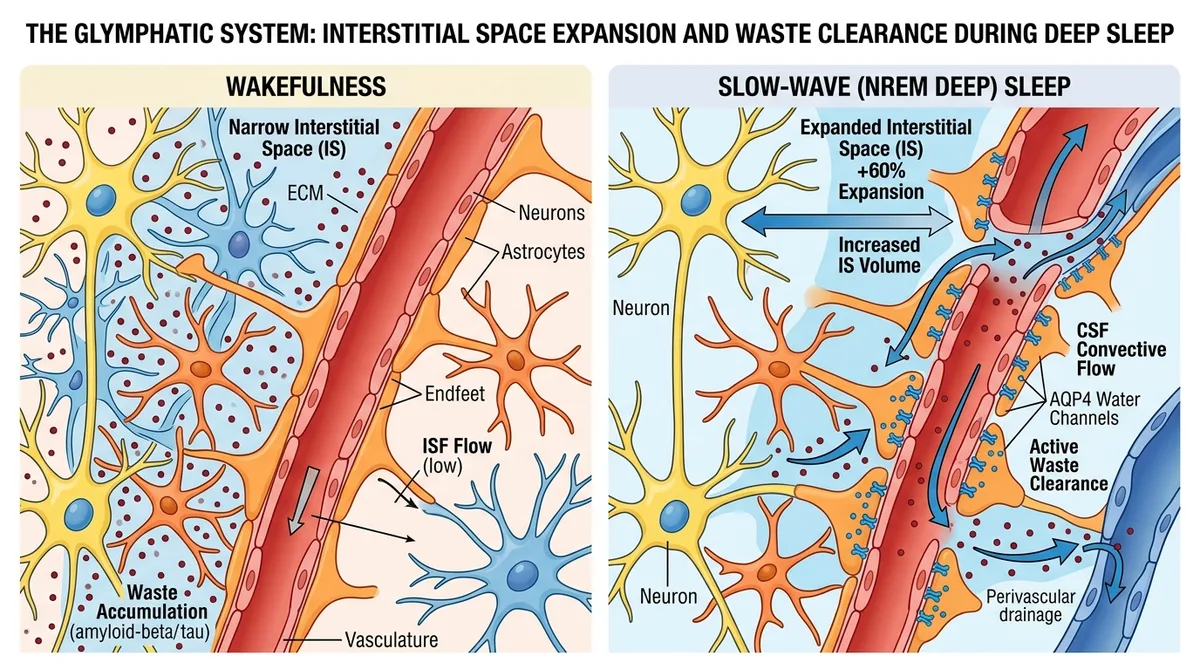
The structural core of this intracranial drainage pathway resides within astrocyte endfeet, specialized cellular projections that encase cerebral arterial and venous vasculature. Embedded within these perivascular endfeet is an extraordinary density of transmembrane water channels known as aquaporin-4 (Aquaporin-4, AQP4).
During wakefulness, neurons and glial cells are packed tightly together, restricting the interstitial space to a mere 14 percent of total brain volume. High concentrations of the neurotransmitter noradrenaline inhibit convective fluid migration. However, as the brain transitions into deep slow-wave sleep (delta sleep or NREM Stage 3), noradrenergic tone drops dramatically.
In response, astrocytes shrink, causing the interstitial volume fraction to expand by an astounding 60 percent! Pulsatile arterial wall dynamics drive cerebrospinal fluid (CSF) from the subarachnoid space along periarterial channels into the brain parenchyma. The fluid surges between neurons, sweeping up solute waste before draining along perivenous pathways into dural sinuses and deep cervical lymph nodes.
During deep slow-wave sleep, brain cells shrink to permit high-velocity convective cerebrospinal fluid flow.
Astrocytes direct fluid currents along blood vessels via specialized polarized water-channel pumps.
Lateral sleeping posture accelerates metabolic amyloid clearance by 25% compared to back or stomach sleeping.
Nighttime convective flushing removes amyloid and tau proteins before they aggregate into lethal neurofibrillary tangles.
Beta-Amyloid and Tau: The Lethal Link Between Sleep Loss and Dementia
Among the metabolic toxins evacuated by the glymphatic tide, two pathological culprits stand out: monomeric amyloid-beta ($A\beta$) and hyperphosphorylated tau proteins. When allowed to stagnate, these hydrophobic peptides self-assemble into toxic oligomers, senile plaques, and neurofibrillary tangles, severing synaptic communication and killing cortical neurons in Alzheimer’s pathology.
Clinical investigations utilizing contrast-enhanced MRI and lumbar puncture biomarkers demonstrate that even a single night of acute sleep deprivation induces immediate spikes in amyloid-beta concentrations across the hippocampus and prefrontal cortex. In chronic insomnia, metabolic waste precipitates out of solution, fueling neuroinflammatory cascades.
Tragically, this generates a destructive positive feedback loop: accumulating amyloid disrupts slow-wave sleep generation in the medial prefrontal cortex, fragmenting NREM sleep and further paralyzing glymphatic clearance. This highlights the indispensable necessity of supporting lifelong cellular metabolic health.
«The brain accounts for roughly twenty percent of our total metabolic energy consumption, yet unlike every other organ in the human body, it completely lacks traditional lymphatic vessels. Nature engineered an extraordinary workaround: it activates a high-pressure glial hydraulic pump specifically when conscious awareness is turned off. Sleep is not a passive luxury; it is the physical maintenance shift of molecular cleaners.»
Maiken Nedergaard, Professor of Neuroscience at the University of Rochester and University of Copenhagen, co-discoverer of the glymphatic system
Actionable Protocols: Optimizing Glymphatic Clearance in Daily Life
While pharmacological agents directly modulating the glymphatic pump remain in experimental development, behavioral interventions offer profound neuroprotective benefits. The foremost evidence-based factor is sleep posture: rodent neuroimaging proves that lateral sleeping (sleeping on one’s side) boosts glymphatic amyloid clearance by 25 percent compared to supine (back) or prone (stomach) positions.
The second vital factor is circadian sleep consistency. Restorative slow-wave delta sleep is overwhelmingly front-loaded into the initial third of the nocturnal cycle (between 10:00 PM and 2:00 AM). Delaying bedtime past midnight starves the brain of delta phases, regardless of whether total sleep duration reaches eight hours.
The third factor is evening nutritional timing. Consuming calorie-dense or high-glycemic meals close to bedtime elevates baseline core body temperature and spikes nocturnal insulin, inhibiting the autonomic parasympathetic shift required for delta sleep entry. Concluding dinner at least three to four hours before sleep is critical for neurovascular recovery.
- Discovered by Professor Maiken Nedergaard in 2012, operating almost exclusively during NREM sleep.
- A single night of sleep deprivation significantly elevates amyloid-beta levels in the human hippocampus.
- Daytime aerobic cardiovascular exercise maintains optimal polarized distribution of AQP4 channels.
- Avoiding heavy meals within 3–4 hours of bedtime ensures deep parasympathetic delta sleep onset.
Physical Exercise and the Frontiers of Preventive Neuroscience
Consistent daytime aerobic exercise (running, swimming, brisk walking) preserves the anatomical polarization of AQP4 channels to astrocytic endfeet. Sedentary lifestyles cause AQP4 channels to redistribute diffusely across the astrocyte membrane, dissipating hydraulic pressure gradients.
Frontier neuroscience laboratories are currently investigating non-invasive 40-Hz gamma sensory stimulation and transcranial acoustic pulsing to artificially entrain delta rhythms and stimulate glymphatic clearance in preclinical dementia cohorts. Continuous updates on neuroprotective medicine are featured on IFLScience.
Prioritizing deep, consistent sleep is neither indulgence nor laziness; it is our most potent, scientifically substantiated defense against cognitive deterioration, preserving mental sharpness across the human lifespan.