



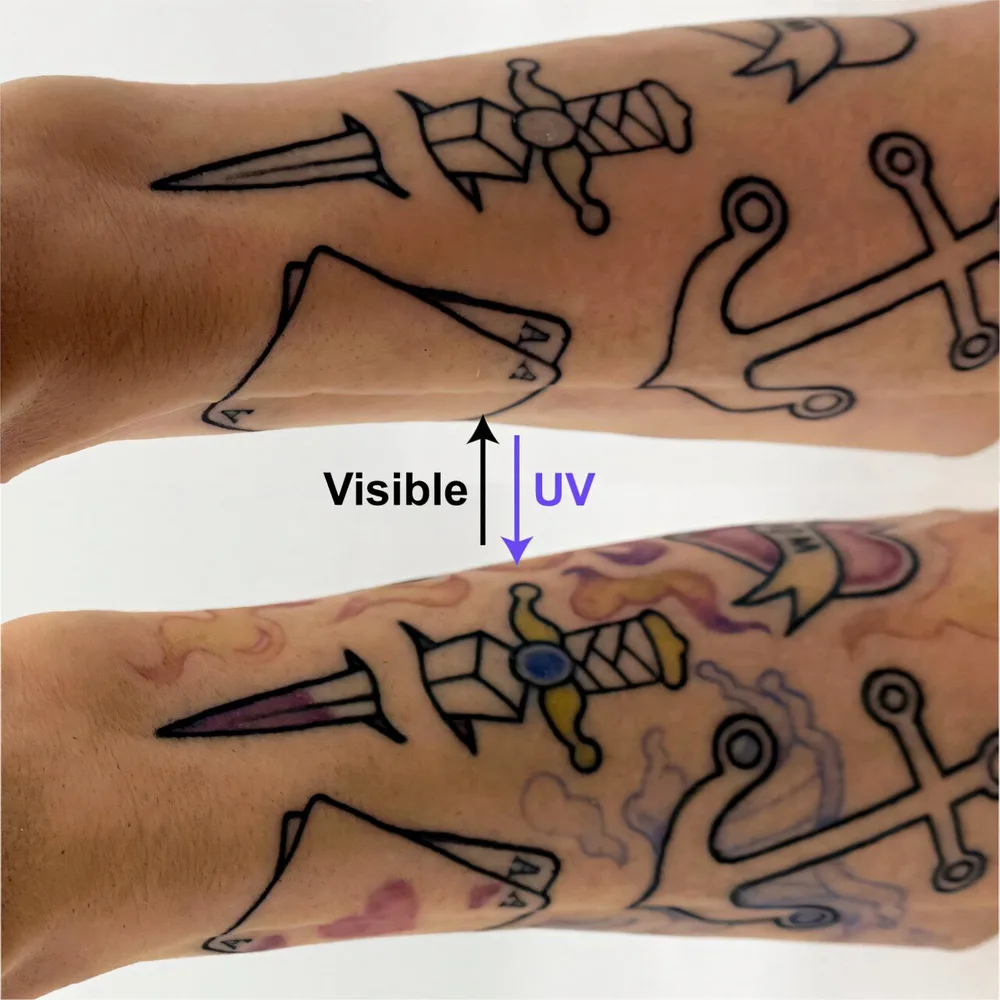
For millennia, tattoos have been the ultimate symbol of biological permanence: insoluble pigment granules engulfed by dermal macrophages remain locked within skin layers forever, requiring painful and expensive laser treatments to erase. Now, a pioneering team of bioengineers at the University of Colorado Boulder, led by Carson Bruns, has shattered that paradigm by introducing PhotoTat. This breakthrough rewritable optical ink uses encapsulated photochromic microcapsules that remain completely invisible and transparent under everyday lighting conditions, yet burst into vibrant, high-contrast colors within seconds of exposure to soft ultraviolet light before fading away under standard LEDs.
Biomechanics of PhotoTat: Photochromic Molecules Inside Biocompatible PMMA Microcapsules
The fundamental scientific challenge in developing light-switchable pigments for living tissue has always been molecular vulnerability. Organic photochromic dyes—such as spiropyrans, oxazines, and diarylethenes—readily alternate between isomeric configurations when stimulated by photons. However, when introduced directly into the hostile dermal microenvironment, extracellular enzymes and phagocytic macrophages degrade these delicate molecules within days.
Carson Bruns and his team bypassed this obstacle through precision microencapsulation. The researchers packaged light-sensitive dye molecules inside microscopic spheres made of polymethyl methacrylate (PMMA) measuring between 1 and 5 micrometers in diameter. PMMA is an extensively validated, biocompatible medical polymer—long utilized in orthopedic bone cement, dental prosthetics, and intraocular lenses—that acts as an impermeable shield protecting the photochromic core from enzymatic hydrolysis and oxidative stress.
The microcapsule diameter was engineered with exacting specifications: large enough to prevent clearance by immune macrophages via lymphatic drainage, yet sufficiently small to be deposited into the dermis using standard commercial tattoo machines and sterile needles. Each microcapsule acts as an autonomous armored nano-chamber where dye molecules switch optical states freely without leaking.
Optics and Switching: From Crystal Invisibility to Vibrant Subtractive CMYK Color
In its default resting state, the photochromic dye within PhotoTat capsules features a closed-ring molecular conformation that absorbs virtually no photons across the visible spectrum, rendering the ink invisible against natural human skin tones. When exposed to soft UVA light at a wavelength of 365 nanometers for just 2 to 3 seconds—equivalent to approximately 10 to 15 seconds of direct midday sunlight—a rapid photoisomerization occurs.
The ultraviolet energy cleaves a specific chemical bond, opening the molecular ring and altering its pi-conjugated electron system. This transition causes the compound to selectively absorb specific wavelengths of light, instantly displaying vivid coloration. The researchers synthesized three primary formulations: cyan, magenta, and yellow. By blending these primary colors according to standard subtractive CMYK color theory, artists can produce virtually any shade, gradient, or full-color illustration.
The erasing process is equally straightforward: exposing the activated skin to standard white LED lighting or bright indoor fixtures supplies visible photons that drive reverse photoisomerization, resetting the molecules to their colorless ground state. This optical switching cycle can be repeated thousands of times without photochemical fatigue or structural degradation of the protective PMMA polymer shell.
Medical-grade acrylic shells (1–5 µm) shield photochromic dyes from enzymes and macrophages, guaranteeing longevity.
A brief exposure to soft 365 nm UVA light triggers rapid photoisomerization, transforming invisible ink into rich colors.
Standard white LED lighting delivers visible photons that quickly return molecules to their transparent ground state.
Replaces permanent dark radiotherapy alignment dots with invisible markers, removing psychological trauma for cancer survivors.
Two-Year Human Trial: Carson Bruns Inks His Own Leg with Fish Scale Pattern
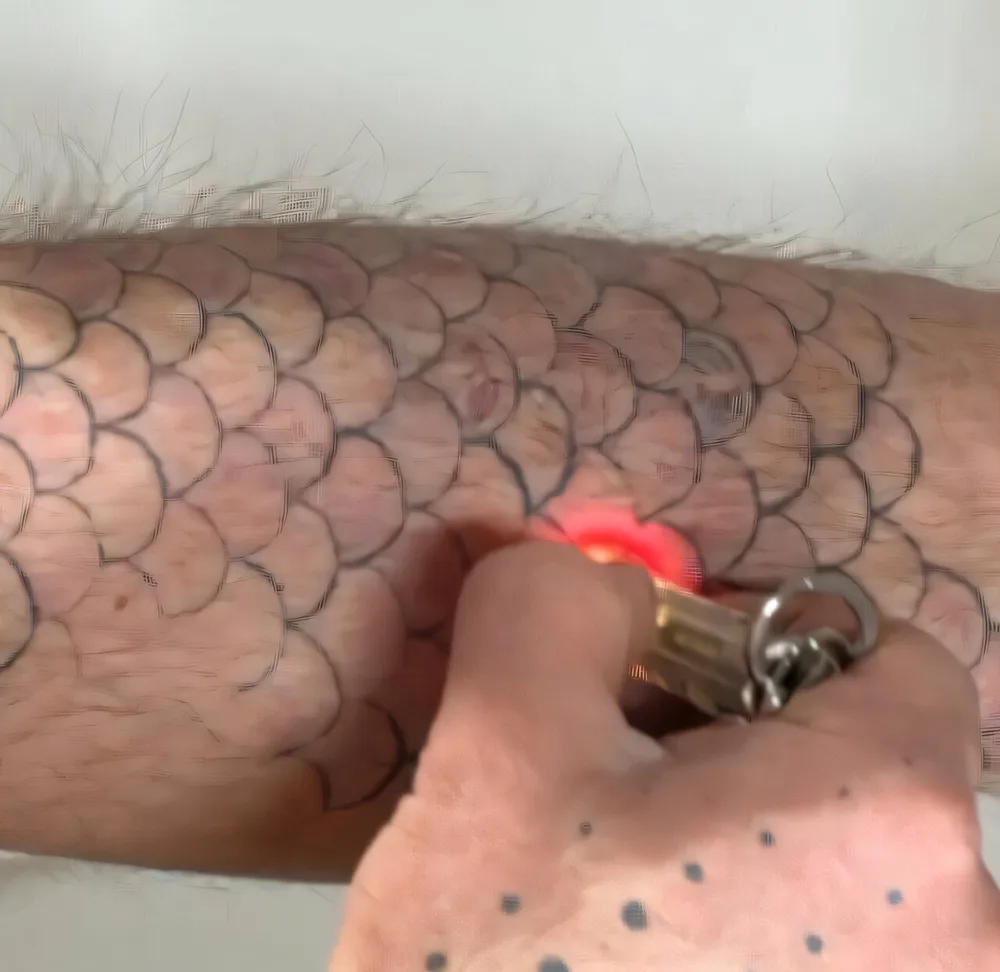
Before publishing their breakthrough in the prestigious journal Matter & Light, Carson Bruns chose to personally validate the durability and biocompatibility of the material by tattooing his own leg. He applied the PhotoTat ink in an intricate fish scale pattern, initiating an observational study that has now surpassed two full years of continuous evaluation.
Throughout the 24-month period, the tattoo maintained immaculate geometric fidelity and responsiveness. Under normal indoor ambient lighting, Dr. Bruns’ leg shows no visible pigmentation, erythema, or irritation. Yet whenever a targeted 365-nm UV pen is directed at the skin, the intricate fish scales immediately materialize in sharp, colorful detail before gently vanishing under everyday room lights.
Histological assessments on laboratory porcine skin and clinical monitoring confirmed no chronic inflammatory responses, granuloma formation, or cytotoxicity. The PMMA shells keep the dye locked inside, preventing systemic migration into the bloodstream or metabolic clearance.
«We have long treated tattoos as static pictures frozen in time. PhotoTat transforms human skin into a programmable optical canvas. Yet the most profound application of our discovery lies not in cosmetic body art, but in clinical oncology: we can liberate hundreds of thousands of cancer survivors from traumatic radiation alignment dots by substituting them with invisible marks that appear only when doctors need them.»
Carson Bruns, lead study author and Associate Professor at the ATLAS Institute and Department of Mechanical Engineering, CU Boulder
Oncology Breakthrough: Eliminating Traumatic Radiation Alignment Dots
While PhotoTat introduces unprecedented opportunities for the body art industry—allowing individuals to enjoy tattoos during leisure hours without conflicting with professional workplace dress codes—its most impactful contribution lies in radiation oncology. Each year, millions of cancer patients undergoing radiation therapy for breast, prostate, or lung malignancies receive permanent dark alignment tattoos on their skin.
Radiotherapists use these permanent ink dots to align linear accelerators with millimeter precision during repeated treatment sessions. For cancer survivors, however, these indelible dark spots serve as permanent, distressing reminders of their diagnosis, trauma, and medical vulnerability.
PhotoTat completely eliminates this psychological burden. Radiation oncologists can place tiny alignment marks that remain completely invisible in daily life. When the patient arrives for a treatment session, clinical staff simply illuminate the treatment field with a diagnostic UV wand, aligning the equipment with absolute accuracy. Once treatment concludes, the dots fade, leaving the survivor’s skin completely clean.
- Full-spectrum color rendering is achieved by blending primary cyan, magenta, and yellow microcapsules.
- Carson Bruns confirmed two-year stability and complete biocompatibility through self-experimentation on his own leg.
- PMMA polymer has decades of clinical safety documentation in orthopedic bone cement and intraocular lenses.
- Unlike laser tattoo removal, PhotoTat switching causes zero tissue thermal injury and endures thousands of cycles.
Future Horizons: From Smart Body Art to Wearable Diagnostic Displays
The technological horizons of switchable dermal inks extend well beyond decorative art. Researchers at the ATLAS Institute are currently exploring microcapsules loaded with biochemical nanosensors capable of responding to metabolic biomarkers, such as interstitial glucose levels, lactic acid accumulation, or core temperature variations. This would transform human skin into an interactive diagnostic readout.
Scientific leaps that blur the boundaries between synthetic materials and human biology mirror historical milestones in genetics—much like how Rosalind Franklin deciphered DNA’s helical structure long before receiving broad acclaim, modern nanoengineers are unlocking new dimensions within human physiology.
The CU Boulder team is now undertaking comprehensive regulatory toxicological trials in preparation for future clinical clearance through the U.S. Food and Drug Administration (FDA). If subsequent trials confirm its clinical efficacy, PhotoTat will inaugurate a new era of on-demand dermal optics.