


Every night, as consciousness fades and the body drifts into sleep, the human brain initiates one of biology’s most sophisticated maintenance operations: the activation of the glymphatic system. For decades, sleep was viewed as a biological puzzle and an evolutionary vulnerability—a passive state of defenselessness against predators. Modern neuroscience has overturned this paradigm: sleep is not an evolutionary compromise, but a vital, high-throughput waste clearance cycle without which the brain poisons itself with its own metabolic refuse.
The human brain accounts for roughly 2% of total body weight yet consumes over 20% of its resting energy budget. In fueling billions of active synapses, neurons produce substantial metabolic byproducts, including misfolded proteins, oxidized substrates, and neurotoxic peptides. While the rest of the body relies on the lymphatic network to filter toxins, the central nervous system was long believed to lack dedicated lymphatic vessels. Groundbreaking discoveries revealed that cerebrospinal fluid actively sweeps through brain tissue, preserving neurological integrity much like optogenetics enables precision control over neural circuits.
The Discovery of the Brain’s Waste Clearance Network
The term “glymphatic system” was coined in 2012 by a team led by Danish neuroscientist Professor Maiken Nedergaard (Maiken Nedergaard) at the University of Rochester Medical Center. The portmanteau merges “glia” (the supporting cells of the brain) with “lymphatic,” highlighting its dependence on glial astrocytic architecture to drive convective fluid transport.
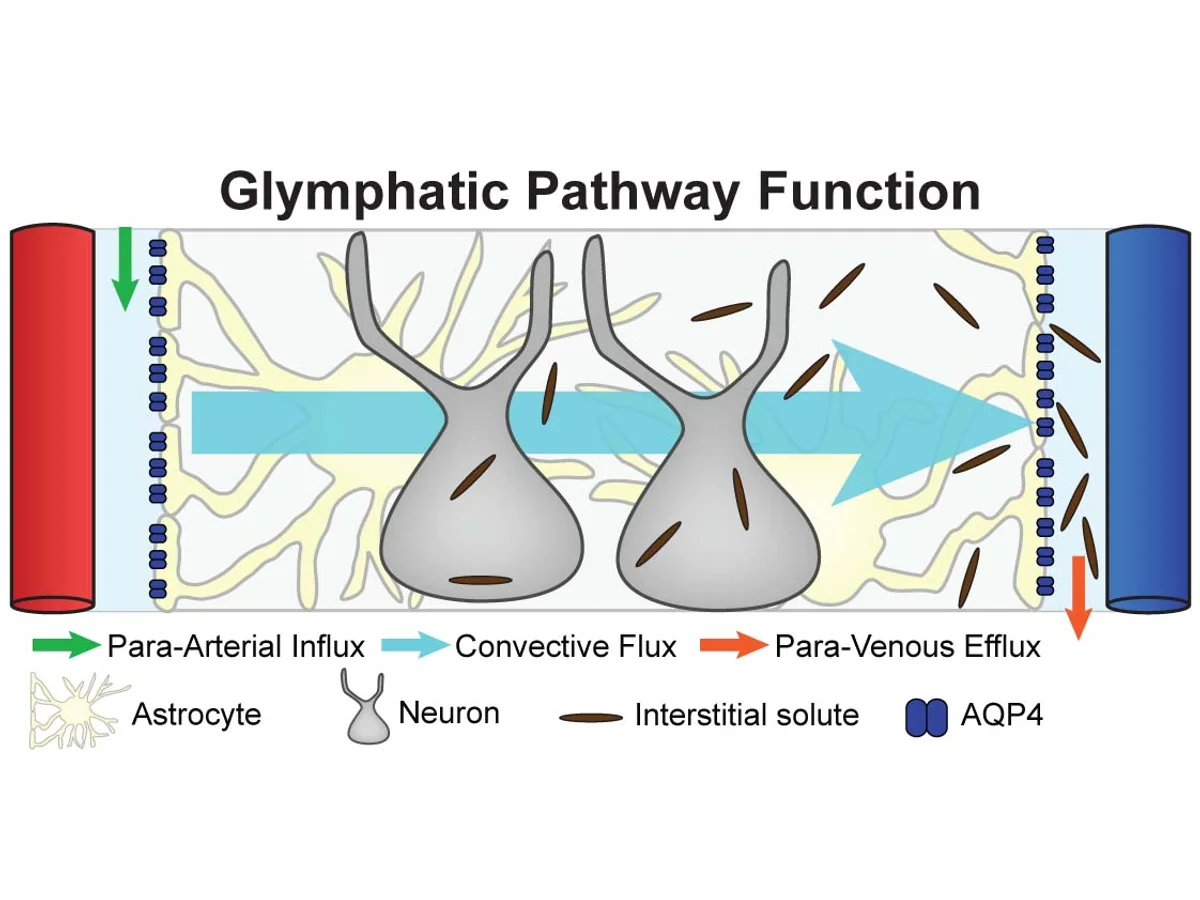
Using in vivo two-photon laser scanning microscopy, researchers observed real-time fluid dynamics inside intact living brain tissue. They discovered that cerebrospinal fluid (CSF) does not simply coat the brain’s outer surface; arterial pulsatility forces it along periarterial spaces (Virchow-Robin channels). It then percolates through the interstitial parenchyma, flushing out accumulated debris before draining along perivenous channels and deep cervical lymph nodes.
«The brain has limited energetic capacity. It must choose between two distinct functional modes: either processing external information while awake, or cleaning house during sleep. The brain cannot operate at full sensory capacity and conduct deep janitorial maintenance simultaneously».
Maiken Nedergaard (Maiken Nedergaard), Co-Director of the Center for Translational Neuromedicine, University of Rochester
60% Interstitial Volume Expansion: During slow-wave non-REM (NREM) sleep, astrocytic glia physically shrink in volume by roughly 60%. This structural contraction dramatically widens the interstitial space, lowering hydrodynamic resistance and accelerating convective solute clearance by 10- to 20-fold compared to the waking state.
Aquaporin-4 Water Channels: The Hydrodynamic Gatekeepers
The primary molecular engine governing this convective flow is aquaporin-4 (Aquaporin-4, AQP4), a specialized water channel protein densely clustered on astrocytic endfeet. These endfeet enwrap the cerebral microvasculature, forming a continuous perivascular sheath that lines the brain’s fluid corridors.
In a healthy brain, AQP4 exhibits strict polarity: it is concentrated almost exclusively on the perivascular vascular-facing membrane, serving as low-resistance hydraulic gates. When aging, traumatic brain injury (TBI), or chronic neuroinflammation causes AQP4 depolarisation—scattering the channels across the entire astrocytic cell body—directed convective flow collapses, halting waste removal.
- Amyloid-Beta Clearance: convective interstitial washing removes soluble Aβ40 and Aβ42 peptides before they aggregate into insoluble senile plaques.
- Tau Protein Evacuation: toxic hyperphosphorylated tau, which destabilizes axonal microtubules, is likewise expelled via glymphatic drainage.
- Arterial Pulsatility: rhythmic cardiac systolic contractions propagate pressure waves that pump CSF through the parenchymal meshwork.
The Intersection with Alzheimer’s, Parkinson’s, and Aging
Glymphatic clearance declines exponentially with chronological age. Stiffened, calcified arteries weaken the mechanical pulse wave, while astrocytic AQP4 mislocalization slows clearance kinetics. A destructive feedback loop often ensues: chronic sleep deprivation accelerates amyloid accumulation, while amyloid deposits in sleep-regulating hypothalamic nuclei progressively destroy sleep architecture.
Emerging neuroimaging techniques, such as non-contrast diffusion tensor imaging along the perivascular space (DTI-ALPS), now allow clinicians to measure glymphatic water diffusivity non-invasively in humans. Suppressed ALPS indices appear in individuals with mild cognitive impairment over a decade before clinical dementia manifests.
Evidence-Based Lifestyle Strategies for Brain Clearance
Because glymphatic transport responds to physical and physiological parameters, neuroscientists have identified actionable strategies to optimize nocturnal brain clearance:
- Sleep Position: Preclinical MRI and optical imaging indicate that lateral sleeping (sleeping on one’s side) significantly maximizes glymphatic transport compared to prone or supine positions, likely due to reduced resistance in the jugular venous drainage pathways.
- Protecting Slow-Wave Delta Sleep: Alcohol, late-night eating, and benzodiazepine sedatives disrupt slow-wave delta rhythms, preventing the astrocytic shrinkage required for efficient clearance.
- Cardiovascular Exercise: Regular aerobic activity preserves cerebral vascular compliance, maintaining the systolic pumping force necessary to drive perivascular CSF flow.
The glymphatic system has evolved from a theoretical hypothesis into a primary target for neuroprotective pharmacology. Developing therapeutic agents that preserve AQP4 polarity or enhance sleep-dependent drainage may hold the key to halting neurodegenerative disease before irreversible cognitive decline takes hold.