

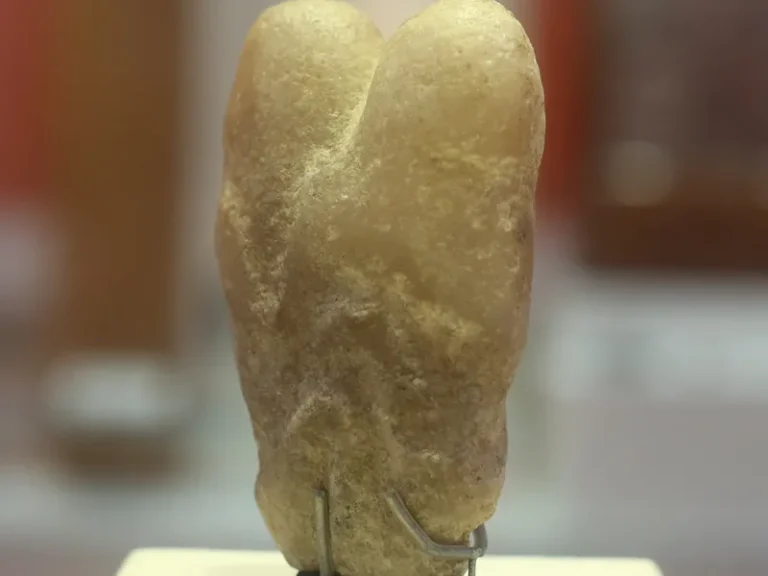

In the vast chronicles of prehistoric art, Stone Age humans left behind thousands of vivid hunting panels, painted hand stencils in dark caves, and exaggerated female fertility figurines such as the Ice Age Venuses. Yet for decades, themes of human tenderness, mutual embrace, and romantic intimacy seemed conspicuously absent from the archaeological record. The single world-renowned masterpiece that overturned this assumption is a small calcite pebble crafted in the ancient Levant at the dawn of human civilization. Carved eleven millennia ago, the worlds earliest sex scene preserved in the celebrated Ain Sakhri Lovers sculpture astonishes contemporary art historians and archaeologists through its sensual intimacy and optical multidimensionality.
Caves of the Judean Desert: The Serendipitous Discovery by René Neuville
In 1933, René Neuville, a French consular official in Jerusalem and a dedicated prehistorian, was exploring prehistoric cave sites along the rugged limestone gorges of Wadi Khareitoun, southeast of Bethlehem. While visiting a local Bedouin encampment, Neuville’s practiced eye caught sight of an unusual water-worn river cobble being used to weight down domestic goods. Inspecting the stone, Neuville immediately realized that its carved contours represented an extraordinary piece of ancient art.
The cobble had been brought from the nearby Ain Sakhri cave. Neuville initiated controlled excavations at the site, confirming that the cave was not a funerary ossuary, but a domestic base camp occupied by Natufian hunter-gatherers during the Epipaleolithic period around 9000 BCE. The archaeological horizon contained thousands of flint lunates, bone awls, marine shell pendants, and evidence of wild gazelle hunting.
Following Neuville’s death, the figurine was consigned to a Sotheby’s auction in London in 1958. Recognizing its unique status as the earliest known portrayal of human sexual coupling, the Trustees of the British Museum acquired the piece, cataloging it under registration number BM 1958,1007.1 as a foundational icon of Middle Eastern prehistory.
Ingenuity in Calcite: Visual Polysemy and Sculptural Metaphor
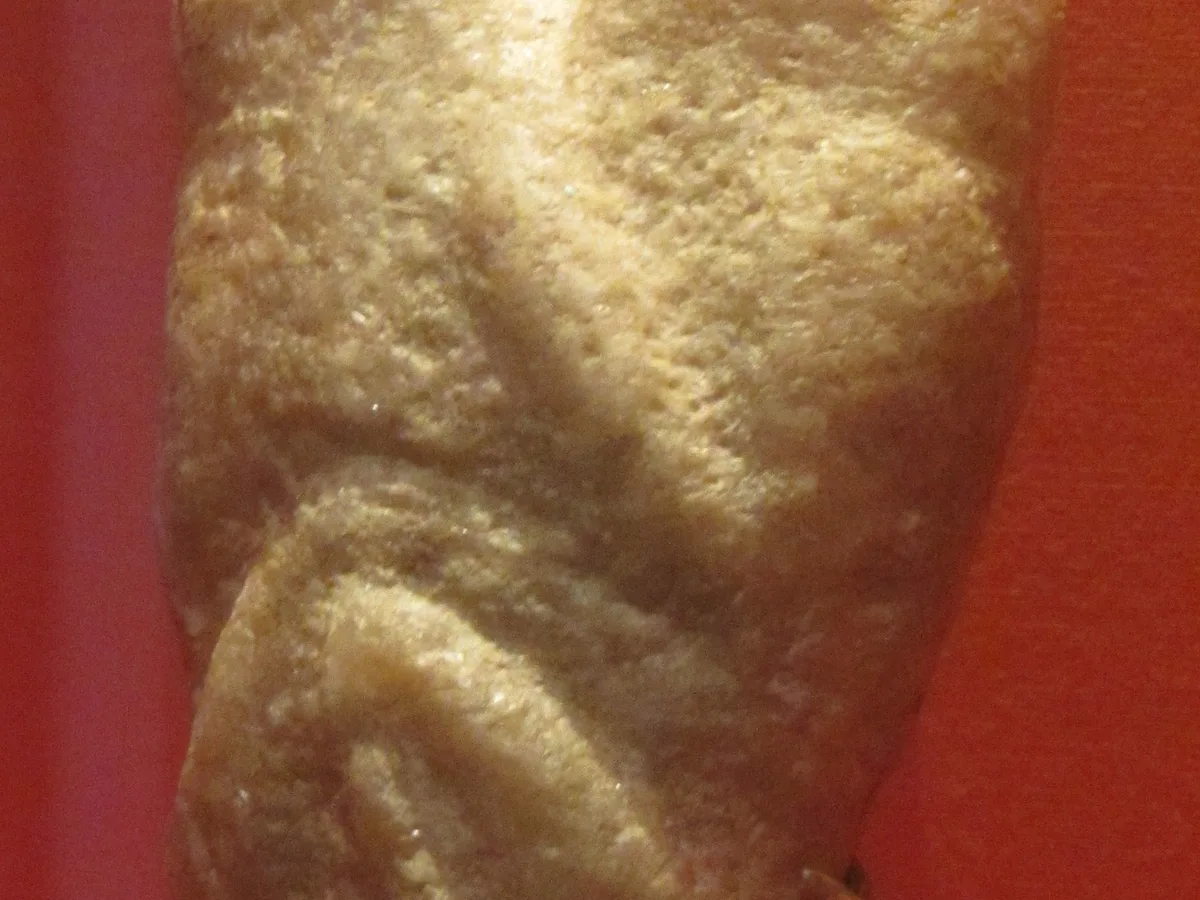
Standing just 10.2 centimeters high, the figurine is chiseled from a honey-colored calcite pebble smoothed by river action. The anonymous Natufian artist demonstrated sophisticated spatial awareness, exploiting the stone’s naturally indented, heart-shaped morphology. With minimal incisions of a flint burin, the artisan turned raw stone into an optical illusion that transforms as it is rotated.
Viewed frontally, two individuals sit face-to-face in an intimate embrace. One partner sits on the other’s lap, their thighs encircling the seated figure’s hips, while stylized arms wrap tenderly around the shoulders. The sculptor eschewed eyes, mouths, and noses, fashioning the heads into rounded domes that suggest mutual absorption and emotional unity.
Yet when rotated ninety degrees, the profile resolves into an anatomical depiction of a phallus. Observed from the top down, the two joined heads read as breasts, while the lateral leg projections delineate the contours of a vulva and testicles. This deliberate polysemy unites male and female principles into a single sculptural expression of life generation.
The carving belongs to the Epipaleolithic Natufian culture of the Levant, which pioneered sedentary villages and early cultivation.
Depending on the viewing angle, the stone simultaneously evokes embracing lovers, female breasts, an erect phallus, or a vulva.
French archaeologist René Neuville recovered the cobble in 1933 within domestic dwelling deposits inside the Ain Sakhri caves.
The sculptor intentionally avoided facial features and individual identities, emphasizing universal physical intimacy and human warmth.
The Natufian Horizon: Why the World’s Earliest Sex Scene Emerged
The creation of such an evocative artwork reflects the social transitions of the Natufian culture (c. 12,500–9,500 BCE). As the Pleistocene ice sheets retreated, the Levant experienced a warm, moist climatic optimum that produced dense oak-pistachio woodlands and vast stands of wild emmer and barley.
With food abundant, Natufian bands abandoned the mobile foraging patterns of the Paleolithic. They constructed sedentary hamlets featuring semi-subterranean circular houses with stone foundations, excavated plastered storage pits, and manufactured heavy basalt querns. Living together year-round in close-knit communities fostered new domestic dynamics and redefined family units and lineage ties.
In this transformative cultural milieu, the worlds earliest sex scene acquired profound meaning. While earlier Upper Paleolithic cave art focused on animal magic, Natufian art shifted toward human sociality and domestic intimacy, sanctifying physical union as the foundation of community cohesion and agricultural fertility.
«The Ain Sakhri sculpture is not merely the earliest known depiction of sexual intercourse; it is a remarkable monument to tenderness. At the moment when hunter-gatherers were establishing settled domestic hamlets, a Natufian sculptor harnessed a river cobble to fuse male and female anatomy into an enduring metaphor for procreation and companionate love.»
Neil MacGregor (Нил Макгрегор), Art Historian and former Director of the British Museum
Gender Ambiguity and the Sacred Dimensions of Union
A remarkable quality of the Ain Sakhri carving is its intentional anatomical ambiguity. The artist chose not to exaggerate the hips of traditional Paleolithic Venuses or delineate male facial hair. The figures are sculpted with balanced symmetry, embodying a harmonious union rather than a hierarchy of dominance.
Scholars continue to debate the artifact’s primary cultural role. Some anthropologists interpret it as a personal fertility amulet held during childbirth or rituals intended to encourage conception. Others propose a broader cosmological significance, viewing the embrace as an expression of sacred marriage (hieros gamos)—the union of Sky and Earth ensuring the seasonal germination of wild crops.
Equally compelling is the sculpture’s tactile, portable quality. Carved to fit snugly within the palm of a hand, its burnished contours invite touch and reflection. It served as a domestic talisman, perhaps kept within a family dwelling as a token of affection and partnership.
- Measuring just 10.2 cm in height, the sculpture was sculpted from a single calcite cobble using flint burins.
- Recovered from domestic occupational strata rather than a grave, suggesting it functioned as an intimate household object.
- Acquired by the British Museum in 1958 at Sotheby’s following the estate settlement of archaeologist René Neuville.
- The Natufians established the earliest circular stone houses, domesticated dogs, and used heavy basalt mortars to grind wild seeds.
- Depicts two figures seated face-to-face, with one figure resting upon the lap of the other in a total interlock of limbs.
The Enduring Legacy of Ain Sakhri: Origins of Humanistic Art
The historical significance of the Ain Sakhri Lovers extends far beyond antiquarian curiosity. This small calcite stone marks the emergence of empathy and psychological introspection in prehistoric visual culture. For the first time, human artists did not focus merely on prey or spirit animals; they turned their creative gaze inward to celebrate interpersonal connection.
Millennia later, the motif of intertwined lovers would echo across artistic traditions—from classical depictions of Cupid and Psyche to Auguste Rodin’s The Kiss and Constantin Brancusi’s modernist masterworks. Yet all trace their psychological lineage to the Natufian hearths of Wadi Khareitoun.
The Ain Sakhri Lovers reminds us that human tenderness, companionate passion, and the desire for emotional closeness are ancient traits woven into our evolutionary journey. Crafted as humans built their first permanent homes, this timeless carving captures the enduring spark of love at the dawn of the civilized world.