


In a historic disclosure within its unclassified Challenges to Security in Space report, the U.S. Defense Intelligence Agency (DIA) published the first high-resolution orbital photograph of China’s elusive robotic spaceplane, known as Shenlong (‘Divine Dragon’). The top-secret Chinese space plane, which Beijing has operated beneath impenetrable military secrecy since 2020, was captured in low Earth orbit by commercial imaging satellite WorldView-3 (operated by Maxar Technologies). The imagery provides defense analysts and aerospace engineers with an unprecedented look at the spacecraft’s aerodynamic lifting body, thermal heat tiles, and notably, open payload bay doors actively engaged in orbital proximity operations and unidentified sub-satellite releases.
The Declassified DIA Photograph: Piercing Beijing’s Spaceplane Secrecy
For over half a decade, China’s reusable spaceplane program existed almost entirely in the shadows. State news agency Xinhua strictly referred to it as a ‘reusable experimental spacecraft,’ omitting all technical schematics, launch footage, and post-landing photographs while state censors swiftly purged amateur tracking videos from Chinese social media platforms.
That veil was definitively lifted with the Defense Intelligence Agency’s release of its unclassified assessment, Challenges to Security in Space. Featured prominently on page 53 is a remarkable orbital photograph captured on May 28, 2024, by Maxar Technologies’ WorldView-3 satellite from a slant range of roughly 90 kilometers.
The image clearly reveals a winged spacecraft featuring dark ceramic thermal protection tiles across its ventral surface and an aft service module with deployed solar arrays. Most notably, the central payload bay doors are shown flung open to the vacuum of space, verifying active on-orbit payload handling.
The capture of such crisp imagery by the WorldView-3 commercial satellite underscores the burgeoning capabilities of civilian space domain awareness. Orbiting at a relative closing velocity of several kilometers per second, the optical tracking system compensated for extreme motion blur, resolving critical aerodynamic surfaces and identifying individual payload bay hinge points.
Flight Log: From a 2-Day Shakedown to 276 Days in Orbit
Shenlong’s test campaign commenced in September 2020 with a two-day inaugural orbital shakedown launched aboard a Long March 2F rocket from the Jiuquan Satellite Launch Center. In August 2022, mission two marked an astounding operational leap: the vehicle remained in orbit for 276 days before executing an autonomous landing on a 5-kilometer runway at Lop Nur in western China.
Its third mission, spanning 268 days between December 2023 and September 2024, showcased mature proximity operations. Throughout the mission, the U.S. Space Surveillance Network and commercial radar provider LeoLabs tracked the spaceplane deploying and maneuvering around multiple mysterious subsatellites (designated Objects A through F).
By February 2026, Beijing initiated its fourth orbital mission, establishing that the spaceplane has transitioned from experimental testing to routine, recurring military-aerospace operations.
The prolonged duration of Shenlong’s flights highlights advanced thermal management and robust power generation. By repeatedly raising and lowering its perigee and alternating between circular and eccentric orbits, the vehicle tested resilient autonomous navigation algorithms capable of surviving prolonged solar particle events without ground station intervention.
«The release of this high-resolution Maxar orbital image provides the world with its first unambiguous look at Shenlong. It confirms that China is operating a reusable platform functionally comparable to the X-37B, demonstrating sophisticated rendezvous and proximity operations.»
Brian Weeden, Director of Program Planning, Secure World Foundation
Strategic Parallels: China’s Shenlong Versus the U.S. Space Force Boeing X-37B
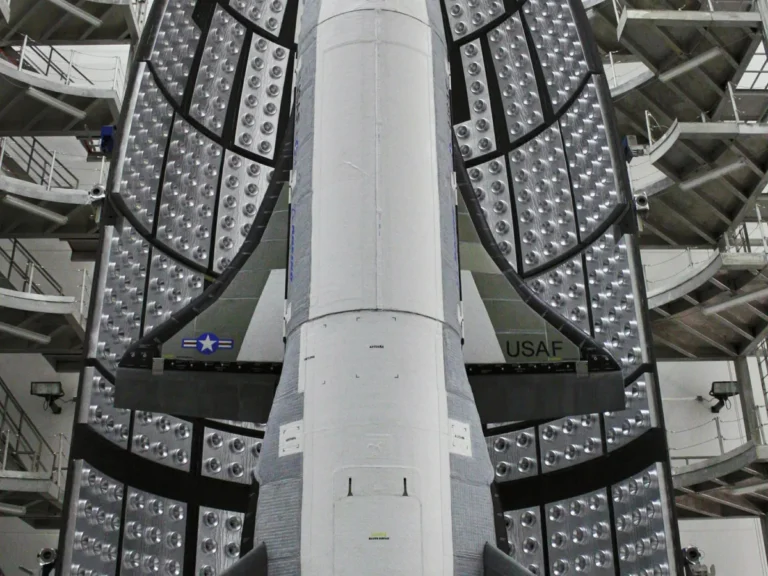
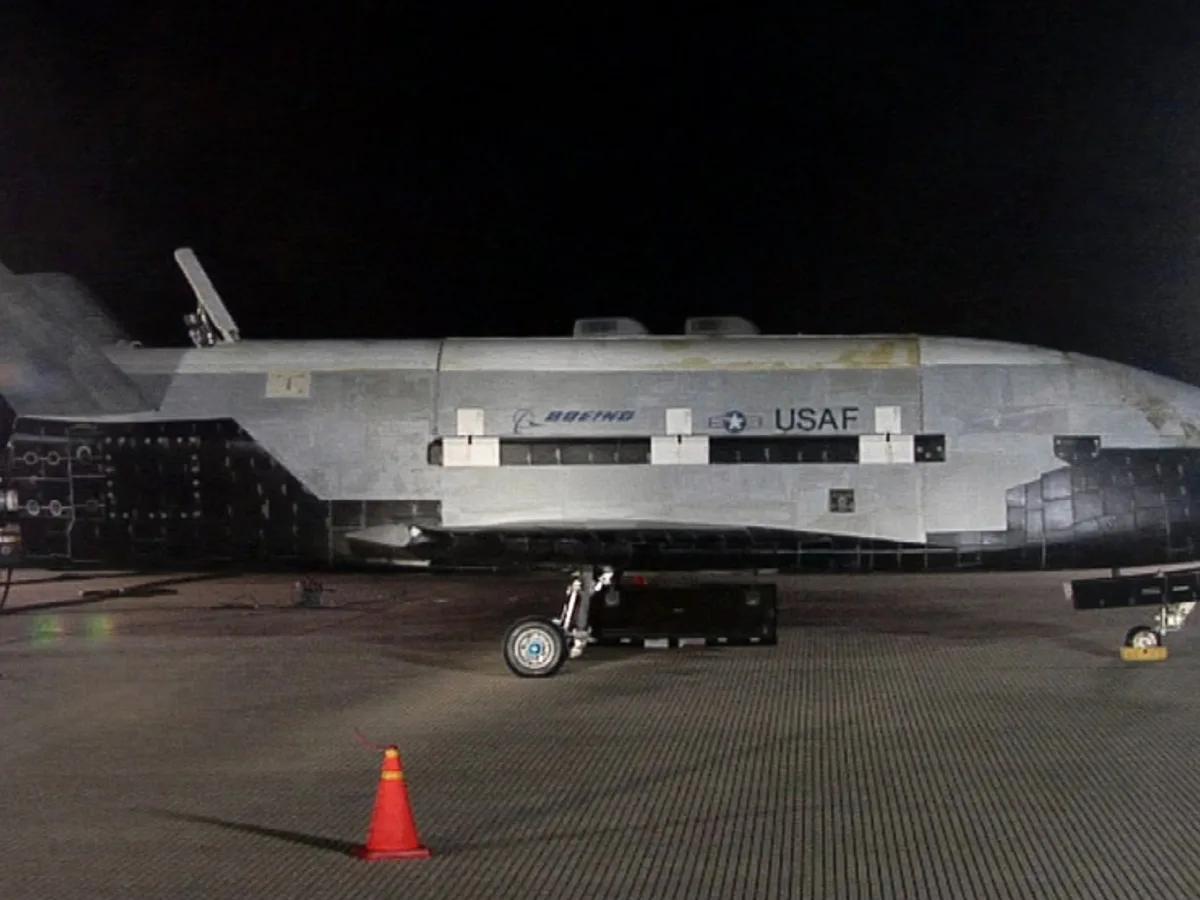
The physical architecture of Shenlong closely mirrors the Boeing-built X-37B Orbital Test Vehicle operated by the U.S. Space Force. Both systems measure approximately 9 to 10 meters in length with an uncrewed launch weight of around 5 metric tons.
However, operational envelopes diverge. While recent X-37B missions have utilized Falcon Heavy boosters to reach highly elliptical orbits testing aerodynamic braking in deeper space, Shenlong remains primarily optimized for low Earth orbit (300 to 600 km). This allows it to loiter near vital surveillance, reconnaissance, and communication constellations.
Its open payload bay demonstrates that Shenlong functions as a versatile testbed for spaceborne electronic warfare, advanced optical sensors, and robotic grappling mechanisms. In our past analysis of high-resolution space instruments, we examined how the Vera Rubin Observatory discovered a distant dwarf planet, proving how orbital clarity reshapes strategic observation.
The choice of the remote Lop Nur military airfield in Xinjiang for autonomous landings highlights the operational doctrine behind Shenlong. Featuring an expansive 5,000-meter landing strip isolated in the Taklamakan Desert, the facility allows Chinese recovery teams to secure sensitive payloads away from foreign orbital surveillance and regional optical observation posts, maintaining strict security over sensitive onboard experiments.
The WorldView-3 optical satellite photographed the Chinese vehicle on May 28, 2024, during its 268-day orbital endurance mission.
During flight three (December 2023 to September 2024), Shenlong executed complex orbital plane shifts across altitudes of 300–600 km.
Space tracking networks monitored up to six uncataloged objects released by the spaceplane, transmitting repeated radio signals.
Shenlong uses ceramic thermal tiles, delta wings, and launches vertically on a Long March 2F rocket from Jiuquan.
Counterspace Implications and Orbital Proximity Warfare
The DIA report highlights that Shenlong’s rapid maneuverability poses distinct challenges for allied space domain awareness. By leveraging onboard propulsion to make sudden orbital altitude and inclination adjustments, the spaceplane can easily evade prediction models and ground-based tracking radars.
Furthermore, demonstrated Rendezvous and Proximity Operations (RPO) imply potent counterspace capabilities: uncrewed winged vehicles can inspect, jam, or physically tamper with adversary orbital assets under the guise of technological testing.
While Beijing officially maintains that Shenlong exists solely to advance low-cost orbital access, space debris mitigation, and scientific sample return, defense planners treat its operational flexibility as a premier space superiority asset.
- Aerodynamic lifting body with canted winglets and dual ruddervator tail assembly;
- Internal payload bay equipped with automated articulating clamshell doors;
- Jettisonable aft propulsion service module featuring deployable gallium-arsenide solar arrays;
- Autonomous deadstick runway landing capability at Lop Nur military base in the Taklamakan Desert.
The Modern Era of Robotic Winged Spacecraft
The maturation of Shenlong cements a permanent renaissance for reusable lifting-body designs. Removing human life support systems grants robotic spaceplanes multi-year endurance, combining the aerodynamic agility of aircraft with the orbital longevity of satellites.
Aerospace strategists project that future iterations may integrate with hypersonic suborbital carrier aircraft, establishing Two-Stage-to-Orbit (TSTO) architectures capable of responsive launch from conventional runways.
As the parallel operations of X-37B and Shenlong illustrate, uncrewed spaceplanes have become indispensable tools in the unfolding era of celestial deterrence.