



At the icy, twilight frontiers of our solar system, an extraordinary planetary discovery has unfolded. The newly operational Vera C. Rubin Observatory, conducting its high-cadence wide-field survey from the Andean summit of Cerro Pachón in Chile, has identified a massive trans-Neptunian object provisionally designated 2026 ED138. Orbiting approximately 46 Astronomical Units (AU) from the Sun beyond the realm of Pluto, the object spans an estimated diameter exceeding 700 kilometers. Possessing sufficient mass to achieve hydrostatic equilibrium, the body represents the foremost candidate to become the sixth officially recognized dwarf planet in our solar system.
The Summit of Cerro Pachón: Engineering the Rubin Sky Survey
The commissioning of the Vera C. Rubin Observatory in Chile’s Atacama Desert marks a seismic transition in observational astrophysics. Historically, large optical telescopes have functioned like narrow drinking straws, probing minuscule patches of deep sky with long integration times. By contrast, the 8.4-meter Simonyi Survey Telescope is designed as a wide-field optical engine. Boasting an optical focal plane equipped with a record-shattering 3.2-gigapixel charge-coupled sensor array—the largest camera ever built for scientific exploration—the instrument captures an area of sky spanning forty full Moon diameters in a single 15-second exposure.
Under the ten-year Legacy Survey of Space and Time (LSST), the observatory repeatedly records the entire accessible southern celestial hemisphere every three to four nights. Advanced high-throughput computational pipelines ingest more than 20 terabytes of raw imaging data each night, running difference imaging algorithms that flag millions of transient phenomena—from distant supernovae to subtle shifts in asteroidal coordinates.
It was through this relentless automated surveillance that an operational astrophysics team led by Dr. Matthew Holman at the Center for Astrophysics | Harvard & Smithsonian flagged the minuscule motion of a faint 21st-magnitude point of light traversing against background stars in the constellation Sagittarius.
Orbital Mechanics of 2026 ED138: Wandering the Scattered Disc
Cross-correlating sequential multi-band observations over months enabled dynamical astronomers to compute a refined elliptical trajectory for the new body, assigned the preliminary designation 2026 ED138. The object travels within the scattered disc—a dynamic reservoir of icy planetesimals populating the fringes of the Kuiper Belt at an average heliocentric distance of approximately 46 Astronomical Units (AU).
For perspective, Neptune orbits at roughly 30 AU, while Pluto maintains an average semi-major axis of 39.5 AU. At 46 AU, 2026 ED138 resides in deep cryogenic equilibrium roughly 6.8 billion kilometers from the Sun, where ambient solar irradiance is diminished to 1/2100th of terrestrial levels and surface temperatures hover near 35 Kelvin (-238°C). The world requires approximately 315 Earth years to complete one orbital period.
Crucially, the body displays an orbital inclination exceeding 28 degrees relative to the invariable plane of the solar system. This steep tilt reveals a violent historical genesis: during the outward migration of the giant planets 4.5 billion years ago, gravitational resonances with Neptune dynamically scattered this massive planetesimal out of the primordial disk onto its current inclined path.
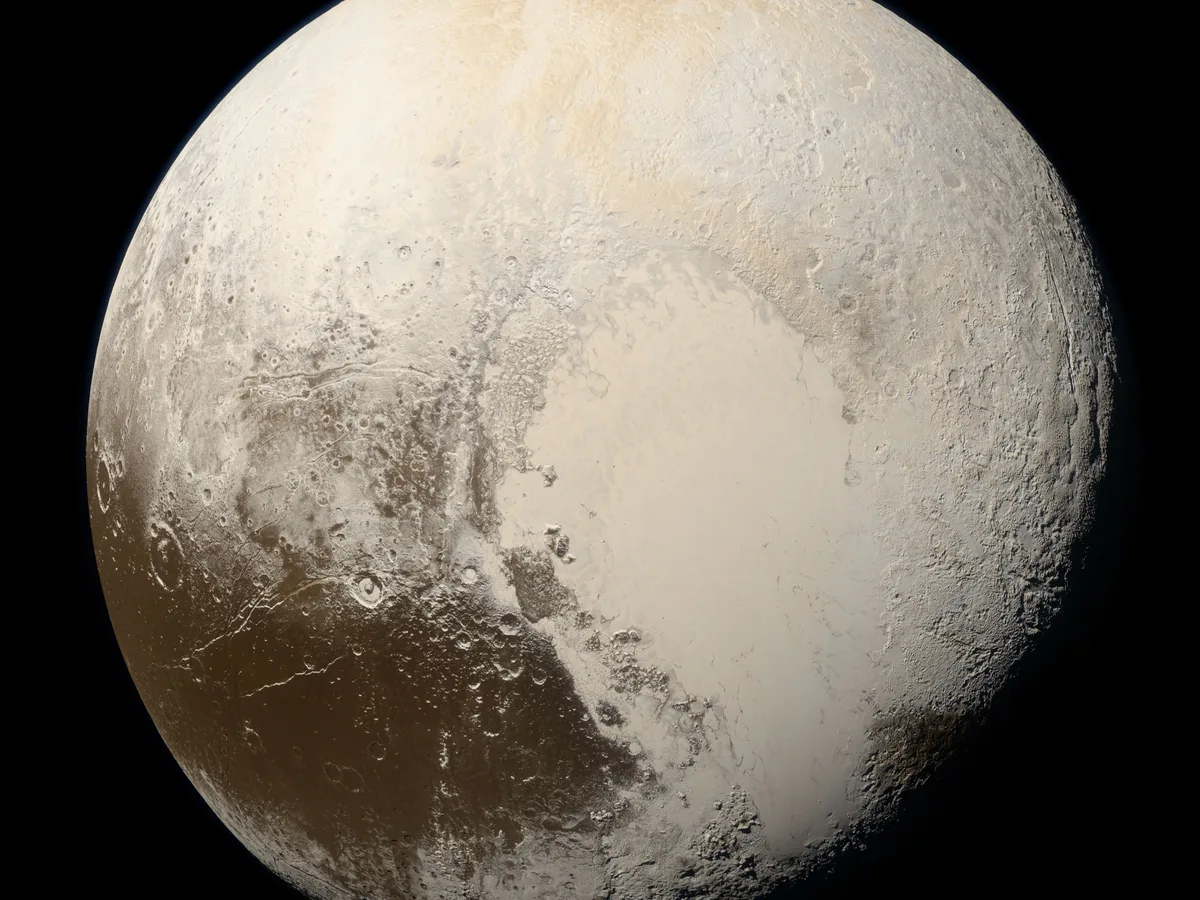
The substantial physical mass generates sufficient gravitational self-attraction to overcome rigid material forces, forming a hydrostatically rounded spheroid.
Orbiting nearly 6.9 billion kilometers from the Sun, this distant icy world completes a single leisurely revolution once every 315 Earth years.
The largest optical imaging array ever built maps the entire southern night sky every three nights, detecting ultra-faint orbital displacements of distant bodies.
Pending formal International Astronomical Union (IAU) validation, the world will join Ceres, Pluto, Eris, Makemake, and Haumea in the official planetary ledger.
The Physics of Sphericity: Criteria for Dwarf Planet Classification
Under the landmark 2006 definition established by the International Astronomical Union (IAU), an astronomical body must fulfill three criteria to be classified as a dwarf planet: it must directly orbit the Sun without being a satellite, it must have failed to clear the neighborhood around its orbit, and it must possess sufficient mass for self-gravity to overcome rigid body forces, achieving hydrostatic equilibrium.
While dense, silicate-rich rocky asteroids in the inner asteroid belt require diameters approaching 800 to 900 kilometers to collapse into spheres, trans-Neptunian objects consist predominantly of low-density volatile ices (water, methane, and ammonia). Because water ice exhibits plastic deformation under lower compressive stresses at deep cryogenic temperatures, the threshold for gravitational rounding in the outer solar system is much lower—typically between 400 and 500 kilometers.
Radiometric modeling and optical brightness assays indicate that 2026 ED138 spans a diameter of approximately 700 to 820 kilometers. This places it well above the threshold of hydrostatic equilibrium, comfortably exceeding the diameter of Ceres and aligning with established dwarf planets Haumea and Quaoar. Consequently, planetary astronomers possess compelling empirical justification to petition the IAU for official dwarf planet designation.
«Detecting 2026 ED138 during the earliest phases of our wide-field sky survey demonstrates the unprecedented optical reach of the Rubin Observatory. We are entering an era where hundreds of hidden worlds in the deep solar system will finally step into the light.»
Dr. Matthew Holman, Senior Astrophysicist, Center for Astrophysics | Harvard & Smithsonian
Cryogenic Surface Geology: Methane Frost and Hidden Oceans
Preliminary near-infrared reflectance spectroscopy hints at a remarkably bright surface. With a geometric albedo estimated above 0.65, 2026 ED138 reflects more than two-thirds of incident solar rays—a striking contrast to the coal-dark surfaces typical of primitive carbonaceous asteroids.
This high reflectivity is indicative of fresh, volatile-rich surface frost. Planetary scientists hypothesize that the body maintains a dynamic micro-environment where seasonal shifts cause trace atmospheres of nitrogen and methane to freeze and precipitate as fine hydrocarbon snow. Furthermore, numerical thermal modeling suggests that internal radiogenic decay from potassium-40 and thorium-232 within a differentiated rocky core could generate sufficient thermal flux to sustain a briny, ammonia-rich subsurface liquid ocean beneath its thick outer ice mantle.
These insights reinforce a major revelation of modern exploration: outer solar system bodies are not sterile slabs of stone, but active cryogenic worlds shaped by complex geophysics, cryovolcanism, and volatile cycles.
- The orbit is inclined by over 28 degrees relative to the ecliptic plane, indicating intense primordial gravitational scattering by Neptune;
- High geometric albedo points toward a pristine cryogenic surface crust dominated by nitrogen, methane, and water ice;
- The discovery substantiates models predicting an abundant population of large planetesimals sequestered in the Kuiper Belt scattered disc;
- Precise astrometric telemetry from 2026 ED138 will provide vital test constraints for the hypothetical existence of Planet Nine.
A Rewritten Solar System Map: The Vanguard of a Cosmic Census
The identification of 2026 ED138 represents merely the opening salvo of the Rubin Observatory’s decade-long astronomical census. Currently, the IAU recognizes only five dwarf planets: Ceres in the main asteroid belt, alongside Pluto, Eris, Makemake, and Haumea in the trans-Neptunian realm.
Astrophysical projections indicate that the LSST program will detect over 40,000 new trans-Neptunian objects over the coming decade, potentially uncovering dozens of additional dwarf planet candidates spanning 500 to 1,200 kilometers. Furthermore, the precise orbital mapping of these distant scattered planetesimals provides the empirical scaffolding required to test the controversial Planet Nine hypothesis—the premise that an unseen super-Earth exerts gravitational clustering on distant perihelia.
The confirmation of 2026 ED138 reshapes our perception of our cosmic neighborhood. Far from terminating at the orbit of Neptune, the solar system is populated by a rich, diverse family of worlds, reminding humanity that the exploration of our celestial backyard has only just begun.