

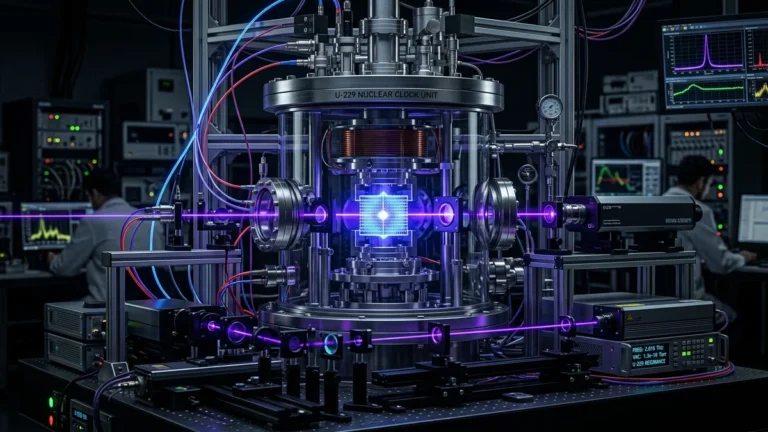

For over seven decades, humanity’s gold standard for measuring time has relied on atomic clocks tracking electron oscillations across atomic shells of cesium, strontium, or ytterbium. Yet electrons are fundamentally susceptible to ambient noise: stray magnetic fields, blackbody radiation fluctuations, and atomic collisions induce unavoidable micro-drifts. In a monumental physics breakthrough, researchers have successfully constructed the world’s first operating nuclear clock. By exploiting a uniquely low-energy nuclear isomer in thorium-229, physicists transferred the quantum pendulum from outer electron clouds directly into the atomic nucleus itself — reducing timing drift to less than one second across 300 billion years.
Limits of Electron Orbits: Why Modern Atomic Standards Stalled
State-of-the-art optical lattice clocks using neutral strontium atoms achieve staggering precision, losing barely a second over 15 billion years. Yet their ultimate performance barrier stems from fundamental atomic physics.
Diffuse electron clouds exhibit large electric dipole polarizabilities, making them vulnerable to ambient blackbody thermal radiation and stray electromagnetic fields. Compensating for these shifts demands massive ultra-high-vacuum chambers and cryogenic shielding, restricting atomic clocks to pristine laboratory baselines.
The Thorium-229 Anomaly: A Direct Laser Key into the Nucleus
Atomic nuclei consist of protons and neutrons held together by the strong nuclear force. Nuclear energy transitions typically require hard gamma-ray photons packing megaelectronvolts (MeV) of energy — orders of magnitude beyond any coherent laser system.
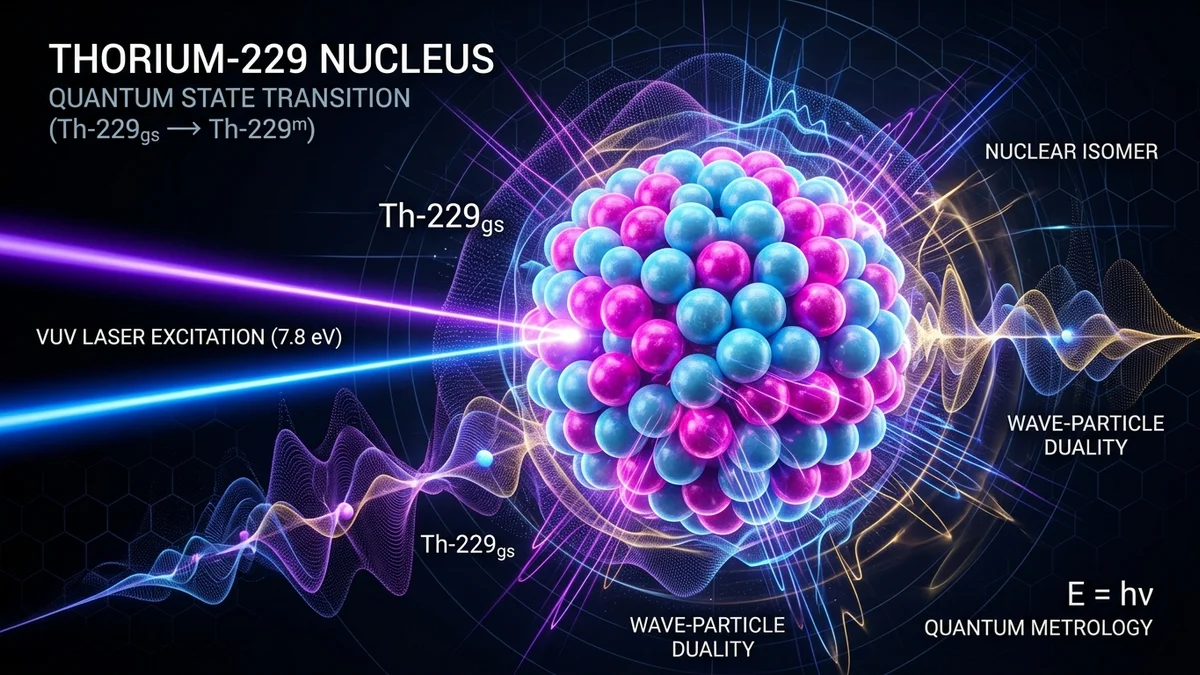
Thorium-229m is nature’s singular anomaly across the periodic table. The energy gap between its nuclear ground state and first isomeric state is a minuscule 8.355 eV (corresponding to a vacuum ultraviolet wavelength around 148 nm). It is the only nuclear isomer in the cosmos accessible to direct tabletop laser spectroscopy.
The compact nucleus is 100,000 times less sensitive to stray electromagnetic perturbations.
Thorium-229 features the only nuclear transition accessible via tabletop VUV laser beams.
Trillions of nuclei trapped in CaF2 crystals enable robust, portable solid-state metrology.
Capable of detecting cosmological variations in fundamental physical constants.
Solid-State Clocks: Billions of Nuclei in a Single Crystal
The defining engineering leap of the nuclear clock is its solid-state compatibility. While atomic optical clocks require trapping isolated neutral atoms in complex optical lattices, thorium-229 nuclei can be embedded directly into transparent calcium fluoride (CaF2) crystal lattices.
A cubic millimeter of crystal hosts trillions of thorium nuclei, perfectly protected from thermal decoherence by the surrounding matrix. This architecture paves the way for rugged, vibration-immune nuclear clocks the size of desktop modules suitable for satellite constellations.
«Transitioning from atomic clocks to a nuclear clock is comparable to replacing an exquisitely delicate crystal pendulum with an impenetrable block of granite. An atomic nucleus is 100,000 times smaller than the electron shell and bound by the fundamental strong nuclear force. Environmental perturbations that plague optical standards cannot shake the thorium nucleus. It represents the ultimate ceiling of chronometry.»
Dr. Thorsten Schumm, Head of the Research Group at TU Wien (Vienna University of Technology)
Probing the Constancy of Fundamental Physical Constants
A nuclear clock functions as an ultra-sensitive quantum sensor capable of revealing new physics beyond the Standard Model. The transition frequency of thorium-229 is governed by an exquisite, near-cancellation balance between the strong nuclear force and electromagnetism.
If fundamental physical constants — such as the fine-structure constant (alpha) or quantum chromodynamic parameters — drift across cosmological epochs, the nuclear clock will detect it immediately. Discrepancies between atomic and nuclear tick rates would provide the first laboratory signature of ultralight dark matter wave interactions.
- Frequency uncertainty projects to 1 second lost over 300 billion years — over 20 times the age of the universe.
- Resonance excitation achieved via coherent vacuum ultraviolet (VUV) laser radiation at 148.38 nm.
- Enables relativistic geodetic elevation mapping with sub-millimeter vertical accuracy.
- Acts as an exquisitely sensitive laboratory probe for ultralight bosonic dark matter.
Relativistic Geodesy and Deep-Space Autonomous Navigation
Under Einstein’s general theory of relativity, Earth’s gravitational potential slows down time. The sensitivity of the thorium clock enables relativistic geodesy: measuring elevation variations of fractions of a millimeter via gravitational redshift.
Interconnected networks of nuclear clocks will track subterranean magma migration, tectonic strain accumulation, and ice sheet mass shifts in real time. For deep-space probes, onboard nuclear clocks will allow autonomous, communication-free navigation across the solar system.