


Resting nearly one and a half miles beneath the surface of the Mediterranean Sea, submerged in pitch-black abyssal waters off the coast of Toulon, France, operates one of the most daring scientific experiments of the modern era. An international collaboration of particle astrophysicists utilized the underwater KM3NeT/ORCA detector array to put Einstein’s relativity to the test across microscopic dimensions of space-time. By tracking thousands of ghost-like neutrinos coursing upward through the entire planetary core, researchers probed for subtle fractures in one of physics’ most cherished symmetries: Lorentz invariance.
Searching for Cracks in Space-Time: The Clash of Einstein and Quantum Mechanics
Modern fundamental physics rests upon two monumental pillars: Albert Einstein’s general theory of relativity and the quantum mechanical Standard Model of particle physics. General relativity describes gravitation as the smooth, continuous curvature of four-dimensional space-time, reigning supreme over planets, black holes, and the grand cosmic expansion. Conversely, quantum field theory governs the microscopic universe with extraordinary mathematical precision. Yet within extreme gravitational singularities—such as the Big Bang or the core of black holes—these two master frameworks catastrophically break down.
For decades, theoretical physicists have searched for a unifying quantum theory of gravity, exploring candidates like string theory and loop quantum gravity. Many of these frontier models predict that at the unfathomably small Planck length ($10^{-35}$ meters), the smooth fabric of space-time fractures into a discrete, granular, or “foamy” structure. If this microscopic grain exists, one of the most foundational principles in modern science—Lorentz invariance—could be subtly violated at high energies.
Lorentz invariance dictates that physical laws and the universal speed limit ($c$) remain invariant regardless of an observer’s orientation or velocity. A breakdown of this symmetry would imply a preferred reference frame woven into the universe. Detecting such imperceptible departures requires a probe that can journey astronomical distances through matter without colliding or scattering—enter the neutrino.
KM3NeT Architecture: Subsea Crystal Spheres in the Mediterranean Abyss
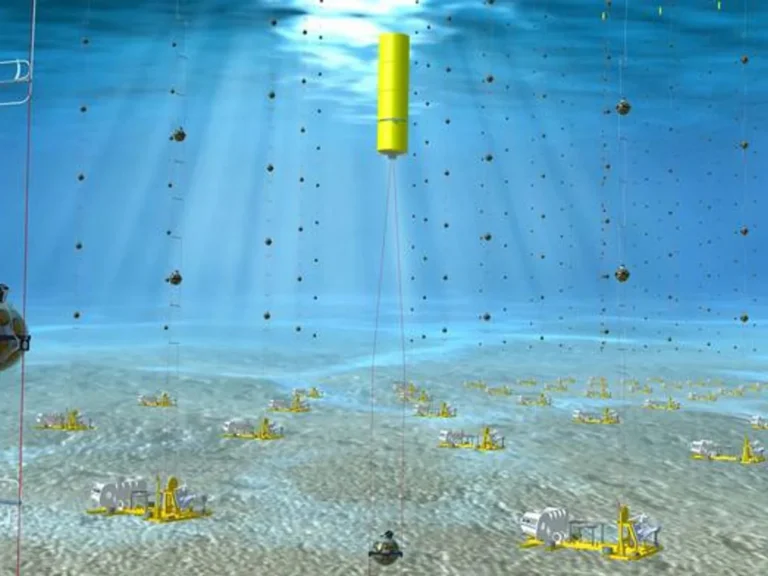
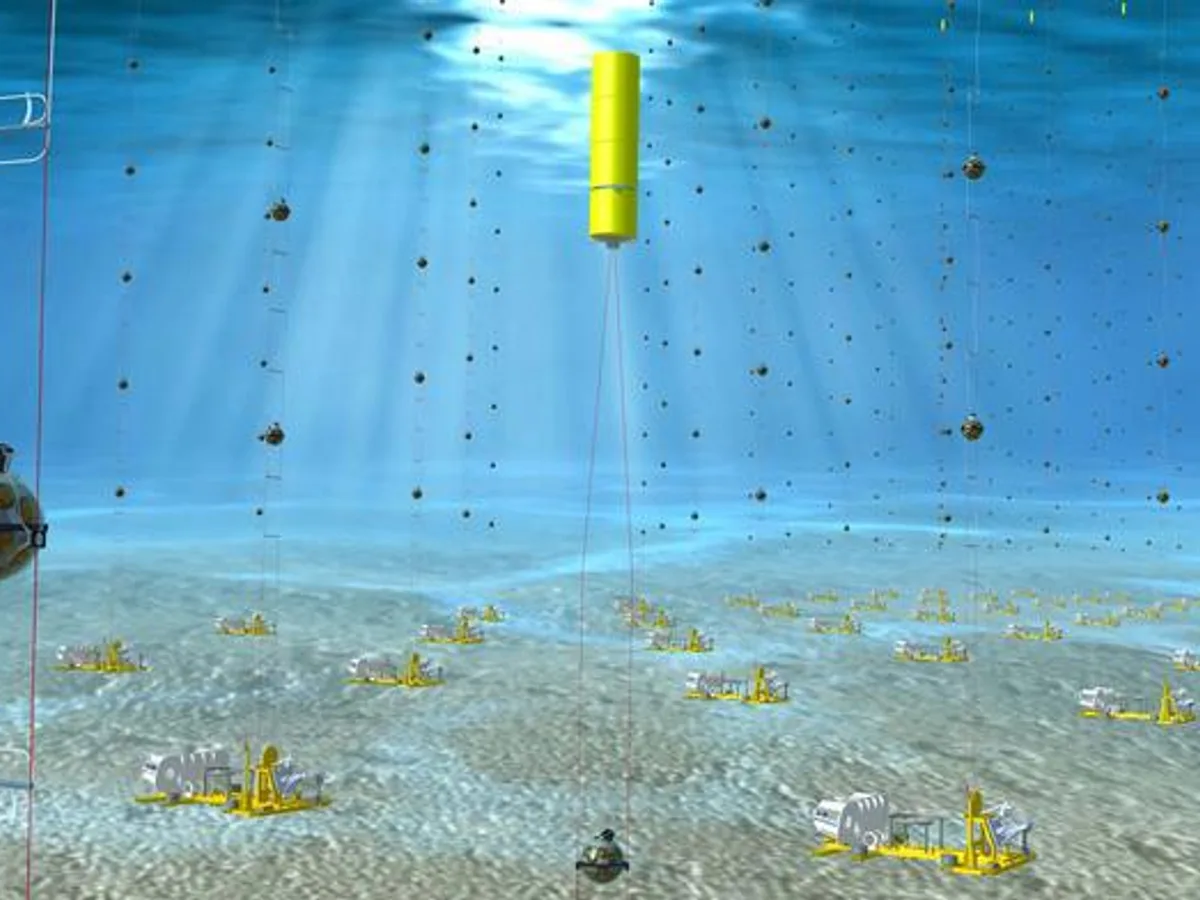
To capture these elusive subatomic messengers, the KM3NeT Collaboration designed an underwater observatory distributed across the deep Mediterranean Sea. The infrastructure features two specialized detector arrays: ARCA (Astroparticle Research with Cosmics in the Abyss), anchored 3,500 meters deep off Capo Passero in Sicily, and ORCA (Oscillation Research with Cosmics in the Abyss), submerged 2,400 meters beneath the waves off Toulon, France.
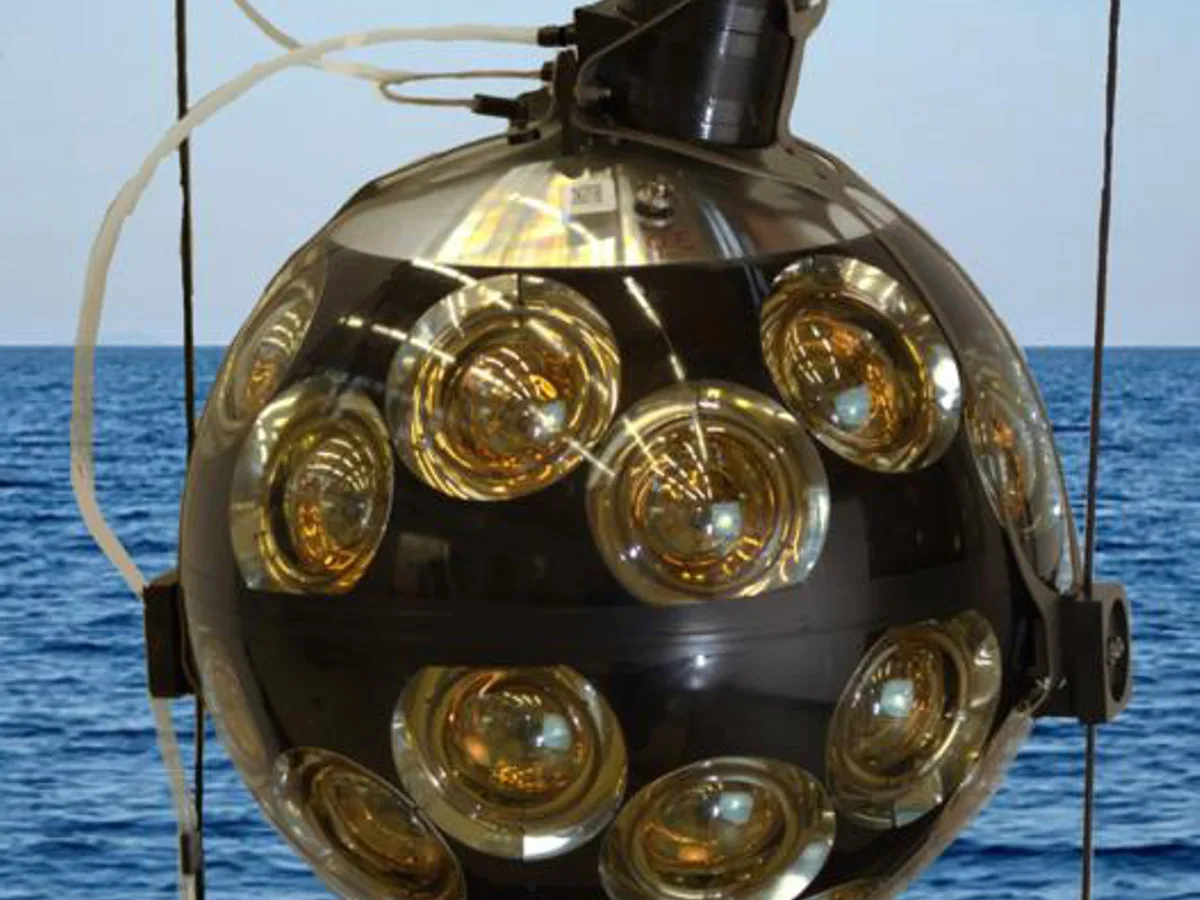
Each detection unit consists of a vertical string hundreds of meters tall, secured to the seabed by heavy anchors and buoyed vertically by subsurface floats. Along flexible Dyneema synthetic tethers, engineers positioned 18 digital optical modules (DOMs). Each pressure-resistant glass sphere encases 31 three-inch photomultiplier tubes, nanosecond timing electronics, and acoustic positioning sensors capable of detecting single photons.
When a high-energy neutrino collides with an atomic nucleus in the seawater, it generates relativistic secondary leptons (such as muons). Traveling faster than the local phase velocity of light in water, these charged particles emit a conical shockwave of faint blue Cherenkov radiation. KM3NeT’s optical sensors detect these nanosecond blue flashes, allowing astrophysicists to reconstruct the particle’s energy, flavor, and arrival trajectory with surgical precision.
«General relativity describes the universe exceptionally well on a cosmological scale, while the Standard Model governs subatomic interactions. Yet at extreme Planckian densities, they clash. If space-time possesses a discrete quantum grain, Lorentz invariance must be violated, and neutrinos are our ultimate probe to detect these microscopic fractures.»
Lukas Hennig, Doctoral Researcher in Astroparticle Physics at FAU Erlangen-Nürnberg and study co-author
The Earth as a Shield: Tracking 5,828 Upward-Traveling Neutrinos
Terrestrial particle detectors face a relentless blizzard of atmospheric cosmic-ray noise. Millions of muons shower down upon the ocean surface every second. To isolate pure neutrino interactions, KM3NeT employs the entire planet as a natural bulk filter.
The detector exclusively triggers on “upward-going” events: neutrinos generated when cosmic rays strike the upper atmosphere in the antipodal hemisphere, which then travel through 7,900 miles (12,700 kilometers) of Earth’s mantle and nickel-iron core before entering the Mediterranean detector from below. No other known elementary particle can penetrate the solid density of the Earth; only weakly interacting neutrinos pass unimpeded.
During this planetary transit, neutrinos undergo quantum mechanical flavor oscillations, cycling between electron, muon, and tau identities. If space-time harbored a Lorentz-violating quantum grain, this oscillation frequency would warp as a function of path length and energy. However, statistical analysis of 5,828 upward-going atmospheric neutrinos recorded by ORCA across 17 months demonstrated that oscillations conformed perfectly to standard Einsteinian physics, revealing zero evidence of Lorentz invariance violation.
The ORCA array is anchored to the seafloor off Toulon, France, while its sister ARCA array sits 3,500 meters deep off Sicily, collectively comprising KM3NeT.
The telescope exclusively tracks neutrinos ascending from below through 12,700 km of planetary rock, which screens out all atmospheric muon noise.
Einstein’s foundational axiom states that the laws of physics and the speed of light are identical for all observers regardless of velocity or orientation.
Analysis across 17 months with just 6 detection lines confirmed Einstein’s equations, establishing world-leading bounds on quantum gravity violations.
Outperforming Expectations: Six Strings Rivaling Super-Kamiokande and IceCube
Published in the Journal of Cosmology and Astroparticle Physics by lead researchers Alba Domi and Lukas Hennig, the findings startled the astrophysics community. The experimental constraints were derived using only the first six operational detection units of KM3NeT/ORCA—a mere fraction of its full designed footprint.
Despite its modest initial size, ORCA established competitive global limits on Lorentz invariance violation that rivaled twelve full years of data from Japan’s Super-Kamiokande and two full years of observations from the complete 86-string IceCube South Pole array.
As doctoral researcher Alba Domi highlighted, liquid seawater provides crucial optical advantages over glacial ice. Antarctic ice sheets exhibit heavy optical scattering due to trapped dust and microscopic air bubbles, whereas deep Mediterranean water boasts remarkable transparency and minimal scattering, permitting precise angular reconstruction of Cherenkov light cones.
This experimental pursuit of fundamental physics in deep abyssal waters parallels the probing departures from fundamental cosmological physics, where astrophysicists test gravitational constants against deep-space observations.
- DOM Optical Spheres: High-pressure boro-silicate glass globes withstand 250 atmospheres, each housing 31 sensitive photomultiplier tubes (PMTs).
- Neutrino Flavor Oscillation: Particles morph between electron, muon, and tau states during transit. Violations of relativity would disrupt this quantum beat.
- Rivaling Giant Detectors: With only six deployed lines, KM3NeT matched the precision of Super-Kamiokande (12 years of data) and IceCube (2 years full array).
- Expansion Roadmap: By 2030, KM3NeT will operate 108 detection units, capturing ultra-high-energy cosmic neutrinos from distant blazars and supernovae.
Toward 2030: ARCA, Extreme Cosmic Rays, and the Unified Frontier
Today, 44 detection strings are deployed in the Mediterranean, with KM3NeT on track to commission 108 strings by 2030. The next frontier involves coupling ORCA’s oscillation limits with data from ARCA, which is tailored to register multi-TeV and PeV astrophysical neutrinos originating from blazars, tidal disruption events, and gamma-ray bursts.
Because hypothetical Lorentz-violating effects amplify dramatically with particle energy and astronomical baseline distances, extragalactic neutrinos traveling across billions of light-years will provide the definitive test of Planck-scale physics. These extreme abyssal research settings evoke the high-pressure aquatic frontiers examined in ongoing exploration of deep high-pressure ocean abysses.
Einstein’s relativistic vision has once again withstood the most stringent empirical test available to human science. Yet by listening in the silence of the ocean depths, physicists stand ready for the day when the universe might finally whisper its deepest quantum secrets.