

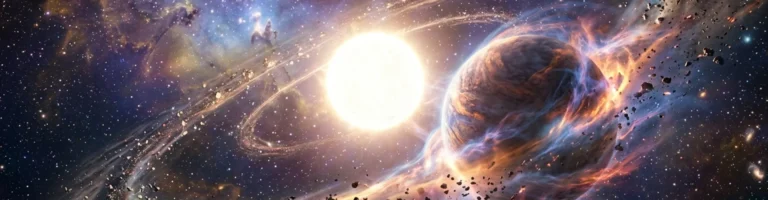

The astrophysical community has been captivated by breakthrough discoveries emerging from the Hubble Space Telescope archives and TESS orbital data: an international team of astrophysicists led by Dr. Christopher Manser from the University of Warwick has uncovered compelling evidence of an exoplanet orbiting the white dwarf HS 0209+0832. Unlike any previously observed world, this Jovian gas giant did not assemble from the primordial circumstellar disk of a young star. Instead, it coalesced from the expelled nucleosynthetic ashes of the dying star itself, marking the first confirmed discovery of a second-generation “Phoenix Planet” in our stellar neighborhood.
Chemical Forensics on a Stellar Remnant: The Niobium Mystery
White dwarfs are ultra-dense stellar corpses roughly the size of Earth yet packing the mass of the Sun. Their crushing surface gravity generates rapid gravitational settling: heavy elements sink below the observable photosphere within mere days or weeks. Consequently, the atmospheric spectra of isolated white dwarfs should appear purely pristine, composed strictly of hydrogen or helium.
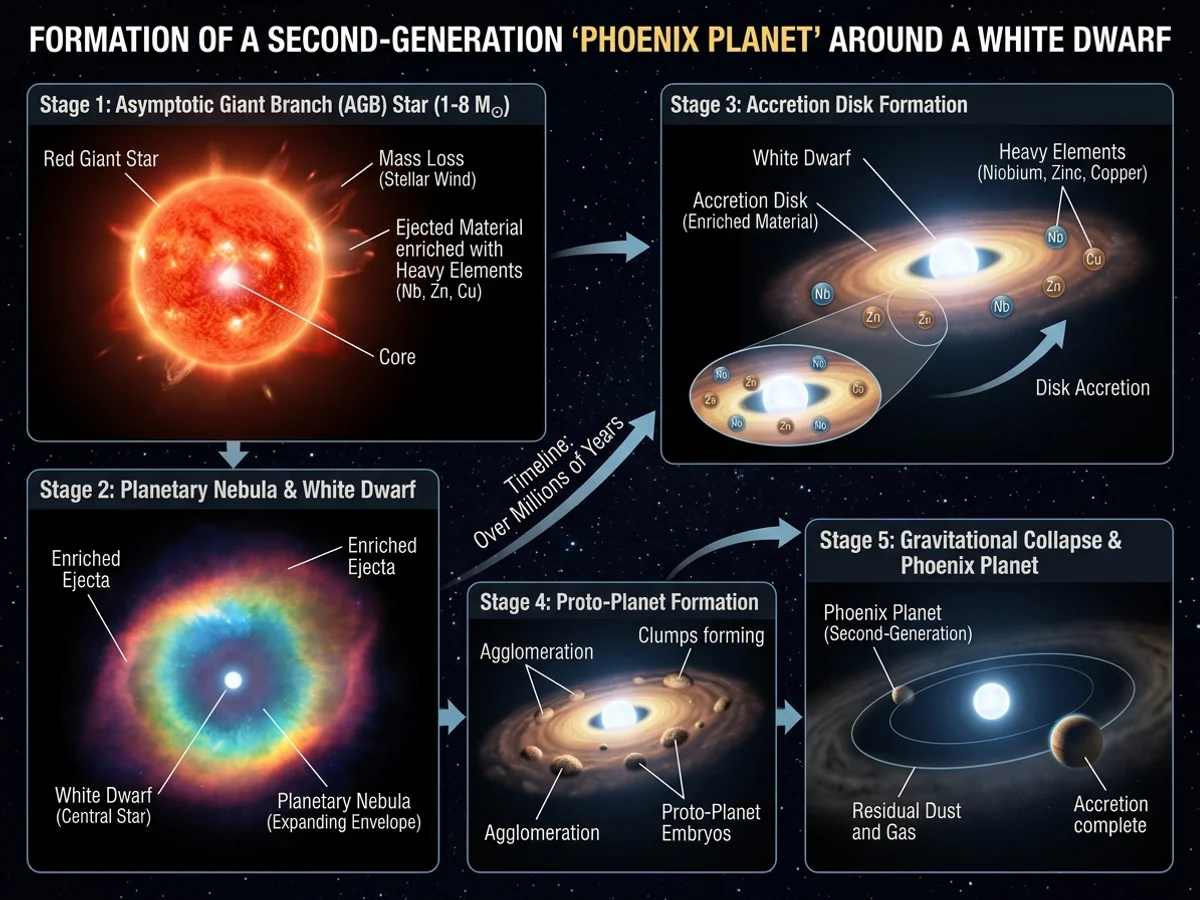
However, high-resolution spectroscopy conducted with the Keck Observatory HIRES instrument on Mauna Kea revealed intense metallic pollution across HS 0209+0832. Most astonishingly, researchers detected an overwhelming abundance of the rare refractory element niobium (Nb), clocking in at over 1,200 times higher than solar levels, accompanied by anomalous concentrations of copper, zinc, and titanium.
“Niobium is an unassailable nucleosynthetic signature. It cannot be primordial relic contamination: niobium is manufactured exclusively deep within the convective shells of asymptotic giant branch (AGB) stars via the slow neutron-capture process (s-process). Observing active niobium on a white dwarf means a massive enriched planet is actively shedding material onto the stellar surface today.”
Dr. Christopher Manser, Lead Astrophysicist at the University of Warwick
Second-generation gas giant roughly 1.2–1.4 Jupiter masses assembled within a metal-dense post-AGB fallback disk.
Ultra-close orbital period of 4.4 days at a distance of 3.8 million miles, subjecting the exoplanet to intense tidal shearing.
Atmospheric stripping channels metal-enriched gas onto the compact star at rates exceeding 109 grams per second.
Planetary Resurrection: Fallback Accretion Dynamics
For decades, conventional planetary science considered the red giant transition the absolute final curtain for any solar system. Standard models predicted that expanding envelopes engulf inner terrestrial worlds while destabilizing outer gas giants into interstellar rogues.
Simulations conducted by astrophysicists at Warwick and Leiden Observatory overturn this doctrine. As the planetary nebula expands, up to 10–12% of the enriched stellar envelope fails to achieve escape velocity. This fallback gas collapses into a dense circumstellar accretion disk around the newly exposed white dwarf, triggering gravitational instabilities that assemble a newborn gas giant within just a few hundred thousand years.
Video: Exploring Compact Stellar Remnants and Cosmic Gravity
In this beautifully animated exploration by Kurzgesagt, the mind-bending physics and gravitational dynamics of white dwarfs and neutron stars are revealed:
Implications for the Solar System’s Distant Future
In five billion years, our Sun will exhaust core hydrogen, expand to engulf the inner planets, and eventually collapse into a white dwarf. The discovery of HS 0209+0832 offers a tantalizing preview of our cosmic destiny: even after Earth is gone, the Sun’s recycled ashes could foster newborn worlds, continuing the cycle of planetary genesis.