

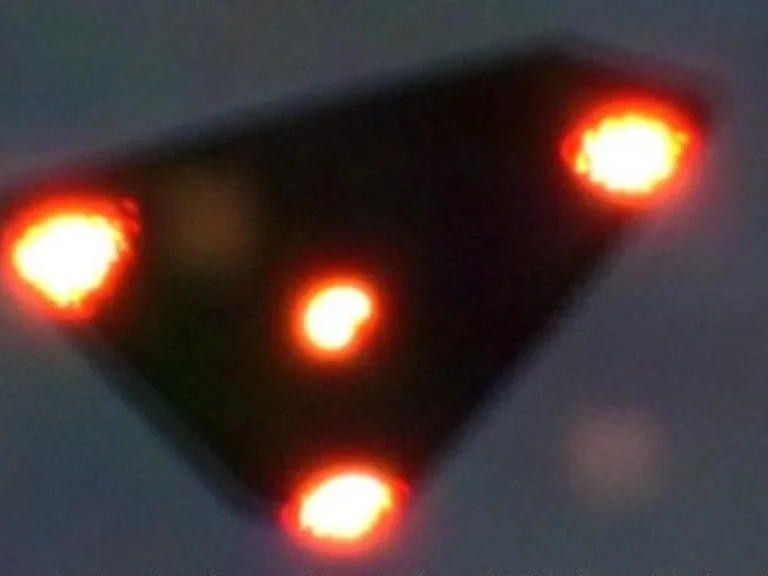

The United States Department of Defense and the All-domain Anomaly Resolution Office (AARO) have officially released their seventh tranche of declassified government records regarding unidentified anomalous phenomena (UAP). Among the newly unveiled dossiers, aviation engineers and security analysts have focused on an encounter documented near a restricted western facility: federal officers and military observers tracked a matte black triangular UFO exhibiting silent vertical ascent and an absence of conventional thermal propulsion.
The Seventh Tranche Release: Chronology of the 2026 Western Encounter
The publication of the seventh declassified documentation package by the All-domain Anomaly Resolution Office (AARO) marks a significant moment in the scientific and public scrutiny of military aerospace encounters. Identified in government records as case memorandum DOW-UAP-D176, the event took place near a designated national security zone in the rugged terrain of the western United States. Unlike ambiguous civilian phone footage, this event was recorded simultaneously by trained personnel, including federal law enforcement officers and duty operators of calibrated military surveillance installations.
Visual tracking began in the pre-dawn twilight when observers spotted a sharp, geometric silhouette rising steadily above a mountain ridgeline. The craft lacked mandatory FAA navigation lights, anti-collision strobes, and transponder signals. Observers noted that the craft maintained an exceptionally stable horizontal attitude throughout the ascent, showing none of the micro-buffeting or attitude corrections typical of conventional aircraft navigating complex mountain wind shears.
Cross-referencing eyewitness statements from geographically separated observation posts—situated between 500 meters and 1.5 kilometers from the estimated flight path—ruled out optical illusions, atmospheric mirages, and lens refraction. The resulting multi-angle confirmation allowed military analysts to catalog the incident as a verified sensor track with high observational confidence, aligning with standards applied in observational astrophysics and precision aerospace surveillance.
The declassification of these sensitive reports reflects a broader institutional transition within the defense intelligence community: historical anomalies are no longer sequestered behind excessive security classifications, but are systematically evaluated by multidisciplinary teams of aerodynamicists, radar engineers, and atmospheric physicists.

Physical Morphology: Matte Black Coating and Compact Delta Geometry
Reconstructed telemetry and rangefinder estimations indicate a platform of distinct dimensions. The craft featured an equilateral or near-isosceles triangular geometry with an estimated wingspan of 13 to 15 feet (approximately 4 to 4.5 meters), a fuselage length of 6 to 9 feet, and a maximum vertical depth of roughly 1 to 2 feet. In conventional aeronautics, an aircraft with such an extremely low aspect ratio requires immense forward airspeed or substantial aerodynamic lift surfaces to maintain level flight.
Equally notable was the surface finish of the airframe. Both optical sensors and visual observers described an absolute matte black finish devoid of metallic sheen, specular highlights, or surface reflectance. This visual signature is characteristic of advanced carbon nanotube matrix composites and ultra-black light-absorbing coatings like Vantablack, which absorb upwards of 99 percent of incident radiation across the visual and near-infrared spectra.
High-magnification electro-optical sensors revealed no visible access panels, seams, riveting lines, protruding antennas, or aerodynamic control surfaces such as elevons, flaps, or rudders. The entire platform appeared to be fabricated from a single monolithic composite shell with softly beveled edges, challenging conventional airframe manufacturing paradigms.
Aerospace materials scientists note that the total absence of physical seams and mechanical joints is an essential engineering prerequisite for true broadband stealth. In contested radio-frequency environments, any surface discontinuity acts as a localized scatterer for high-frequency millimeter-wave radar tracking arrays.
A compact isosceles delta shape with an estimated wingspan of 13 to 15 feet, a longitudinal length of 6 to 9 feet, and a profile thickness under two feet with an anti-reflective coating.
Smooth vertical translation of 200–300 feet without mechanical rotor tilt, prolonged stable hover, and an instantaneous high-velocity vector shift into lateral flight.
Total absence of acoustic signatures, zero jet or rotor wash, no downwash dust disturbance, and no localized mid-wave infrared (MWIR) thermal exhaust plumes.
Inclusion in the seventh public release tranche under the PURSUE transparency mandate confirms multisensory tracking across visual and electro-optical bands.
Kinematic Anomalies: Silent Vertical Lift and Instantaneous Vector Shift
The core scientific interest of the encounter lies in the object’s propulsion and flight dynamics. According to the declassified logs, the craft initially hovered at approximately 150 feet above the terrain before commencing a steady, completely vertical climb of an additional 200 to 300 feet. The ascent occurred at a constant rate of translation, exhibiting no angular tilt, vertical overshoot, or visible mechanical oscillation.
Throughout this maneuver, calibrated acoustic arrays and personnel on the ground recorded total silence. There was no whine of turbofans, no rotor blade slap associated with eVTOL and multicopter drones, and no rocket exhaust hiss. Furthermore, vegetation directly beneath the craft showed no displacement, proving that the vehicle did not rely on high-velocity downwash to generate aerodynamic lift.
Upon reaching the apex of its vertical translation, the craft entered a motionless hover for precisely twenty seconds, as if completing internal sensor calibration or orbital data uplink. Then, without pre-banking or pitching down to gather forward momentum, it pivoted abruptly and accelerated horizontally down a winding canyon corridor at an estimated speed exceeding several hundred knots, rapidly departing the visual range of the sensor network.
In classical fluid dynamics, executing an instantaneous lateral vector translation at high velocity without prior banking imposes catastrophic gravitational loads. The lack of airframe deformation or pilot compensation strongly suggests an unmanned autonomous architecture designed to withstand extreme aerodynamic force profiles.
«The object presented an equilateral delta profile with a non-reflective, matte black surface exhibiting no rivets, seams, or flight control surfaces. It executed a silent vertical ascent of approximately 300 feet over the ridge, hovered motionless for twenty seconds, and executed a sharp banking maneuver at extreme velocity down the canyon corridor.»
Field Investigation Memorandum DOW-UAP-D176, Declassified AARO / DoD Archive
Technical Hypotheses: Advanced Black Projects, Electroaerodynamics, or Decoys
Aerospace analysts and defense engineers have proposed several grounded technical hypotheses to explain the phenomenon without resorting to extraterrestrial assumptions. The foremost conventional theory is that observers witnessed a live operational test of a classified tactical reconnaissance unmanned aerial system (UAS). Major aerospace defense contractors have developed stealth delta platforms for decades, seeking airframes with minuscule radar cross-sections (RCS) tailored for contested airspace penetration.
Another intriguing engineering explanation involves electroaerodynamic (EAD) propulsion or cold-plasma boundary layer control. Electrohydrodynamic systems generate ionic wind by charging air molecules and accelerating them across high-voltage electrostatic fields, producing silent, reactionless thrust without rotating parts or thermal plumes. While contemporary laboratory EAD models possess low thrust-to-weight ratios, breakthroughs in solid-state energy density could enable specialized low-acoustic surveillance platforms.
A third viable hypothesis explores laser-induced plasma filamentation and decoy projection. Advanced naval research programs have explored short-pulse femtosecond lasers to ionize atmospheric gas at predetermined focal points, generating visible and radar-reflective plasma targets. Because such plasma projections carry no physical mass, they can execute instantaneous directional shifts and apparent hyper-velocity acceleration without violating classical laws of inertia.
Additionally, engineers point toward hybrid micro-turbines utilizing closed-cycle heat exchangers and aft boundary-layer suction. By exhausting diffuse, cooled air along the trailing edge rather than through a concentrated nozzle, such architectures can attenuate thermal infrared signatures down to ambient background levels.
- Encounter recorded over a restricted national security corridor in the western United States by joint federal personnel and military observers.
- Craft exhibited an ultra-low optical reflectivity profile comparable to carbon nanotube and light-absorbing metamaterial coatings.
- High-resolution thermal sensors recorded no thermal bloom, turbofan exhausts, or boundary-layer atmospheric heating.
- Leading operational hypotheses evaluate next-generation classified drone prototypes, electrohydrodynamic propulsion, and plasma decoys.
Institutional Transparency: AARO and the Evolution of UAP Science
The formal declassification of this incident illustrates the structural evolution of how the United States government investigates unexplained aerospace phenomena. Mandated by Congress, AARO operates under rigorous scientific frameworks designed to collect multi-sensor data, eliminate identification ambiguities, and safeguard national airspace against unexpected foreign technological breakthroughs.
Triangular aerial phenomena occupy a historic role in modern folklore, from the 1989–1990 Belgian UFO wave to the 1997 Phoenix Lights incident. However, whereas previous reports relied predominantly on civilian anecdotal recollections, the 2026 declassification reflects a methodology rooted in digital telemetry, calibrated optics, and synchronized sensor tracking. Applying rigorous scientific scrutiny separates physiological misperceptions from genuine engineering advancements, echoing broader public interest in aerial photographic anomalies.
The release of the seventh archival tranche underscores a broader commitment to demystifying anomalous aerial events. Whether the observed matte black triangle represents a breakthrough in next-generation unmanned defense aviation, exotic plasma mechanics, or an unheralded propulsion architecture, continuous open investigation remains essential to expanding our understanding of aerospace science and national security.
By fostering transparent scientific inquiry into declassified records, defense organizations demystify aerospace anomalies and encourage constructive collaboration with civilian academic institutions. The 2026 records establish that rigorous physical investigation is the only viable path to turning unexplained aerospace encounters into actionable scientific knowledge.