


Humanity has achieved its first direct laboratory confirmation that nuking an asteroid using a standoff nuclear detonation can reliably deflect catastrophic cosmic threats away from Earth. A team of physicists at Sandia National Laboratories led by Dr. Nathan Moore published a milestone study in Nature Physics utilizing the colossal pulsed-power Z machine. Abandoning the Hollywood tropes of the movie Armageddon—where astronauts drill into the core of an incoming rock—the researchers demonstrated that an intense burst of X-rays from a nearby nuclear explosion flash-vaporizes the asteroid’s outer crust, turning its own mineral vapor into an enormous rocket engine that alters its orbital path without shattering it into dangerous fragments.
Why Hollywood Got It Wrong: Nuclear Physics in the Cosmic Vacuum
In popular culture, the concept of saving Earth from an impending planetary collision has long been defined by Michael Bay’s 1998 blockbuster Armageddon, in which heroic deep-sea drillers land on an asteroid to plant a thermonuclear warhead inside its core. For astrophysicists and planetary defense engineers, however, this cinematic fantasy represents an absolute worst-case engineering approach. Fracturing a kilometer-wide monolithic asteroid into thousands of radioactive fragments would not prevent a disaster; it would convert a single devastating impact into a global shotgun blast, scouring life from our planet across multiple continents.
Furthermore, the physics of a nuclear detonation in outer space diverges fundamentally from atmospheric tests on Earth. In the hard vacuum of interplanetary space, there is no atmospheric medium to generate the crushing mechanical shockwave that levels reinforced concrete structures on the ground. Instead, approximately 80 percent of the total thermonuclear energy yield is emitted in a fraction of a microsecond as an intense, omnidirectional burst of soft and hard X-ray radiation traveling at the speed of light.
This unique physical behavior forms the foundation of modern planetary defense doctrine developed by researchers at Sandia National Laboratories. Rather than attempting to crack the target open, scientists advocate for a standoff detonation: detonating the nuclear device at a carefully calculated distance of several tens to hundreds of meters from the asteroid. At this standoff distance, the structural integrity of the asteroid remains intact while the radiant X-ray energy acts as a contactless, high-powered planetary thruster.
The Z Machine and the Novel X-ray Scissors Technique
For decades, experimental verification of nuclear asteroid deflection remained impossible due to the 1963 Comprehensive Nuclear-Test-Ban Treaty and Outer Space Treaty, which strictly prohibit nuclear testing in space. Planetary defense scientists were forced to rely almost entirely on mathematical assumptions and unvalidated computer simulations. However, lead physicist Dr. Nathan Moore (Nathan Moore) and his colleagues circumvented this barrier by using the world’s most powerful pulsed-power facility: the Z machine (Z machine) at Sandia National Laboratories in Albuquerque, New Mexico.
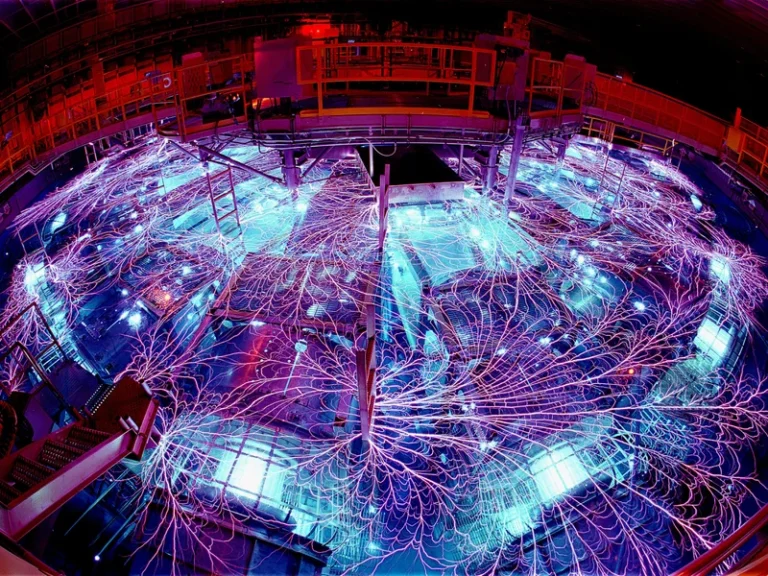
The Z machine is a monumental pulsed-power electrical device that stores vast amounts of electrical charge within massive capacitor banks, discharging currents of tens of millions of amperes into an array of microscopic tungsten wires. In a fraction of a microsecond, the wire grid vaporizes into a superheated plasma, which is violently compressed inward by intense self-generated magnetic forces (the Z-pinch effect). At maximum stagnation, the machine releases an astonishing pulse of over 300 terawatts of soft X-rays—an instantaneous power output exceeding the combined output of all electric power grids on Earth.
To model an asteroid floating freely in outer space, however, researchers had to overcome Earth’s gravitational tethering without mechanical interference. Any physical clamps or support wires would absorb recoil energy and invalidate velocity measurements. Moore’s team devised the ingenious “X-ray scissors” method: millimeter-scale targets of natural quartz and synthetic plagioclase were suspended by ultra-thin aluminum foil only a fraction of a micron thick. The initial fringe of the X-ray pulse vaporized the foil within nanoseconds, freeing the targets into true weightlessness just before the main radiation pulse struck their front surfaces.
Unlike Hollywood’s Armageddon, detonating a nuclear device hundreds of meters away avoids shattering the asteroid into a destructive swarm of fragments.
A nanosecond X-ray pulse vaporizes the target’s ultra-thin foil tether, releasing it into weightlessness before physical measurements can be disrupted.
Flash-vaporizing the mineral crust produces an explosive exhaust jet of hot gas and plasma, imparting massive momentum in the opposite direction.
Simulations demonstrate that a 1-megaton standoff detonation can safely alter the velocity of a 4-kilometer asteroid with just a few years of advance warning.
Rocket-Like Surface Ablation: Converting Minerals into Exhaust Thrust
When the dense front of high-energy X-ray photons collides with the silicate face of the target, radiation penetrates only tens of micrometers into the mineral matrix. Yet the energy deposition is so staggering that this ultra-thin surface layer flash-heats to hundreds of thousands of degrees Celsius. The solid mineral rock undergoes instantaneous phase transformation, bypassing normal melting to violently sublime into an expanding plume of superheated vapor and ionized plasma within billionths of a second.
In high-energy-density physics, this phenomenon is known as radiative ablation. The resulting ionized mineral gas expands into the vacuum of space at velocities of tens of kilometers per second. Governed by Newton’s third law of motion and the conservation of momentum, this hypervelocity gas plume functions precisely like the exhaust plume of a massive liquid-propellant rocket engine, imparting tremendous mechanical recoil pressure to the cold, solid rock behind it.
In the Sandia trials, high-speed VISAR laser interferometers tracked the miniature targets accelerating across the vacuum chamber to an astonishing recoil velocity of roughly 70 meters per second (over 250 kilometers per hour) within microseconds. Crucially, the target samples remained structurally unified and did not shatter under shock stress. The empirical velocity profiles and push-momentum measurements matched 3D radiation-hydrodynamic computer models with remarkable fidelity, providing definitive proof of the ablation mechanism.
«In the vacuum of space, a nuclear explosion behaves entirely differently than in an atmosphere: there is no air to sustain a blast wave. Instead, an intense burst of X-rays flash-heats and vaporizes a thin surface layer of the asteroid. The rapidly escaping mineral vapor generates a powerful rocket-like thrust that can push even a massive asteroid off a collision course with Earth.»
Dr. Nathan Moore, lead research physicist at Sandia National Laboratories
From Laboratory Microns to Four-Kilometer Planetary Hazards
The empirical validation achieved on the Z machine enables scientists to confidently scale predictive models to real-world cosmic threats. In 2022, NASA’s DART mission demonstrated the viability of kinetic impactors when a spacecraft slammed into the 160-meter asteroid Dimorphos, successfully altering its orbital period. However, kinetic deflection is effective almost exclusively against modest celestial bodies and necessitates a decade or two of advance travel time to intercept the target deep in space.
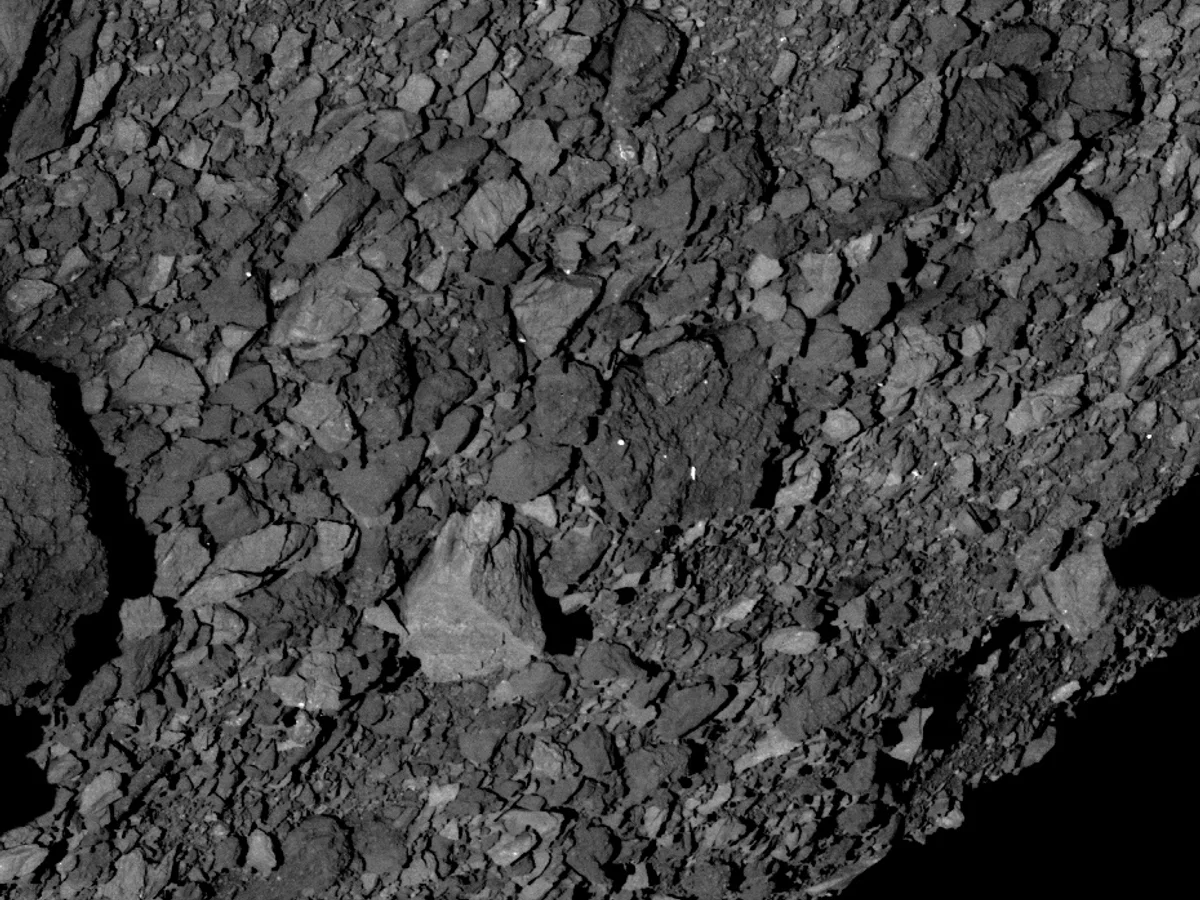
Should astronomers discover a substantial near-Earth hazard comparable to asteroid Bennu (around 500 meters wide) or a four-kilometer-wide planet-killer on an impact trajectory, the mass of any conceivable chemical kinetic probe would be virtually negligible. In such dire scenarios, nuking an asteroid through standoff nuclear ablation represents the solitary physically viable defense mechanism available to human civilization. Moreover, the reactive momentum transfer generated by vaporized rock provides far greater efficiency than a direct kinetic collision.
Sandia’s advanced supercomputing simulations demonstrate that a 1-megaton nuclear device detonated several hundred meters away from a four-kilometer asteroid would impart a velocity change (delta-V) of several centimeters per second. While modest on a human scale, this velocity increment compounds over millions of kilometers of orbital travel, causing the asteroid to arrive at the intersection point hours off schedule and safely bypass Earth by tens of thousands of kilometers.
- The Z machine at Sandia compresses wire arrays with tens of millions of amperes, generating over 300 terawatts of soft X-rays in a single pulsed blast.
- The innovative “X-ray scissors” technique solved a decades-old experimental challenge by severing foil supports nanoseconds before the primary ablation pulse.
- Target tests on quartz and plagioclase silicates demonstrated a remarkable recoil velocity of approximately 70 m/s, perfectly corroborating 3D hydrodynamic models.
- Planetary defense against medium-sized asteroids requires an orbital velocity shift of mere centimeters per second when executed several years ahead of impact.
- Nuclear standoff ablation remains the only physically viable planetary defense technology for kilometer-scale asteroids or short warning windows.
Cosmic Hazards and the Geopolitics of Planetary Defense
Despite the scientific validation of standoff nuclear deflection, fielding an operational planetary defense architecture involves complex legal, political, and operational hurdles. Deploying nuclear payloads beyond Earth’s atmosphere touches sensitive international treaties, while launching high-yield thermonuclear devices aboard heavy-lift launch vehicles carries an inherent risk of launch-stage failure. The unpredictable nature of orbital hardware and reentry dynamics was underscored recently by the Chinese Zhuque-2E rocket debris crashing in Minnesota, illustrating how space operations can unpredictably impact populated areas.
Nonetheless, confronted with an existential threat from a rogue asteroid, the international community would be compelled to establish multilateral cooperation frameworks under the United Nations. In contrast to Hollywood dramatizations, the survival of humanity will not depend on courageous astronaut pilots, but rather on the automated precision of deep-space optical sensors, autonomous laser guidance packages, and microsecond-level timing of the standoff detonation.
Dr. Nathan Moore’s breakthrough at Sandia National Laboratories marks a pivotal transition in planetary defense from theoretical speculation to rigorous experimental physics. For the first time in our species’ history, we possess empirical proof that humanity can leverage the extreme physics of nuclear energy to deflect celestial bodies, ensuring that our civilization never succumbs to the catastrophic fate that wiped out the dinosaurs 66 million years ago.