

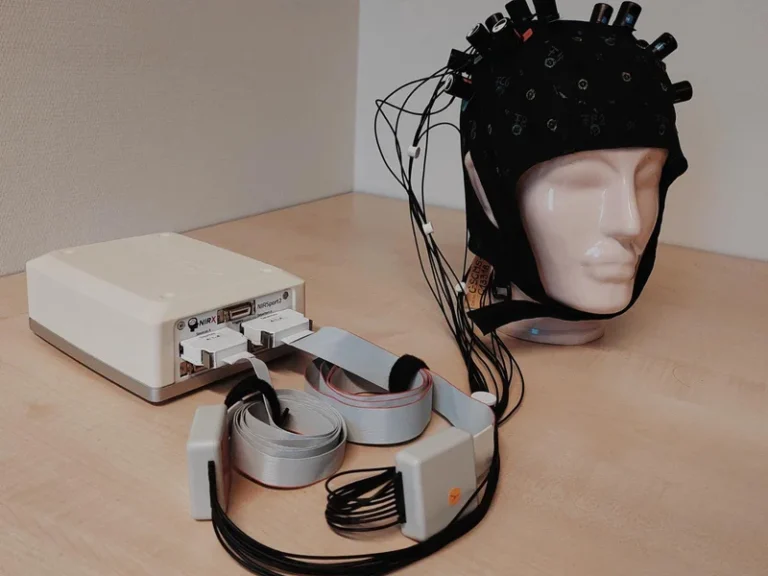

For decades, the mainstream technological narrative insisted that bridging the human intellect directly with digital silicon demanded high-risk neurosurgical craniotomies to implant microelectrode arrays into the fragile neocortex. However, a revolutionary technological convergence is overturning this dogma: non-invasive BCI optical brain scanning fNIRS surface EMG has reached a performance threshold where motor intent and internal speech are decoded with microsecond fidelity without a single surgical incision. By fusing portable time-domain functional near-infrared spectroscopy (TD-fNIRS), wrist-worn high-density surface electromyography (sEMG), and generative transformer decoders, modern neuroengineering is ushering in an era where digital computing operates as an organic extension of human thought.
The Surgical Fallacy: Why Craniotomies Will Never Become Mainstream
When venture-backed firms like Neuralink showcased paralyzed patients playing video games via intracortical microelectrodes, popular media proclaimed the dawn of mandatory surgical cyborgization. However, for widespread consumer adoption, invasive brain implants face intractable biological bottlenecks. Any surgical craniotomy introduces acute risks of intracranial hemorrhage, bacterial meningeal infection, and foreign-body glial scarring that gradually insulates electrode tips from active neurons.
Furthermore, the human brain is a dynamic organ that pulsates continuously within cerebrospinal fluid with every arterial heartbeat and respiratory cycle. This micro-motion causes chronic shear stress against rigid silicon shanks, inducing neuroinflammatory degradation over multi-year timescales. To establish brain-computer interfaces as ubiquitous and unobtrusive as wireless earbuds or smartwatches, neuroscientists had to learn how to eavesdrop on neural dynamics non-invasively through the human skull.
Over the past several years, this historic grand challenge was conquered through the harmonious integration of two complementary non-invasive physics paradigms: time-domain functional near-infrared spectroscopy (TD-fNIRS) of the cerebral cortex, and high-density surface electromyography (sEMG) of descending motor nerve trunks.
Optical Brain Scanning: The Quantum Physics of Kernel Flow
Modern non-invasive functional neuroimaging exploits a fundamental optical phenomenon known as the «biological near-infrared diagnostic window». While skin, scalp, and dense cranial bone scatter visible light, near-infrared electromagnetic radiation (wavelengths spanning 650 to 900 nanometers) penetrates biological tissue with minimal absorption.
Within the neocortex, near-infrared photons interact with hemoglobin molecules navigating the cerebral microvasculature. When a cluster of cortical neurons fires—such as when visualizing an object or formulating a sentence—local metabolic demand triggers immediate neurovascular coupling, flooding the active region with oxygenated blood. Oxygenated and deoxygenated hemoglobin possess distinctly divergent absorption spectra across specific infrared bands.
Next-generation headsets, spearheaded by platforms like Kernel Flow, implement Time-Domain fNIRS (TD-fNIRS). Specialized laser diodes project trillions of sub-nanosecond optical pulses per second into the scalp. Highly sensitive silicon photomultipliers (SiPMs) record the exact arrival timestamp of individual exiting photons. Photons that merely graze superficial scalp tissue exit almost immediately, while those penetrating 25 millimeters into active cortical gray matter experience slight temporal delays. By analyzing photon time-of-flight distributions, algorithms reconstruct high-resolution 3D hemodynamic activation maps without requiring multi-ton MRI machines.
Sub-nanosecond near-infrared laser pulses traverse the skull, measuring photon time-of-flight to map cerebral capillary hemoglobin oxygenation with high spatial fidelity.
Wrist-worn sensor bands intercept spinal motor action potentials descending to the fingers, detecting neuromuscular intent milliseconds before mechanical tendon displacement.
Transformer-based language models denoise biological signals in real time, translating silent inner speech and micro-gestures into continuous text at up to 60 words per minute.
Eliminating surgical craniotomy, infection hazards, glial scarring, and immune rejection enables frictionless, safe scalability across hundreds of millions of consumers.
Surface EMG at the Wrist: Intercepting Motor Commands Before Motion
In parallel with cranial optical imaging, a monumental breakthrough emerged in capturing peripheral neuromuscular commands. Spearheaded by Meta Reality Labs, wrist-worn surface electromyography (sEMG) arrays have radically redefined how humans interact with digital environments.
Every voluntary physical gesture initiates in the primary motor cortex as a coordinated burst of action potentials. These bioelectric signals travel down the spinal cord, traverse the radial, median, and ulnar nerves of the forearm, and terminate at the muscle fibers controlling the hand. A compact ring of dry electrical sensors encircling the wrist registers these minuscule bioelectric field potentials with microvolt sensitivity.
The most astonishing feature of wrist sEMG is its ability to decode user intent milliseconds before tendons mechanically move. Even when a user executes a microscopic finger twitch with displacement under one micron—or simply imagines a pinch without executing visible movement—machine learning decoders classify the neural firing pattern. This empowers users to type on invisible keyboards, navigate augmented reality interfaces, and manipulate virtual objects with hands resting motionless in their pockets.
«The future of consumer neurotechnology will not belong to surgical brain implants, but to elegant wearable sensors that capture optical and neuromuscular signals right from the scalp and wrist.»
Bryan Johnson, Founder of Neurotechnology Pioneer Kernel
Generative AI as the Universal Decoder of Biological Signals
Historically, non-invasive neurotechnologies struggled with unfavorable signal-to-noise ratios: bone, scalp, and ambient muscle contractions disperse and distort neural waveforms. This barrier was ultimately obliterated by modern deep learning and transformer-based artificial intelligence.
Current non-invasive BCI architectures employ bidirectional transformer models trained on extensive corpuses of synchronized bioelectrical, optical, and behavioral telemetry. Specialized diffusion algorithms automatically subtract biological artifacts—such as arterial pulse waves, ocular saccades, and jaw clenching—revealing pristine underlying cognitive signals.
In landmark trials at Stanford and UC Berkeley, AI-driven decoders translated silent inner speech—words verbalized purely within the participant’s conscious thought without vocal fold activation—into real-time text at over 60 words per minute with greater than 90% accuracy. Human cognition has finally acquired a frictionless, high-bandwidth digital output channel.
- The Kernel Flow headset integrates over 2,000 laser detector channels operating at picosecond temporal resolution.
- Wrist sEMG sensors register finger motor activations with displacement amplitudes under 1 micrometer.
- Neural networks decode the semantic intent of imagined sentences even in completely locked-in patients.
- End-to-end motor command latency in modern wearable BCI controllers has dropped to an imperceptible 15–20 milliseconds.
The Screenless Horizon and the Imperative of Neuro-Rights
The fusion of wearable cranial optical imaging and wrist-based neuromuscular sensing lays the architectural cornerstone for the post-smartphone era. Over the coming decade, physical touchscreens, mice, and mechanical keyboards will steadily yield to lightweight augmented reality smart glasses driven by ambient BCI controls.
Consumers will no longer need to retrieve handheld devices or vocalize commands in public spaces: glancing at an interface element and generating a subtle neuromuscular impulse will effortlessly send messages, control environments, and navigate spatial computing worlds. For individuals suffering from ALS, stroke-induced aphasia, or spinal trauma, these systems offer life-changing autonomy without neurosurgical intervention.
Yet, the ascendance of non-invasive BCIs introduces pressing neuroethical dilemmas. When wearable devices continuously monitor cognitive workload, emotional arousal, and silent intentionality, robust legal protections for «neuro-rights» and mental privacy become paramount. Humanity stands at the threshold of a profound civilizational leap, where the boundary between human intent and machine execution dissolves forever. Also read our related investigative feature on breakthroughs in robotic manipulation and next-generation neural interface control.