



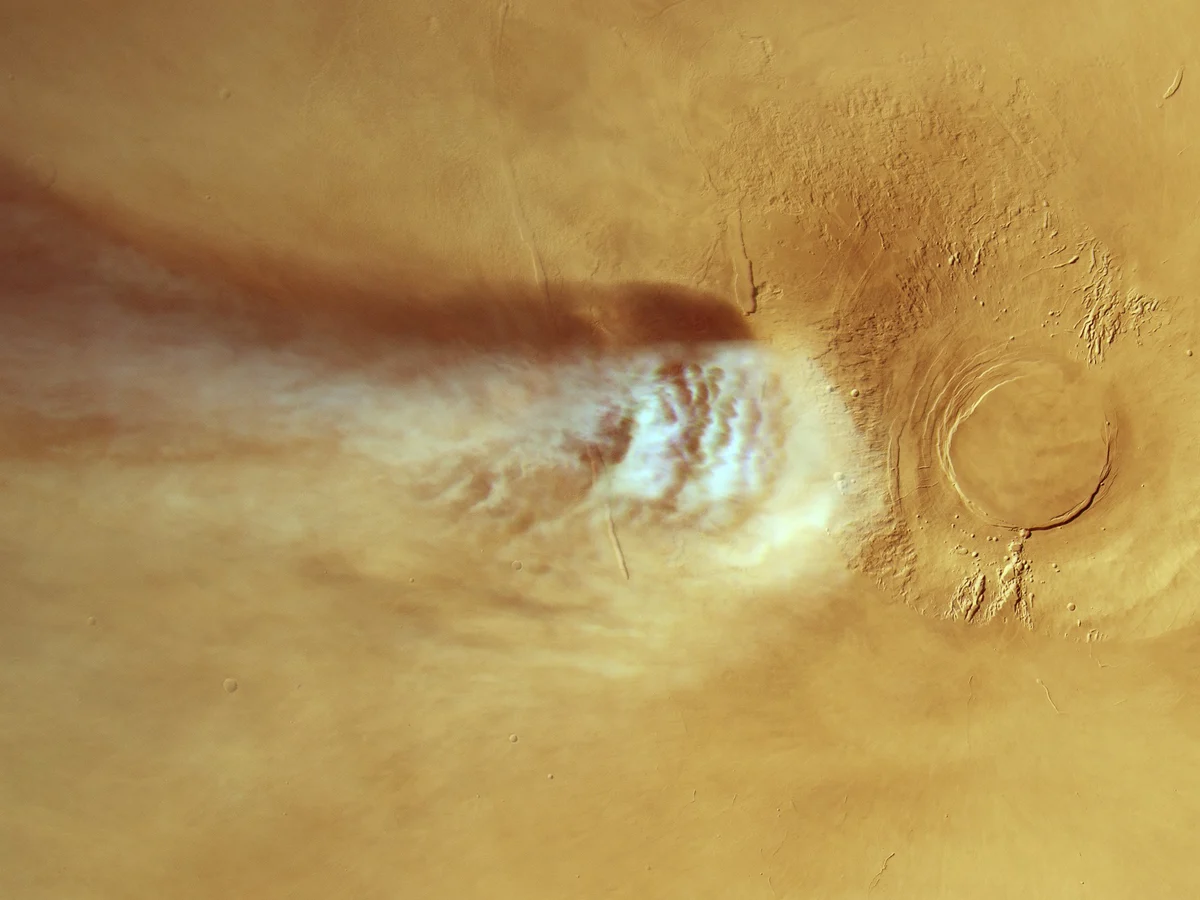
Mars harbors some of the most dynamic and dramatic meteorological phenomena in the Solar System, none more captivating than the cyclopean ice cloud that emerges each year over the extinct shield volcano Arsia Mons. Every southern spring and summer, a brilliant white plume stretching more than 1,800 kilometers (1,100 miles) across the Martian equator forms above the 20-kilometer-high volcanic caldera. Thanks to long-term monitoring by the European Space Agency’s (ESA) Mars Express orbiter and its Visual Monitoring Camera (VMC), planetary scientists have finally unraveled the full lifecycle and physical mechanisms driving this atmospheric wonder: the Arsia Mons Elongated Cloud (AMEC).
The Atmospheric Giant of Mars: AMEC Dynamics
The Arsia Mons Elongated Cloud follows a rapid and precise diurnal schedule unmatched anywhere in the Solar System. During southern summer solstice, it initiates formation before dawn, around 4:00 AM local solar time, on the volcano’s leeward western flank at altitudes between 40 and 45 kilometers above the Martian datum.
Within just two and a half hours, the cloud expands dramatically westward at speeds exceeding 600 km/h (370 mph), reaching a staggering length of 1,800 km and widths up to 150 km. By local midday, as solar radiation heats the rarefied carbon dioxide atmosphere, the ice crystals sublimate and the colossal cloud vanishes entirely—only to reappear the following morning with clockwork regularity.
- Physical Dimensions: Up to 1,800 km in length, 150 km in width, reaching peak altitudes of 45–50 km.
- Microphysics: Microscopic water-ice crystals smaller than 10 micrometers nucleated on suspended mineral dust.
- Dynamic Driver: Orographic gravity waves generated by high-velocity winds ascending the gigantic volcanic shield.
Orographic Gravity Waves: Forging Ice in a Dry Sky
When amateur astronomers first photographed the feature, some speculated it represented renewed volcanic outgassing. However, high-resolution spectroscopy from Mars Express’s OMEGA and HRSC instruments definitively proved the cloud is composed exclusively of pure water ice. Its origin is purely meteorological: an extreme case of an orographic wave cloud.
Arsia Mons rises 16 kilometers above the surrounding plains with a basal footprint spanning 430 kilometers. Prevailing eastward winds strike the massive volcanic obstacle, forcing atmospheric parcels upwards in powerful updrafts. As air expands into lower atmospheric pressure at 45 km altitude, temperatures plummet below -120°C (-184°F). Residual water vapor condenses instantly onto airborne dust particles through homogeneous and heterogeneous nucleation, creating high-altitude ice microcrystals.
Why Mars Express Succeeded Where Others Missed It
Major NASA orbiters such as Mars Reconnaissance Orbiter (MRO) and Mars Odyssey routinely missed capturing AMEC’s peak lifecycle due to their Sun-synchronous orbits, which pass overhead in the early afternoon (typically 2:00–3:00 PM local time), when the cloud has already sublimated.
Mars Express, operating in a highly elliptical non-Sun-synchronous orbit, offered a critical vantage point. Its Visual Monitoring Camera—originally designed as an engineering camera—was repurposed as a wide-field scientific instrument. Led by Dr. Agustín Sánchez-Lavega and Dr. Jorge Hernández-Bernal of the University of the Basque Country, researchers compiled hundreds of early morning observations to reconstruct AMEC’s full seasonal evolution.
«AMEC serves as an unparalleled natural laboratory for understanding Martian mesoscale dynamics. It demonstrates how efficiently high-altitude winds can transport water across planetary scales in thin air,»
Dr. Jorge Hernández-Bernal, planetary scientist with the Mars Express team
Winds hit the 20-km Arsia Mons caldera, thrusting moist air parcels into the cold upper Martian atmosphere.
The ice plume expands across one-third of Mars in 2.5 hours at propagation speeds topping 600 km/h.
Water vapor freezes into sub-10-micron crystals at temperatures below -120°C, sublimating by midday.
Reveals vertical transport pathways driving water vapor photolysis and atmospheric hydrogen escape.
Video Exploration: Mars Atmosphere and Terraforming Challenges
This animated analysis from Kurzgesagt explores the extreme atmospheric dynamics of Mars and the grand challenges of planetary modification:
Implications for Mars Paleoclimate and Future Exploration
Understanding AMEC provides crucial insights into how Mars lost its ancient water inventory. The giant volcanoes of the Tharsis ridge act as planetary atmospheric elevators. By lifting water vapor to altitudes above 45–50 kilometers, these systems expose H2O molecules to intense solar ultraviolet radiation, causing photodissociation into hydroxyl radicals and hydrogen. The lightweight hydrogen then escapes into space unchecked.
Furthermore, accurate models of high-altitude clouds and atmospheric densities are vital for future human and robotic exploration missions, ensuring safe aerobraking and entry, descent, and landing (EDL) trajectories on the Red Planet.