



While popular intuition assumes that the change of seasons is a symmetrical mirror image across the globe, astrophysics reveals a startling reality: the question of how summers differ between Earth’s hemispheres uncovers profound cosmic and thermodynamic asymmetries. From Keplerian orbital mechanics to the thermal inertia of vast southern oceans, summer on opposite ends of the globe is governed by fundamentally distinct physical rules.
The Orbital Paradox: Why Earth Is Closest to the Sun During Southern Summer
The primary driver of seasonal variations on Earth is its axial tilt of approximately 23.44 degrees relative to the orbital plane. When the Northern Hemisphere tilts toward the Sun, it enjoys summer while the south endures winter, and vice versa. However, Earth’s trajectory around the Sun is an ellipse rather than a circle, characterized by an orbital eccentricity of roughly 0.0167. Consequently, the distance between Earth and our host star fluctuates continuously throughout the year.
This elliptical geometry generates an intriguing astronomical paradox: Earth reaches perihelion — its closest approach to the Sun at approximately 147.1 million kilometers (91.4 million miles) — in early January. This coincides precisely with the height of summer in the Southern Hemisphere. Conversely, in early July, during the peak of northern summer heatwaves, Earth reaches aphelion at roughly 152.1 million kilometers (94.5 million miles). Because intensity obeys the inverse-square law, the Southern Hemisphere receives 6.8% to 7% more peak solar irradiance (insolation) during its summer than the Northern Hemisphere does during its own.
If Earth were a homogeneous terrestrial rock, this five-million-kilometer orbital swing would scorch Australia and South America while leaving Europe and North America with perpetually mild summers. Exploring global equilibrium dynamics, climate scientists observe that studies of dynamic physical and human environments demonstrate how complex feedback mechanisms prevent ecological instability across interconnected systems.
Kepler’s Second Law: Southern Summers Are Five Days Shorter
Orbital physics dictates not merely the intensity of solar radiation but also the calendar duration of the seasons. Formulated in the early 17th century, Johannes Kepler’s Second Law of Planetary Motion establishes that an imaginary line drawn from the Sun to a planet sweeps out equal areas during equal intervals of time. In practical terms: planets travel faster when they are closer to their gravitational anchor.
Hurling through perihelion in January, Earth cruises along its orbital arc at approximately 30.29 km/s (67,750 mph), whereas during July aphelion, its speed drops to 29.29 km/s (65,520 mph). Because of this gravitational acceleration, Earth sweeps through the Southern Hemisphere’s summer segment far more rapidly. Astronomically defined from the December solstice to the March equinox, summer in the Southern Hemisphere lasts approximately 89.0 days.
In stark contrast, Earth lumbers through its aphelion arc during northern summer, stretching the season from the June solstice to the September equinox to roughly 93.6 days. Northern Hemisphere residents thus enjoy an extra 4.6 to 5 full days — roughly 110 bonus hours of warm solar daylight every single year — entirely courtesy of Keplerian orbital mechanics.
«The hemispheric difference in summer weather is a magnificent thermodynamic machine. Without the colossal thermal buffer of the Southern Ocean, the temperature swings between Earth’s seasons would exceed all survivable biological thresholds.»
Dr. Gavin Schmidt, Director of the NASA Goddard Institute for Space Studies (GISS)
The Oceanic Heat Sink: Why the Southern Hemisphere Does Not Boil
If the Southern Hemisphere receives 7% more solar radiation at perihelion, why is southern summer not overwhelmingly hotter than northern summer? The planetary safeguard lies in the stark contrast of land-to-sea distribution. The Northern Hemisphere is 39% land and 61% water, whereas the Southern Hemisphere is overwhelmingly marine: 81% ocean and merely 19% landmass.
Liquid water boasts an extraordinary specific heat capacity of roughly 4,184 J/(kg·K) — four to five times higher than typical rock, granite, or topsoil (approx. 800–1,000 J/(kg·K)). The immense expanse of the Southern Ocean absorbs the surplus solar radiation of perihelion without experiencing sharp spikes in atmospheric temperature. The ocean functions as a giant planetary heat sink, buffering summer extremes and gradually releasing stored heat during winter.
In the Northern Hemisphere, massive continental landmasses in Eurasia and North America heat up rapidly under sustained summer sunlight, breeding scorching continental heat domes. These natural thermal adaptations echo the resilience found in living ecosystems, where biological micro-structures adapt to environmental swings across equatorial and temperate habitats.
Earth swings 5 million km closer to the Sun in January, delivering 6.8–7% more solar irradiance during southern summer than northern summer in aphelion.
Kepler’s Second Law accelerates Earth near perihelion: southern summer lasts only 89 days, compared to 93.6 days in the Northern Hemisphere.
Water’s immense specific heat capacity allows the 81% marine Southern Hemisphere to absorb perihelion energy without runaway atmospheric heat.
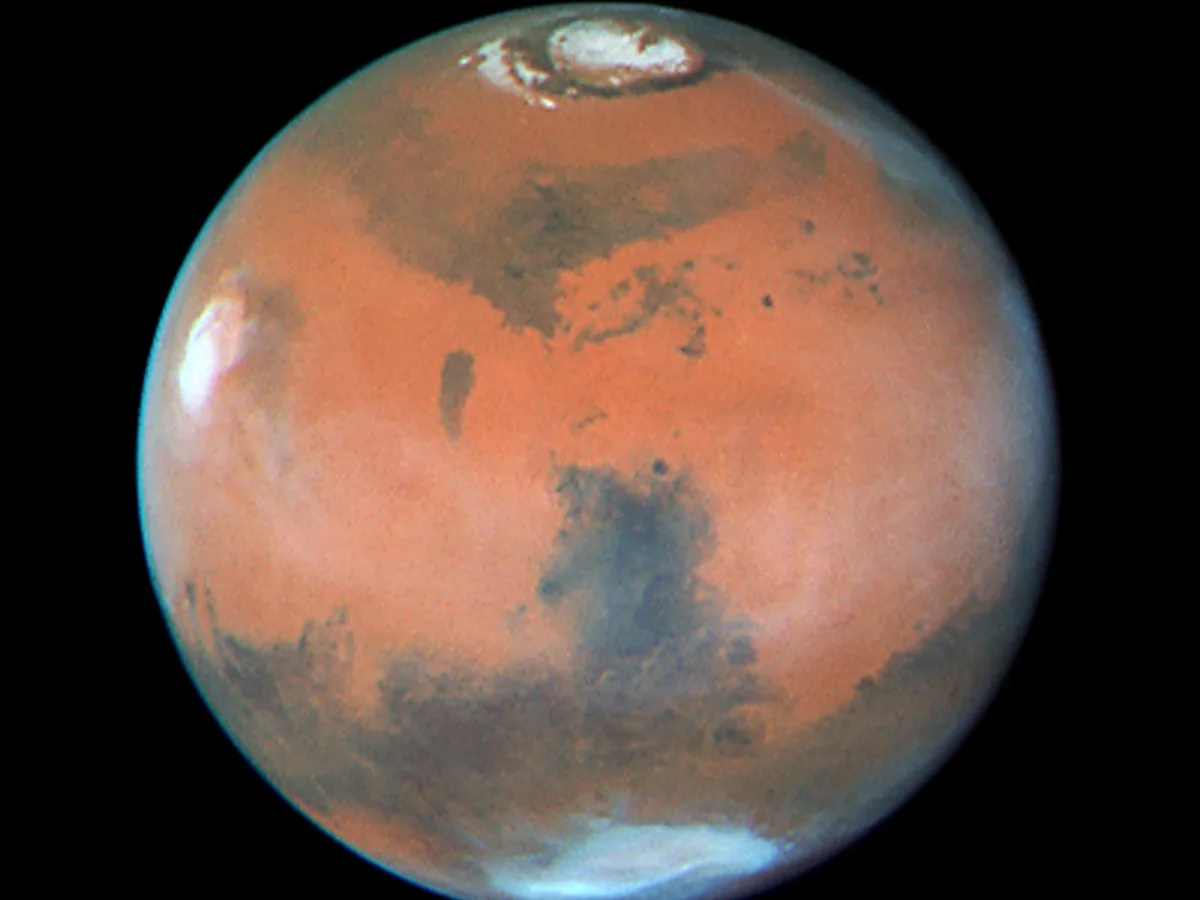
Mars’s 0.0934 eccentricity and lack of oceans cause southern summer to unleash violent global dust storms that blanket the entire planet.
Martian Dichotomy: An Extreme Cosmic Comparison
Earth’s orbital seasonality is relatively benign when viewed alongside neighboring terrestrial planets. Mars provides the definitive textbook example of extreme hemispheric dichotomy. With an orbital eccentricity of e ≈ 0.0934 — nearly six times greater than Earth’s — the Martian distance to the Sun varies by over 42 million kilometers throughout its orbit.
Data transmitted by NASA’s Mars Reconnaissance Orbiter and rovers Curiosity and Perseverance reveal that southern Martian summer aligns precisely with perihelion, causing insolation to surge by more than 40%. Because Mars lacks buffering oceans, this sudden thermal influx generates catastrophic atmospheric convective plumes. Surface dust is lofted into the stratosphere, frequently igniting planet-encircling global dust storms that black out the Martian sky for months at a time.
Conversely, northern Martian summer coincides with aphelion. It is noticeably prolonged, comparatively temperate, and characterized by transparent skies with thin water-ice cirrus clouds. Planetary scientists study these Martian cycles to benchmark general circulation models under clean, ocean-free thermodynamic regimes.
- Solar Distance at Summer Peak: Southern Hemisphere — 147.1 million km (perihelion) | Northern Hemisphere — 152.1 million km (aphelion).
- Astronomical Duration: Southern Summer — ~89.0 days | Northern Summer — ~93.6 days (Northern summer is ~110 hours longer).
- Surface Water Distribution: Southern Hemisphere is 81% water | Northern Hemisphere is 61% water (39% land).
- Orbital Velocity: January perihelion — 30.29 km/s | July aphelion — 29.29 km/s.
- Peak Solar Irradiance: Southern Hemisphere receives ~7% more insolation at peak summer due to orbital proximity.
Milankovitch Cycles and the Shifting Future of Earth’s Seasons
The current seasonal alignment is by no means permanent. Serbian geophysicist Milutin Milankovitch demonstrated that gravitational tugs from Jupiter and the Moon induce cyclical variations in three key orbital parameters: orbital eccentricity (100,000-year cycle), obliquity or axial tilt (41,000-year cycle), and axial precession (approx. 23,000-year cycle).
Due to axial precession, Earth’s rotational axis wobbles like a slowing gyroscope. In roughly 10,000 to 11,000 years, the alignment will reverse: perihelion will coincide with summer in the Northern Hemisphere. During that future epoch, northern summers will become short, intensely hot, and volatile, while winters will lengthen, accelerating glacial melting and reshuffling Atlantic meridional overturning circulation.
Understanding how summers differ between Earth’s hemispheres is therefore far more than an academic puzzle in our warming world. As greenhouse gases warm oceans and alter planetary albedo, humanity is modifying the delicate thermodynamic balancing act that has preserved climate stability across hundreds of millennia.