

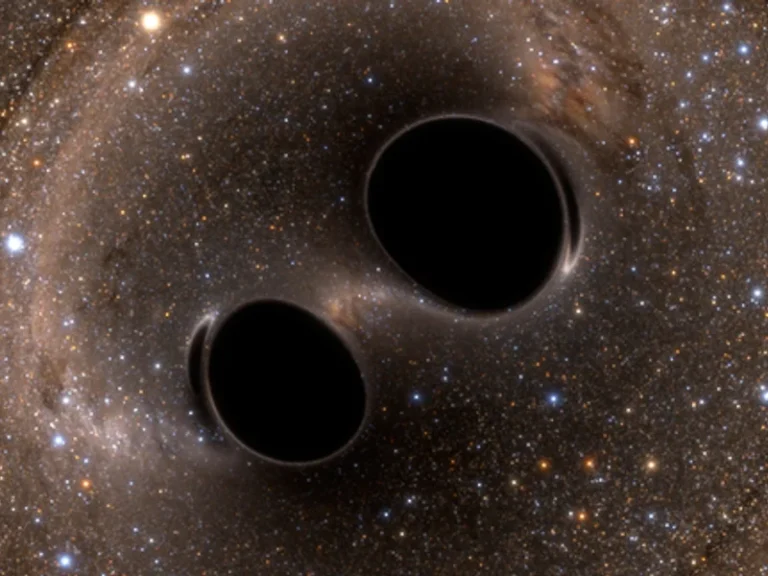

On January 14, 2025, the ultra-sensitive laser interferometers of the international LIGO-Virgo-KAGRA collaboration captured the most luminous, acoustically pristine gravitational-wave signal ever observed, cataloged as GW250114. The cataclysmic coalescence of two spinning stellar-mass black holes 1.3 billion light-years distant vibrated the very metric of spacetime with an unprecedented signal-to-noise ratio approaching 80. This extraordinary fidelity has allowed theoretical astrophysicists to empirically confirm gravitational waves hawking area theorem—formulated by Stephen Hawking in 1971—with a definitive statistical significance exceeding 99.999%.
A Thunderous Cosmic Chord: Detecting the GW250114 Signal
In the early hours of January 14, 2025, the twin advanced laser interferometers of the LIGO observatory in Hanford, Washington, and Livingston, Louisiana, operating in tandem with Virgo and KAGRA during the culmination of the O4b observing run, recorded an overwhelming gravitational oscillation. Automated coherent wave-burst pipelines instantly flagged an event of singular significance, designated GW250114.
Whereas standard gravitational-wave discoveries present subtle waveforms buried near the detector noise floor, GW250114 shattered all previous benchmarks with an unprecedented Signal-to-Noise Ratio (SNR) of approximately 80. For context, the Nobel Prize-winning detection GW150914 recorded an SNR of 24. GW250114 stands as the cleanest, loudest, and most information-rich gravitational chirp ever registered by human science, delivering an unblemished acoustic snapshot of extreme gravitational dynamics.
The astrophysical engine behind this monumental release was the inspiral and merger of two stellar-mass black holes located approximately 1.3 billion light-years from Earth. The progenitor bodies possessed remarkably symmetrical masses of roughly 34 and 32 times the mass of the Sun. In their final fractions of a second, the two horizons whipped around their common center of gravity hundreds of times per second, accelerating to relativistic fractions of the speed of light before coalescing.

Stephen Hawking’s 1971 Area Theorem: The Second Law of Black Hole Mechanics
In 1971, British theoretical physicist Stephen Hawking formulated a landmark mathematical theorem derived directly from Albert Einstein’s field equations of General Relativity. Hawking proved that, under the assumption of positive energy conditions, the total surface area of a black hole’s event horizon can never decrease over time. Even when two black holes violently merge, radiating copious amounts of energy and angular momentum across the cosmos as gravitational waves, the final horizon area must satisfy the inequality: A_final >= A_1 + A_2.
Hawking drew a revolutionary parallel between the non-decreasing surface area of an event horizon and the non-decreasing entropy of an isolated thermodynamic system governed by the Second Law of Thermodynamics. This geometric insight soon merged with the pioneering ideas of Jacob Bekenstein, culminating in the Bekenstein-Hawking entropy formula and birthing modern black hole thermodynamics, which establishes that horizon area is directly proportional to quantum entanglement entropy.
Nevertheless, for over fifty years, Hawking’s area theorem remained an unverified theoretical postulate. No electromagnetic telescope could resolve the event horizons of stellar-mass black holes at cosmological distances with the sub-millisecond precision required to test the inequality. The definitive test had to await the advent of high-precision gravitational-wave spectroscopy.
GW250114 achieved the highest signal-to-noise ratio in gravitational astronomy, almost tripling the spectral clarity of the historic GW150914 discovery chirp.
The binary merger 1.3 billion light-years away combined black holes of ~34 and ~32 solar masses into a rapidly spinning Kerr black hole remnant of 63 solar masses.
The combined pre-merger horizon surface measured ~240,000 sq km, expanding to ~400,000 sq km post-collision, verifying the inequality A_final >= A_1 + A_2.
Isolating the fundamental quasinormal mode alongside its primary overtone experimentally confirmed the Kerr metric and the celebrated no-hair theorem.
Mapping Horizon Geometry: From the United Kingdom to Sweden
Thanks to the pristine fidelity of the GW250114 data stream, astrophysicists were able to dissect the gravitational waveform into its three canonical relativistic stages: inspiral, merger, and ringdown, with millisecond-level precision.
From the inspiral chirp phase, researchers determined the individual masses and spin vectors of the two progenitor black holes prior to collision. Translating these dynamical properties into geometric boundaries revealed that the initial combined horizon area of the two separate black holes was approximately 240,000 square kilometers—a geographic area roughly equivalent to the landmass of the United Kingdom.
The team subsequently analyzed the properties of the post-merger remnant. During the violent collision, approximately three solar masses worth of pure mass-energy was converted into gravitational radiation and blasted into space at the speed of light. The remaining single black hole retained a mass of 63 solar masses and possessed rapid rotational spin. Crucially, the surface area of this new Kerr black hole expanded to approximately 400,000 square kilometers—comparable in scale to Sweden. The horizon area surged by approximately 67%, providing an empirical vindication of Hawking’s theorem.
«GW250114 was an extraordinary celestial gift. Owing to its astonishing acoustic clarity, we were able to isolate the post-merger ringdown overtones and demonstrate with unprecedented mathematical rigor that the remnant event horizon exceeds the combined areas of its progenitors. Stephen Hawking’s half-century-old theoretical triumph has passed its most stringent empirical trial.»
Dr. Maximiliano Isi, Gravitational-Wave Astrophysicist at the Flatiron Institute and LIGO Collaboration
Ringdown Spectroscopy and the Vindication of the Kerr Metric
In 2021, a research group spearheaded by astrophysicist Dr. Maximiliano Isi conducted an initial test of the area law using archival data from GW150914. While encouraging, that early analysis achieved a statistical confidence level of approximately 95% (2-sigma), leaving room for alternative interpretations. GW250114 dramatically elevated the empirical threshold, establishing Hawking’s theorem at a staggering 99.999% confidence level, comfortably crossing the revered 5-sigma gold standard of experimental physics.
Equally profound was the triumphant realization of black hole spectroscopy during the ringdown phase. Much like a struck bell resonates at discrete acoustic overtones that reveal its alloy composition and geometric shape, a newly forged black hole vibrates through characteristic gravitational quasinormal modes as its perturbed horizon settles into equilibrium. In GW250114, researchers securely isolated the fundamental quadrupole mode alongside its first quasinormal overtone.
The measured oscillation frequencies and exponential damping rates matched the theoretical predictions derived from Roy Kerr’s 1963 metric with exquisite accuracy. This agreement confirmed the celebrated «no-hair theorem», proving that an astrophysical black hole is an exquisitely simple macroscopic object characterized solely by mass and spin, devoid of additional multipole complexities.
Bridging General Relativity and Quantum Information Theory
The empirical verification of the area theorem in GW250114 carries monumental implications extending into high-energy quantum physics. In the holographic framework of quantum gravity, a black hole’s event horizon functions as a holographic screen encoding all interior quantum degrees of freedom. The relentless growth of horizon area guarantees that quantum information remains conserved and unitary evolution is preserved at the cosmic scale.
Furthermore, the data decisively constrains a wide array of modified gravity theories. Hypotheses postulating exotic compact objects without event horizons (such as boson stars or gravastars) or theories predicting horizon shrinkage in non-linear curvature regimes are definitively ruled out by the observed quasinormal spectrum.
Astrophysics has entered an era where the deepest theoretical conjectures of the twentieth century can be rigorously interrogated against celestial phenomena. As modern research reveals in extreme relativistic phenomena in astrophysical observations, the marriage of observational precision and theoretical audacity continues to unlock the fundamental mechanics governing our universe. Also read our related investigative feature on extreme relativistic phenomena in astrophysical observations.