

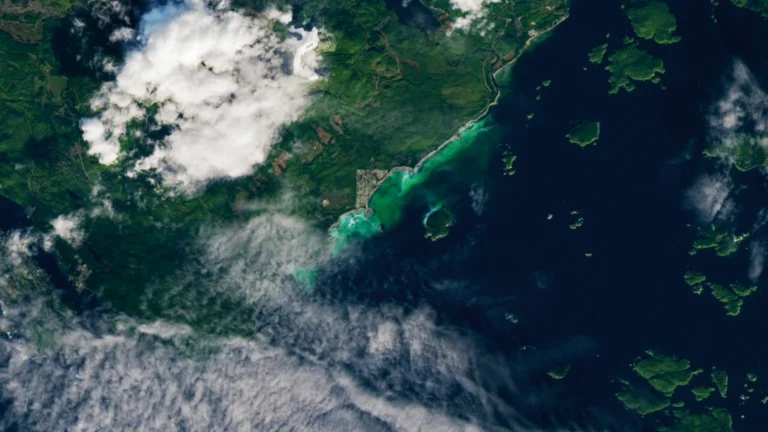

Earth-observing satellites operated by NASA captured an extraordinary ecological spectacle along the eastern coastline of Vancouver Island, British Columbia: spawning Pacific herring released such an astronomical volume of milt that coastal ocean waters shifted into brilliant milky-turquoise swirls vividly visible from Earth orbit.
Orbital Perspectives on Massive Spawning: Ocean Waters Shifting Color Across Hundreds of Miles
The Operational Land Imager (OLI) aboard the Landsat 8 satellite, co-managed by NASA and the U.S. Geological Survey, recently beamed down breathtaking orbital photography of the Strait of Georgia separating Vancouver Island from mainland British Columbia. The marine channels, normally characterized by deep navy and slate-blue hues, were dramatically transformed into swirling marble bands of luminous turquoise and chalky jade meandering along dozens of miles of shoreline.
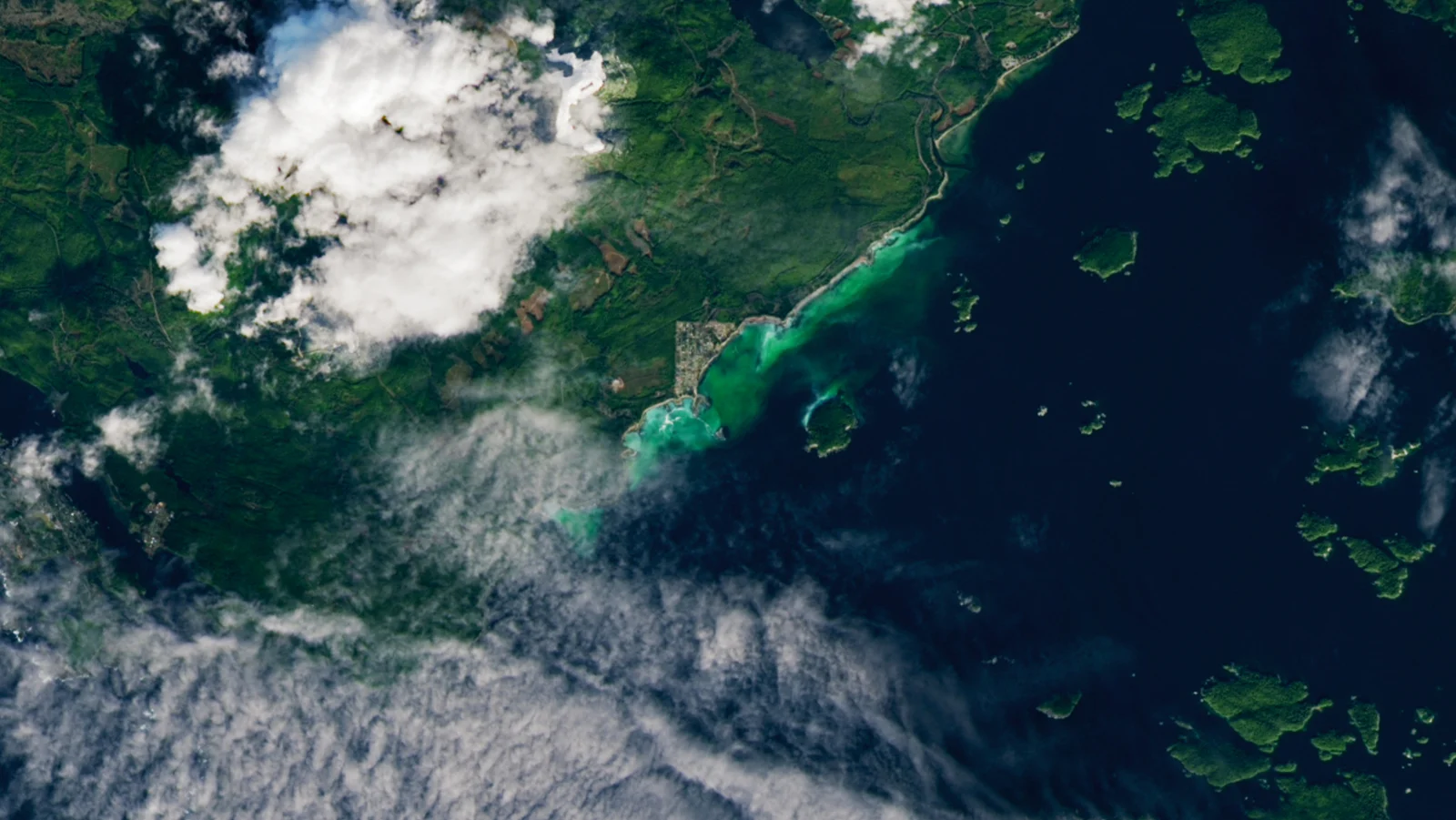
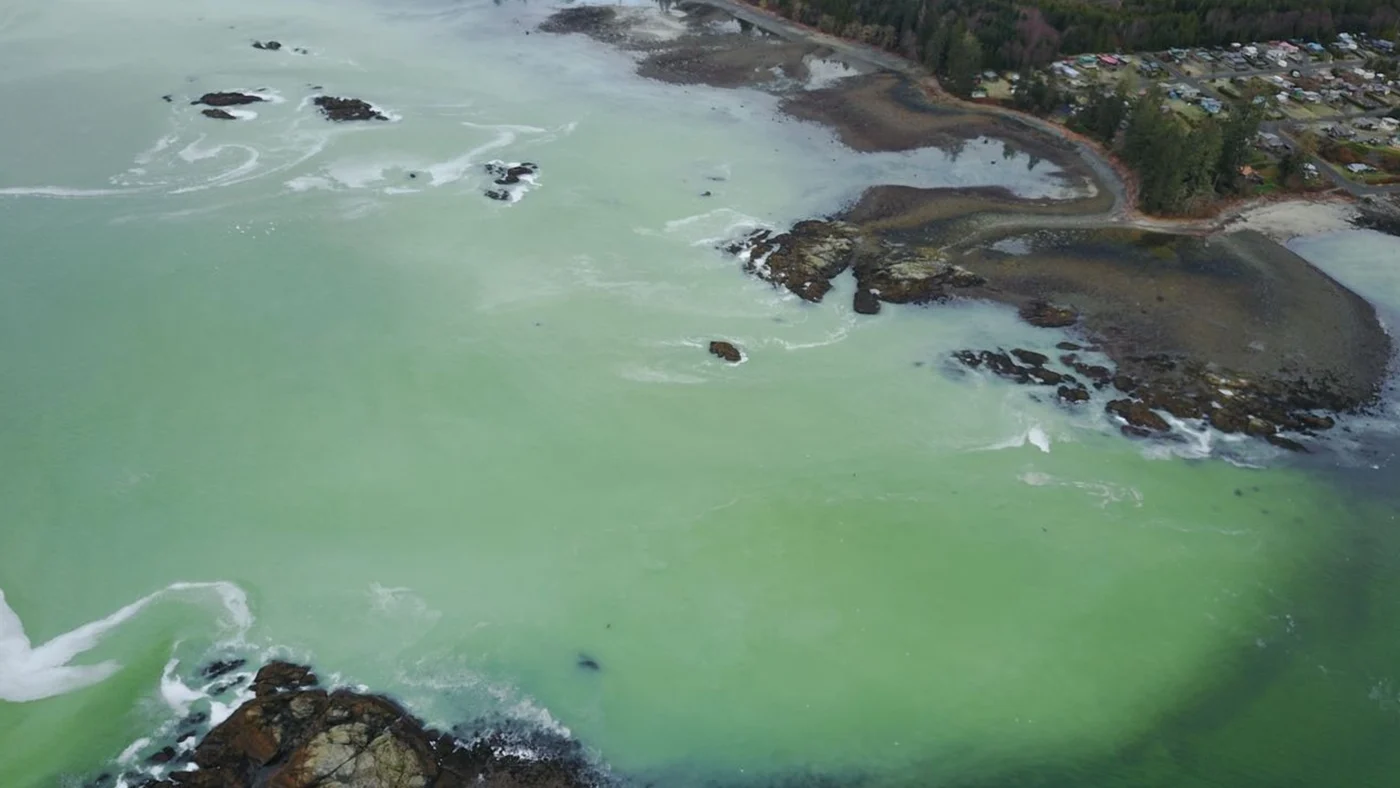
The biological driver behind this staggering oceanographic phenomenon is milt—the sperm fluid discharged by male Pacific herring (Clupea pallasii). Each year in late winter and early spring, millions of mature herring congregate in protected coastal embayments and shallow fjords, executing one of the most concentrated and synchronized mass spawning events in the animal kingdom.
Female herring deposit billions of tiny, adhesive eggs onto submerged kelp beds, rock surfaces, and eelgrass meadows (Zostera marina). Simultaneously, vast schools of male fish release dense plumes of milt into the water column. The intense concentration of microscopic proteins and cellular structures scatters incoming solar radiation in the same physical manner as glacial flour, creating the characteristic milky-aquamarine hue detected hundreds of miles above the planet.
Ecological Bonanza: The Great Convergence of Marine Predators in British Columbia
The sudden milky discoloration of coastal waters acts as an unmistakable biological beacon across the Northeast Pacific food web. Within hours of the spawn’s commencement, quiet coastal channels transform into a roaring theater of apex predator foraging, widely celebrated by marine biologists as the “great ocean feast.”
Tens of thousands of seabirds dive relentlessly from above: Bald Eagles (Haliaeetus leucocephalus), Bonaparte’s gulls, common murres, and cormorants gather in staggering densities. From the depths, megafauna assemble: massive Steller sea lions (Eumetopias jubatus), California sea lions, harbor seals, orcas, and humpback whales surge through the schools. Humpbacks deploy sophisticated bubble-net curtains to corral disoriented fish into dense bait balls before lunging through the surface.
Herring roe represents an extraordinary energetic goldmine, packed with essential omega-3 fatty acids, lipids, and bioavailable protein. Even terrestrial apex carnivores—including British Columbia’s famed coastal sea wolves and grizzly bears—patrol the intertidal zone during low tide, gorging on thick carpets of nutrient-rich roe deposited across exposed seaweed. Such synchronized planetary pulses echo phenomena like the millions of baby red crabs returning from the sea on Christmas Island.
| Trophic Level / Species | Taxonomic Group | Ecological Role During Spawn | Nutritional Dependency on Herring |
|---|---|---|---|
| Pacific Herring (Clupea pallasii) | Actinopterygii / Clupeidae | Primary forage biomass producer; sheds trillions of adhesive eggs and milt plumes | Feeds on pelagic copepods, euphausiids, and larval crustaceans |
| Steller Sea Lion (Eumetopias jubatus) | Mammalia / Otariidae | Aggressive shallow-water pack hunter targeting dense pre-spawn shoals | Critical calorie intake prior to summer territorial breeding rookeries |
| Bald Eagle (Haliaeetus leucocephalus) | Aves / Accipitridae | Surface snatching of stunned fish; thousands congregate along shoreline roosts | Fuels early spring egg development and early fledgling brooding energy |
| Coastal Gray Wolf & Grizzly Bear | Mammalia / Canidae & Ursidae | Intertidal foraging on beached roe and stranded post-spawn fish at low tide | Transfers marine-derived nitrogen and phosphorus into old-growth rainforests |
«The herring spawn is not simply the reproductive cycle of a single fish species; it is the master heartbeat that energizes the entire Northeast Pacific ecosystem. When these waters turn milky jade, life converges from thousands of miles away.»
Dr. Brian Hunt, Associate Professor of Marine Ecology at the University of British Columbia
Indigenous Stewardship: Thousands of Years of Sustainable Spawn-on-Bough Harvest
For coastal First Nations across British Columbia—including the Kwakwaka’wakw, Nuu-chah-nulth, and Haida nations—the arrival of the spring herring spawn has signified rebirth, prosperity, and liberation from harsh winter scarcity for over five millennia. Indigenous societies developed sophisticated, non-destructive harvesting methods known widely as “roe-on-kelp” or “roe-on-boughs.”
Rather than netting or killing adult spawning fish, harvesters submerged freshly cut western hemlock (Tsuga heterophylla) boughs or suspended giant kelp fronds into traditional spawning embayments. Herring instinctively coated the boughs with thick, crystalline layers of fertilized roe. Once spawning concluded, the egg-laden branches were harvested for food and trade, leaving the parent herring completely unharmed to return to offshore feeding grounds and spawn again in future seasons.
Modern ethnoecological research demonstrates that this indigenous harvest model maintained robust, resilient herring stocks for thousands of years prior to the advent of industrialized European reduction fisheries, offering profound lessons for 21st-century marine conservation.
Dense suspended sperm proteins scatter shortwave solar light, transforming the Strait of Georgia into a luminous turquoise tapestry visible from space.
Pacific herring convert planktonic ocean energy into high-lipid biomass, sustaining dozens of seabird, seal, whale, and predator populations.
First Nations’ traditional spawn-on-bough techniques collect nutrient-rich roe without sacrificing the reproductive vitality of adult fish stocks.
Satellite imagery and acoustic biomass surveys help marine biologists track how marine heatwaves impact Pacific Northwest forage fish stocks.
Keystone Ecology: Why Fluctuating Herring Biomass Alarms Marine Scientists
Despite the majestic appearance of satellite imagery, marine biologists from Fisheries and Oceans Canada (DFO) caution that widespread milt plumes can project a false sense of ecological abundance. In reality, total Pacific herring biomass has experienced severe historic declines and sharp volatility driven by commercial overfishing and climate-induced marine heatwaves in the Gulf of Alaska.
Herring operate as quintessential keystone forage fish, transferring critical energy from microscopic zooplankton (copepods and euphausiids) up to commercial salmon stocks, Pacific halibut, seabirds, and endangered marine mammals. The depletion of localized herring populations directly impairs the survival of Chinook and Coho salmon, which in turn jeopardizes the critically endangered Southern Resident Killer Whale population.
Conservation scientists advocate leveraging high-resolution satellite remote sensing not merely for aesthetic celebration, but as an indispensable biophysical monitoring tool to quantify spawning reach and enforce timely commercial fishing closures across sensitive coastal inlets.
- The turquoise milt plume off Vancouver Island regularly spans over 150 square kilometers during peak spawning days.
- A single mature female herring produces up to 40,000 adhesive eggs in one synchronized spawning event.
- The spring spawn triggers North America’s highest seasonal aggregation of Bald Eagles and marine mammals.
- NASA’s Landsat and Sentinel-2 satellite data are actively utilized by Canadian researchers to map critical spawning habitats.