


Chronological age, defined conventionally by the number of times the Earth has orbited the Sun since one’s birth, is a notoriously crude and superficial metric of an organism’s physiological resilience. Two individuals celebrating their fiftieth birthday may inhabit radically divergent biological realities: one displays the pristine cardiovascular and metabolic profile of a thirty-year-old athlete, while the other exhibits tissue degradation characteristic of late-stage senescence. Today, epigenetic clocks biological age dna methylation rejuvenation have elevated aging from a mysterious biological fate into an exquisitely quantifiable mathematical science, enabling clinicians to measure true physiological decay and rigorously validate longevity therapies.
The Code Above the Genome: The Biophysics of DNA Methylation
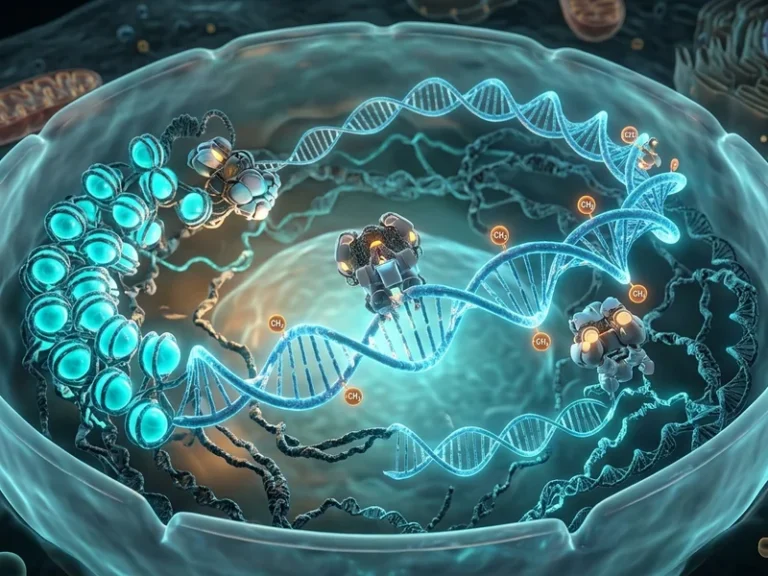
Virtually every somatic cell in the human body harbors an identical library of three billion base pairs. Yet a cortical neuron, a cardiac myocyte, and a pancreatic beta-cell execute vastly distinct physiological repertoires. This specialized orchestrator is epigenetics—a sophisticated array of chemical tags that dictates transcriptional access without altering the underlying genetic sequence.
The premier mechanism of epigenetic regulation is DNA methylation, wherein DNA methyltransferase enzymes attach a methyl moiety (-CH3) to the fifth carbon of cytosine bases preceding guanines (CpG sites). Dense clusters of methylated CpG dinucleotides within gene promoter regions structurally impede transcription factors, locking target genes in a dormant state.
Throughout adulthood, the epigenome undergoes systemic degradation known as epigenetic drift: crucial tumor suppressor genes undergo hypermethylation and are silenced, while ancient retrotransposons lose methylation, precipitating genomic instability and chronic sterile inflammation (inflammaging).
The thermodynamic stability of covalent carbon-methyl bonds renders DNA methylation an enduring biological memory. Unlike ephemeral RNA transcripts, 5-methylcytosine marks replicate faithfully across cell divisions mediated by maintenance methyltransferase DNMT1.
With advanced age, however, enzymatic fidelity degrades, precipitating stochastic epigenetic drift. Promoter regions of tumor suppressor genes suffer aberrant hypermethylation while heterochromatic transposons undergo derepression, fueling genomic instability.
The Horvath Revolution: Constructing the First Pan-Tissue Bioclock
In 2013, UCLA biostatistician Steve Horvath published a historic breakthrough in Genome Biology. Analyzing Illumina DNA methylation arrays from more than 8,000 biological samples spanning 51 healthy and malignant human tissues, Horvath deployed elastic-net penalized regression algorithms.
The computational model distilled an exact ensemble of 353 conserved CpG sites whose collective methylation levels correlate with chronological age with unprecedented fidelity across the human lifespan from embryonic development to centenarians. The algorithm exhibited a median absolute error of less than 3.6 years across virtually every somatic tissue type.
For the first time in medical history, scientists possessed a universal, pan-tissue molecular clock that operates seamlessly in blood, internal organs, and skin cells alike.
Steve Horvath’s algorithmic breakthrough leveraged elastic net regression to isolate 353 invariant CpG sites from tens of thousands of candidates across the Illumina Infinium platform. This ensemble maintains linear chronological correlation across 51 diverse human tissue types.
Crucially, the clock ticks in non-senescent stem cells and long-lived species, revealing that epigenetic ticking represents an innate, evolutionary developmental program embedded within mammalian biology.
The pioneering pan-tissue molecular clock predicts biological age across 51 human tissues within 3.6 years.
Second-generation clock calibrated against plasma mortality biomarkers accurately predicts cardiovascular and cancer risks.
Quantifies the instantaneous pace of physiological aging in real time for every chronological calendar year.
Transient expression of transcription factors resets cellular epigenetic methylation back to embryonic youth.
The Generational Evolution: From Horvath and PhenoAge to GrimAge and DunedinPACE
While first-generation clocks tracked chronological age with precision, translational gerontology required biomarkers capable of prognosticating physiological healthspan, disease susceptibility, and residual mortality risk.
This inspired second-generation clocks, most prominently DNAm PhenoAge and DNAm GrimAge. Formulated by Horvath’s team in 2019, GrimAge incorporates CpG surrogates trained directly against circulating plasma proteins linked to mortality, such as growth differentiation factor 15 (GDF15) and plasminogen activator inhibitor 1 (PAI-1). GrimAge has emerged as the premier predictor of all-cause mortality, cardiovascular events, and oncogenesis.
More recently, the third-generation DunedinPACE algorithm, developed by researchers at Duke and Columbia University tracking the longitudinal Dunedin birth cohort, operates as a dynamic speedometer: measuring the instantaneous rate of physiological decline per calendar year.
The evolution toward GrimAge shifted focus from chronological reckoning to functional mortality prediction. Trained on DNAm-surrogates for pathological plasma proteins and pack-years of smoking, GrimAge demonstrates clinical hazard ratios for cardiovascular collapse and dementia.
Complementing this, the DunedinPACE algorithm calculates the instantaneous pace of physiological aging, operating as a biological speedometer that measures physiological decay per calendar year.
«Epigenetic clocks do not merely record cellular wear and tear; they read the underlying mathematical program of aging itself. If we can manipulate this epigenetic code, biological age can be systematically reversed.»
Steve Horvath, Professor of Biostatistics at UCLA and Principal Investigator at Altos Labs
Validating Rejuvenation: From Yamanaka Factors to Clinical Trials
The ultimate promise of epigenetic clocks lies in serving as surrogate clinical endpoints for anti-aging therapeutics, bypassing multi-decade clinical trial horizons.
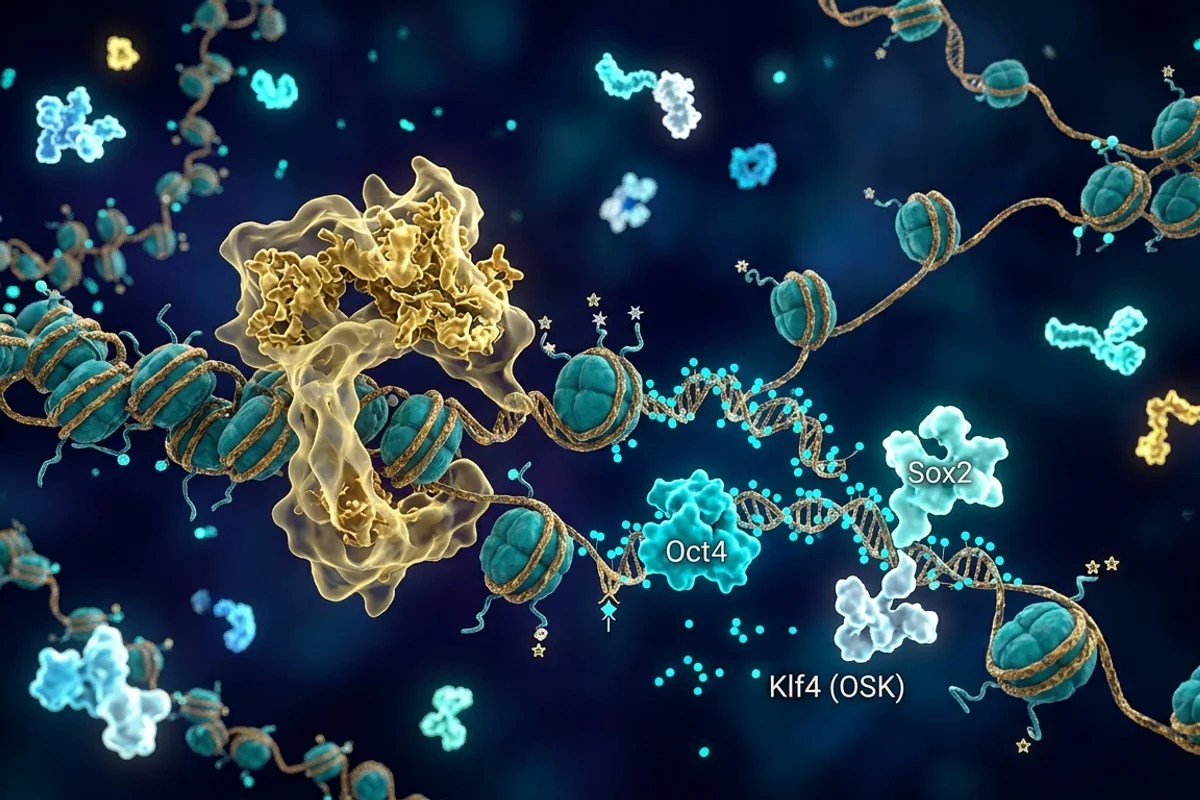
Remarkable advances in partial cellular reprogramming demonstrate this power. Following the groundbreaking discovery of Yamanaka transcription factors (Oct4, Sox2, Klf4), transient in vivo expression in senescent tissues resets epigenetic methylation patterns to an embryonic state without inducing teratomas or loss of cell identity.
In human clinical investigations—notably Gregory Faehy’s TRIIM and TRIIM-X trials—a regime of recombinant human growth hormone, metformin, and DHEA successfully regenerated functional thymic tissue and reversed GrimAge biological age by an average of 2.5 years after twelve months of treatment.
Partial cellular reprogramming via Yamanaka factors (Oct4, Sox2, Klf4) resets pathological DNA methylation architectures while preserving specialized somatic identity. Cyclic transient induction restores mitochondrial respiration and reverses tissue decline.
Human clinical trials, including the TRIIM trial combining rhGH, metformin, and DHEA, achieved sustained reversal of epigenetic aging by an average of 2.5 years, proving that biological aging is plastic and therapeutically malleable.
- 2013: Steve Horvath constructs the universal pan-tissue DNA methylation clock.
- 2018: Morgan Levine develops DNAm PhenoAge integrating clinical chemistry panels.
- 2019: Introduction of GrimAge, the benchmark for all-cause mortality prediction.
- 2022-2026: Rollout of DunedinPACE for precision validation of longevity therapeutics.
The Multi-Omic Frontier and Predictive Geroprotection
The cutting edge of longevity medicine is advancing toward multi-omic aging matrices that integrate DNA methylation with proteomic profiles, telomere attrition rates, metabolomic mitochondrial readouts, and microbiome signatures.
As next-generation sequencing and artificial intelligence platforms become standard in diagnostic care, routine quantification of biological age will empower targeted prophylactic interventions long before clinical pathologies manifest.
Aging is no longer perceived as an immutable metaphysical reality—it has become a quantifiable, manageable, and fundamentally reversible biological process.
The frontier of predictive geroprotection unites multi-tissue methylation clocks with aptamer-based proteomics (SomaScan), metabolomics, and single-cell transcriptomics.
Continuous biological age monitoring will anchor preventive medicine, enabling personalized geroprotective interventions decades before clinical symptoms emerge. Also read our related investigative feature on fundamental evolutionary principles of cell biology and tissue coevolution.