

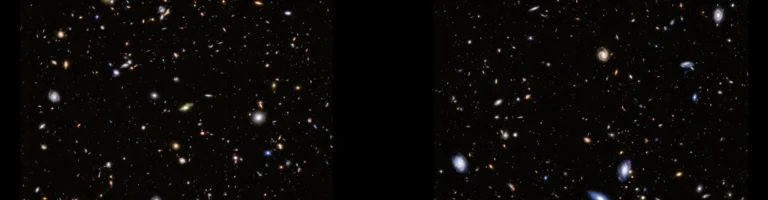

Fundamental astrophysics stands on the precipice of its greatest theoretical revolution since the discovery of dark energy: the international Local Distance Network (H0DN) collaboration has published the most comprehensive, high-precision analysis of the expanding local universe in astronomical history. Leveraging infrared observations from the James Webb Space Telescope (JWST) alongside the Hubble Space Telescope (HST), astronomers determined the local Hubble constant with an unprecedented uncertainty of just 1%, arriving at a definitive value of 73.50 km/s/Mpc. This local measurement starkly contradicts the theoretical prediction of 67.4 km/s/Mpc derived from Planck cosmic microwave background observations under the standard ΛCDM cosmological model. Reaching a staggering statistical discrepancy of 7 sigma, the findings decisively eliminate observational systematic errors and compel physicists to search for new physics beyond the standard model.
Cosmic Dilemma: Two Mutually Exclusive Expansion Rates of One Universe
The Hubble constant ($H_0$) serves as the fundamental anchor of modern cosmology, dictating the expansion rate of spacetime and the absolute age of the cosmos. Yet over the past decade, astronomers have found themselves trapped inside an escalating paradox known worldwide as the “Hubble Tension.” The crisis is stark: two independent, meticulously refined measurement methodologies consistently yield two irreconcilable expansion velocities.
The first method interrogates the Cosmic Microwave Background (CMB)—the thermal afterglow of the Big Bang released roughly 380,000 years after cosmic inception. By measuring minuscule temperature and polarization anisotropies recorded by the European Space Agency’s Planck satellite, cosmologists working within the standard ΛCDM (Lambda Cold Dark Matter) framework calculate that space should presently expand at approximately 67.4 ± 0.5 km/s per megaparsec.
The second method measures the late universe directly through the classic “cosmic distance ladder.” Astronomers first calibrate distances to nearby galaxies using pulsating Cepheid variable stars, subsequently anchoring Type Ia supernovae in more distant cosmic realms. For decades, this direct kinematic method has unyieldingly yielded values between 73 and 74 km/s/Mpc. As measurement errors shrank, the likelihood of this discrepancy occurring by random chance plunged to less than one in three billion.
The JWST Arbitration: Dispelling the Hubble Crowding Hypothesis
For years, traditionalist cosmologists maintained hope that the tension arose from subtle systematic artifacts embedded within the Hubble Space Telescope’s optical instrumentation. In crowded galactic centers, individual stars can blur into overlapping points of light (stellar crowding), artificially boosting Cepheid brightness readings and underestimating cosmic distances, thereby artificially inflating $H_0$. Interstellar dust absorption introduced further potential calibration ambiguities.
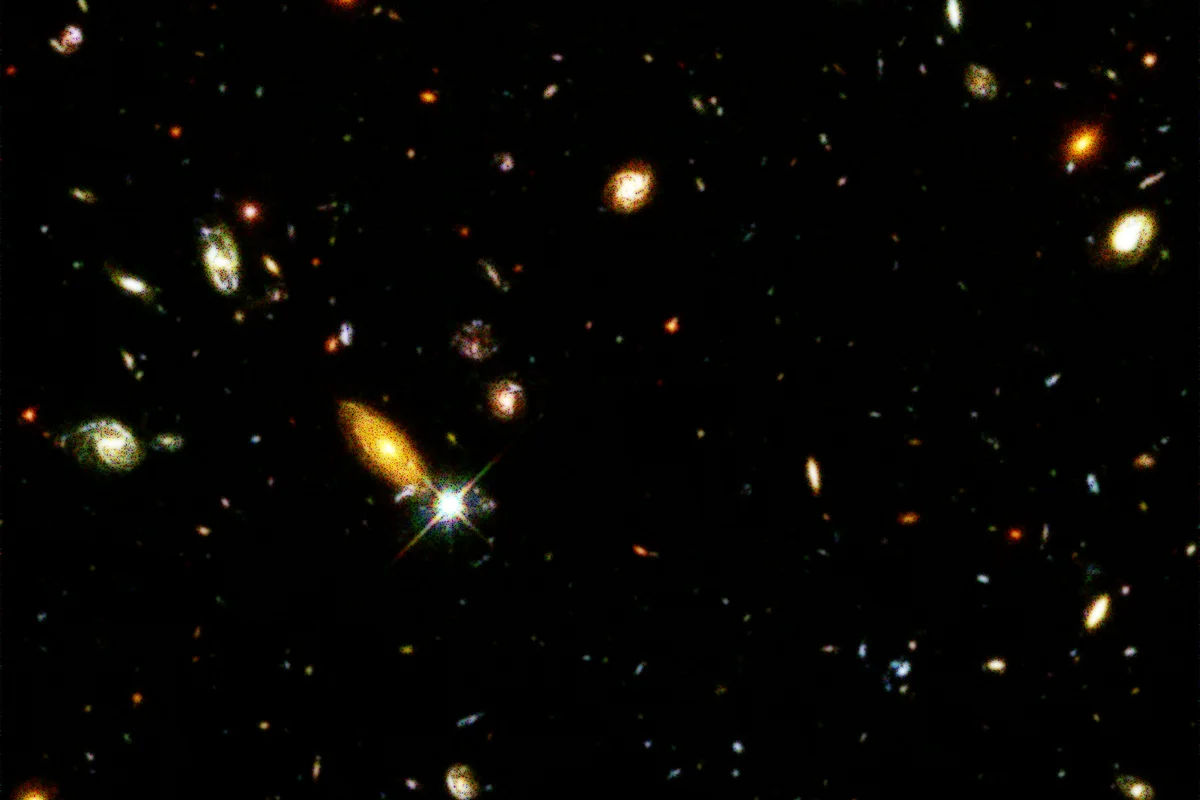
The James Webb Space Telescope served as the decisive arbiter. Equipped with a colossal 6.5-meter gold-plated primary mirror and ultra-sensitive Near-Infrared Cameras (NIRCam), JWST effortlessly resolves individual stellar targets inside densely packed galactic clusters while gazing directly through obscuring dust veils.
The re-examination of Cepheid populations within supernova host galaxies delivered unambiguous results: Hubble’s original photometric calibrations were remarkably accurate. JWST confirmed the brightness of hundreds of Cepheids with unprecedented signal-to-noise ratios, proving beyond doubt that stellar crowding did not skew local distance measurements. The cosmic distance ladder survived the most rigorous scrutiny in astronomical history.
«We can no longer explain away the Hubble tension with instrumental artifacts or cosmic dust obscuration. The Webb telescope has penetrated dense galactic cores with pristine optical clarity. The discrepancy between the infant universe and our local cosmos is undeniable. It tells us that our cosmological equations are fundamentally incomplete.»
Prof. Adam Riess, Nobel Laureate in Physics, Co-leader of the H0DN Collaboration
Consensus of the H0DN: An Integrated Web of Cosmic Yardsticks
The definitive milestone arrived with the publication of the Local Distance Network (H0DN) consensus, uniting leading researchers from the International Space Science Institute (ISSI) in Bern with global astronomical institutions. Rather than relying on a solitary calibration sequence, astrophysicists constructed a robust multidimensional network combining several independent “standard candles.”
Beyond Cepheids, the collaboration incorporated the Tip of the Red Giant Branch (TRGB)—evolved stars whose peak luminosity during core helium flash is strictly dictated by quantum mechanics. They further integrated long-period Mira variables and time-delay cosmography from gravitationally lensed quasars. Integrating these distinct calibration avenues into a joint covariance matrix produced the definitive benchmark: $H_0 = 73.50 pm 0.81$ km/s/Mpc.
Achieving an aggregate precision of 1% formally concludes the debate over observational artifacts. Both research paradigms—Planck mapping the cosmic infancy and H0DN surveying the modern epoch—performed their empirical duties flawlessly. The tension resides not in our instruments, but within the fabric of the universe itself.
✦ Benchmark 1% Precision
The H0DN collaboration pinned the local Hubble constant at 73.50 km/s/Mpc, systematically ruling out calibration artifacts.
✦ JWST Validation
Infrared NIRCam imaging resolved individual Cepheids in crowded galactic cores, confirming Hubble Telescope accuracy.
✦ 7-Sigma Discrepancy
The statistical divergence between early and late universe measurements eliminates random chance as an explanation.
✦ Gateway to New Physics
The irreconcilable expansion rates demand modifications to the standard ΛCDM model via Early Dark Energy or altered gravity.
Cracks in the Standard Model: Why ΛCDM Fails Across Cosmic Time
The standard ΛCDM paradigm has achieved extraordinary success in modeling the cosmic web, large-scale galaxy clustering, and primordial nucleosynthesis. However, it hinges on fundamental assumptions: dark energy is modeled as a static cosmological constant ($Lambda$) with unvarying energy density, while dark matter is presumed to be strictly “cold,” composed of collisionless massive particles.
The Hubble tension demonstrates that these assumptions buckle when stretched across 13.8 billion years of cosmic evolution. If the local universe is racing apart faster than predicted by forward-modeling the Big Bang, either an unrecognized energy component accelerated the early cosmos, or gravitational physics departs from General Relativity across cosmological horizons.
Just as the unexplained anomalous precession of Mercury’s perihelion catalyzed Albert Einstein’s formulation of General Relativity in the early 20th century, the Hubble discrepancy is nudging modern astrophysics toward a new theoretical paradigm.
Key Takeaways on the Escalating Crisis in Cosmology:
- Early-universe CMB models predict an expansion rate of 67.4 km/s/Mpc, while local empirical measurements confirm 73.50 km/s/Mpc.
- JWST proved that stellar crowding and cosmic dust did not distort classical Cepheid distance ladders.
- The H0DN consensus combined Cepheids, TRGB red giants, Mira variables, and supernovae into an integrated distance web.
- The 7-sigma impasse challenges the static nature of dark energy and signals an imminent paradigm shift in astrophysics.
The Quest for New Physics: Early Dark Energy and Modified Gravity
Which theoretical frameworks offer viable solutions to the cosmological crisis? The leading candidate is Early Dark Energy (EDE). This hypothesis posits that a transient scalar field energized the cosmos in the final millennia preceding recombination, accelerating cosmic expansion, shrinking the sound horizon sound scale, and harmonizing CMB predictions with local observations.
Alternative proposals explore self-interacting dark radiation, sterile neutrinos, or decaying dark matter species that operate outside the Standard Model of particle physics. A more radical path involves modified gravity theories (such as $f(R)$ gravity and braneworld cosmology), where gravitational attraction softens over mega-parsec scales.
Over the coming years, flagship observations from NASA’s Nancy Grace Roman Space Telescope and the ESA Euclid observatory will chart hundreds of millions of galaxies. By tracking expansion velocity across cosmic epochs, they will pinpoint the exact cosmological moment where this mysterious hidden force revealed itself.