

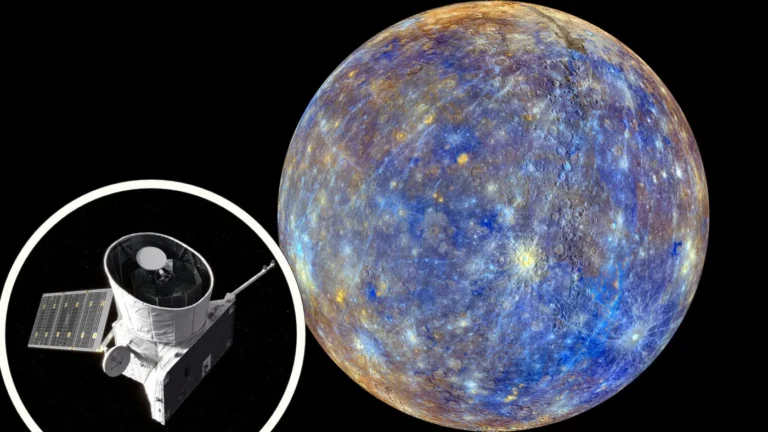

Eight years after launching from Earth, the joint European-Japanese mission has achieved BepiColombo Mercury orbit insertion—becoming only the second spacecraft in history to enter orbit around the solar system’s innermost planet.
BepiColombo Mercury Orbit: Why Reaching the Innermost Planet Is Harder Than Pluto
The European Space Agency (ESA) and the Japan Aerospace Exploration Agency (JAXA) have confirmed a landmark achievement: BepiColombo is safely in Mercury orbit, capping an eight-year interplanetary trek across the inner solar system.
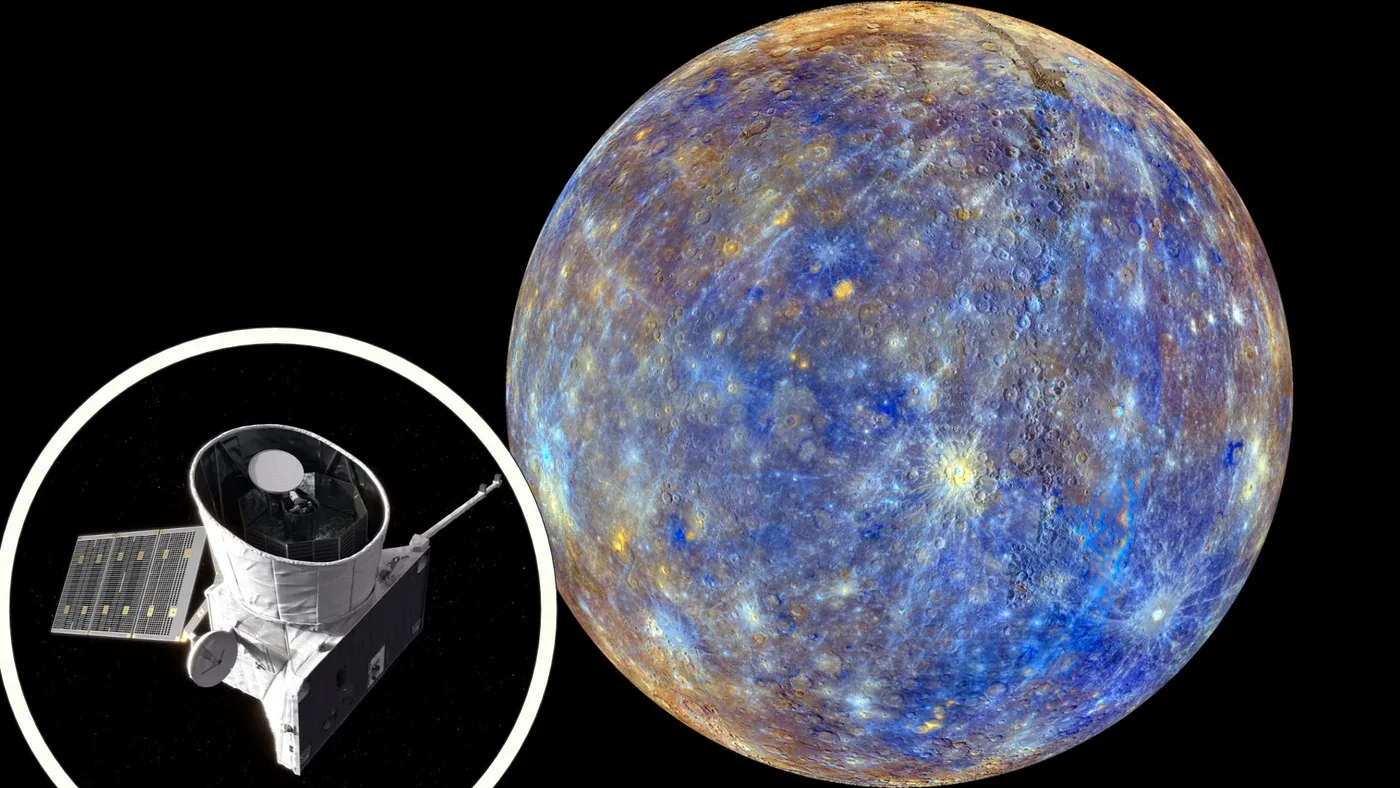
Until now, NASA’s MESSENGER probe—which ended its mission in 2015—was the only spacecraft ever to orbit Mercury. Counterintuitively, reaching Mercury requires far more energy management than flying out to Jupiter or Pluto.
Because the Sun’s immense gravity continuously accelerates any spacecraft falling inward, BepiColombo had to execute nine intricate gravity-assist flybys past Earth, Venus, and Mercury itself to bleed off speed before orbital capture.
An Unexpected Braking Challenge—and Confirmation That the Probe Is Safe
The final orbital insertion burn brought tense moments for flight controllers. In its official update, ESA noted that the spacecraft encountered an unexpected technical challenge during the critical maneuver, resulting in a shorter burn than originally planned.
Crucially, Mercury’s gravity still captured the spacecraft, and ESA confirmed that BepiColombo remains “safe” as engineers investigate the anomaly and refine its upcoming trajectory adjustments.
Powered by solar-electric ion thrusters rather than conventional chemical rockets alone, the mission’s orbital mechanics highlight the razor-sharp mathematical precision required in planetary geometry and astrodynamics.
«While ESA investigates the issue and what it means for the spacecraft’s trajectory, BepiColombo remains safe in Mercury orbit.»
European Space Agency (ESA) Official Mission Statement
Two Orbiters in One: Splitting Into European and Japanese Science Craft
BepiColombo is actually a stacked dual-orbiter complex. Once its initial capture orbit is stabilized, the transfer module will separate to release two independent scientific spacecraft.
ESA’s Mercury Planetary Orbiter (MPO) will settle into a low polar orbit to map Mercury’s surface mineralogy, gravity field, and permanently shadowed polar craters that harbor water ice. Meanwhile, JAXA’s Mio (Mercury Magnetospheric Orbiter) will sweep through an elliptical orbit to measure Mercury’s magnetic field and fierce solar wind interactions.
Operating simultaneously from two distinct vantage points, MPO and Mio will deliver stereoscopic insights impossible for any single probe.
BepiColombo joins NASA’s MESSENGER as only the second spacecraft in history to orbit Mercury.
The complex trajectory required nine gravity-assist flybys of Earth, Venus, and Mercury.
The stack will soon split into ESA’s MPO surface mapper and JAXA’s Mio magnetosphere probe.
Instruments will probe why Mercury’s metallic core makes up over 60% of the planet’s mass.
Unlocking the Mysteries of Mercury’s Oversized Iron Core
Mercury remains one of planetary science’s deepest puzzles. Despite being barely larger than Earth’s Moon, it houses a massive metallic core accounting for more than 60 percent of its total mass—perhaps the remnant of a cataclysmic ancient impact.
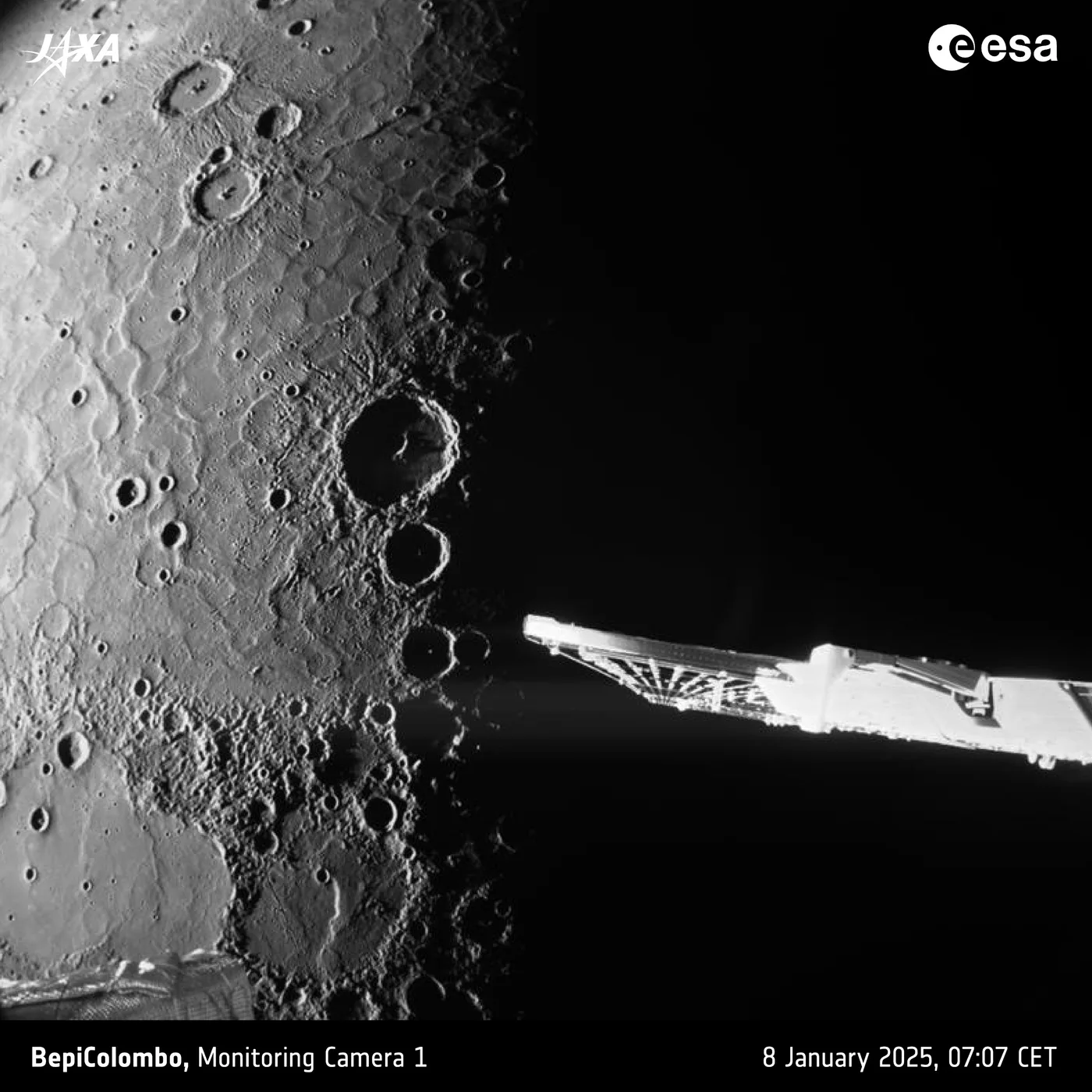
Earlier flybys, including BepiColombo’s striking 2025 north-pole monitoring camera selfie, also revealed enigmatic surface hollows and signs of volatile-rich geology.
As detailed on NASA’s BepiColombo mission portal, decoding how Mercury formed and survived so close to the Sun will directly inform our understanding of rocky exoplanets orbiting tight around distant stars.
- ESA and JAXA confirmed successful orbital capture despite an unexpected braking burn anomaly.
- The spacecraft remains safe while flight dynamics teams refine its upcoming science orbit.
- Two independent orbiters (MPO and Mio) will study Mercury’s crust, polar ice, and magnetosphere simultaneously.
- Findings will shed light on how rocky exoplanets evolve close to host stars.
Surviving Extreme Thermal Stress and the Road Ahead for MPO and Mio
Operating in Mercury orbit ranks among the harshest thermal challenges in robotic spaceflight. On the planet’s sunlit side, surface temperatures climb past 430 °C, and the combination of direct solar flux and intense infrared radiation reflecting off Mercury’s crust subjects spacecraft to roughly ten times the heat experienced near Earth. To protect delicate instruments aboard MPO and Mio, engineers encased the spacecraft in multi-layer ceramic and titanium shielding paired with radiators angled toward deep space.
Once flight dynamics teams finish refining the capture trajectory and the two orbiters separate, a comprehensive multi-year science campaign will begin. Laser altimeters and X-ray spectrometers will map towering scarps—cliff systems formed as Mercury literally shrank while its oversized iron core cooled—while magnetometers trace how solar wind strips particles from the planet’s tenuous exosphere.
Together, ESA and JAXA are picking up where NASA’s MESSENGER mission left off in 2015, turning a single-spacecraft reconnaissance into a synchronized dual-orbiter observatory that will redefine our understanding of the innermost solar system.
Just as importantly, the eight-year, nine-billion-kilometer voyage demonstrates the maturity of solar-electric ion propulsion and international deep-space teamwork. By overcoming an unexpected braking burn anomaly tens of millions of kilometers from Earth and securing Mercury orbit safely, BepiColombo sets the stage for years of groundbreaking planetary science—and paves the way for future robotic landers on the solar system’s most extreme rocky world.