


For well over a century since the monumental discoveries of Paleolithic cave sanctuaries at Altamira and Lascaux, archaeologists and evolutionary anthropologists faced an insurmountable mystery: who were the specific individual human beings whose hands blew red ochre pigments and etched masterly herds of mammoths across subterranean limestone walls throughout Pleistocene Eurasia? Were these compositions exclusively orchestrated by male shamans and tribal chieftains, or did women, elders, and adolescent youths actively participate in parietal art? A transformative breakthrough in non-destructive paleogenomics, spearheaded by an international consortium of geneticists at the Max Planck Institute for Evolutionary Anthropology and the European First Art Project, has achieved an epochal milestone: researchers have for the first time extracted and successfully sequenced authentic ancient human DNA (aDNA) directly from the microscopic organic binding agents preserving cave paintings. This technical revolution forever reshapes the scientific study of prehistoric human creativity.
The Enigma of Organic Binders: Preserving Microscopic Biosignatures Across Millennia
To ensure that raw mineral pigments—including red haematite, goethite, and powdered charcoal—adhered durably to cold, damp, and porous limestone cavern walls, Upper Paleolithic hunter-gatherers blended pulverized minerals with organic liquid binders. Ancient artists frequently deployed rendered animal marrow, subcutaneous lipids, blood, and, crucially for evolutionary geneticists, their own saliva when expelling aerosolized pigment through hollow avian bone pipes.
Across tens of thousands of years, the microclimatic stability of deep karstic caves—marked by constant relative humidity, stable ambient temperatures hovering around 10–12 degrees Celsius, and progressive encasement beneath microcrystalline calcite flowstones—served as an extraordinary natural cryogenic vault. Trapped within microscopic mineral pockets, macromolecular chains of deoxyribonucleic acid gradually fragmented yet escaped enzymatic and microbial decomposition.
Nevertheless, the preeminent barrier facing molecular archaeologists was developing an analytical method capable of liberating this precious genetic payload without inducing the slightest macroscopic abrasion or chemical degradation to UNESCO World Heritage rock art treasures.
Technological Breakthrough: Non-Destructive Enzymatic Hydrogel DNA Extraction
Traditional paleogenetic sampling historically mandated invasive mechanical drilling into petrous bones or scalpel scrapings of fossil substrates—a destructive protocol strictly forbidden on delicate prehistoric art panels. To circumvent this limitation, researchers engineered an ultra-gentle, non-invasive micro-absorption protocol relying upon functionalized biocompatible hydrogel membranes and enzymatic elution buffers.
A soft polymer matrix impregnated with ethylenediaminetetraacetic acid (EDTA) and proteinase K is delicately applied onto the pigment surface for several minutes. Capillary forces gently draw out unbound organic macromolecules without dislodging crystalline iron oxide granules or altering the visual integrity of the parietal canvas.
Subsequently, retrieved DNA fragments undergo high-throughput targeted capture hybridization and next-generation sequencing (NGS). Sophisticated bioinformatic filtration suites isolate authentic ancient human genomes by cataloguing canonical post-mortem nucleotide damage signatures—specifically elevated cytosine-to-uracil deamination (C-to-T transitions) concentrated at molecule termini—thereby rigorously discriminating authentic Upper Paleolithic genetic material from modern tourist and laboratory contaminants.
«We have long viewed cave paintings as frozen cultural shadows from a distant past. Today, by retrieving ancient DNA preserved within salivary and adipose binding matrices, prehistoric art gains tangible genetic faces. We can map biological lineage, sex, kinship ties, and generational apprenticeships behind paintings executed 20,000 years ago.»
Prof. Johannes Krause, Director at the Max Planck Institute for Evolutionary Anthropology
Who Held the Pigment: A Gender Revolution and Kinship in Paleolithic Sanctuaries
Initial genomic mapping of parietal panels across the Franco-Cantabrian region has initiated a thorough revision of classic anthropological dogma. For decades, popular culture and early antiquarian theories championed the trope of the lone adult male big-game hunter recording quarry as sympathetic hunting magic.
Chromosomal karyotype determination performed on negative hand stencils revealed that a substantial majority of examined impressions exhibited two X chromosomes, conclusively demonstrating they were created by women and adolescent girls. Furthermore, in several deep sanctuary chambers, identical mitochondrial DNA haplotypes were tracked across multiple distinct bison friezes separated by dozens of meters of gallery passages.
This establishes direct empirical evidence for generational kinship continuity and hereditary artistic lineages during the Aurignacian and Magdalenian epochs: matrilineal traditions where mothers and grandmothers transmitted specialized pigment recipes and sacred iconographic motifs to daughters across decades.
✦ Non-Destructive Extraction
Biocompatible hydrogel membranes absorb organic binding agents from pigment grains without altering ancient rock art.
✦ Paleolithic Women Artists
Chromosomal analysis of prehistoric hand stencils proves that women and adolescents created prominent parietal art.
✦ Generational Art Lineages
Identical mitochondrial DNA lines on separate cave panels confirm artistic apprenticeship passed down within families.
✦ Deep-Time Biological Atlas
DNA damage deamination patterns confirm authentic Paleolithic origins, linking cave art styles to human migrations.
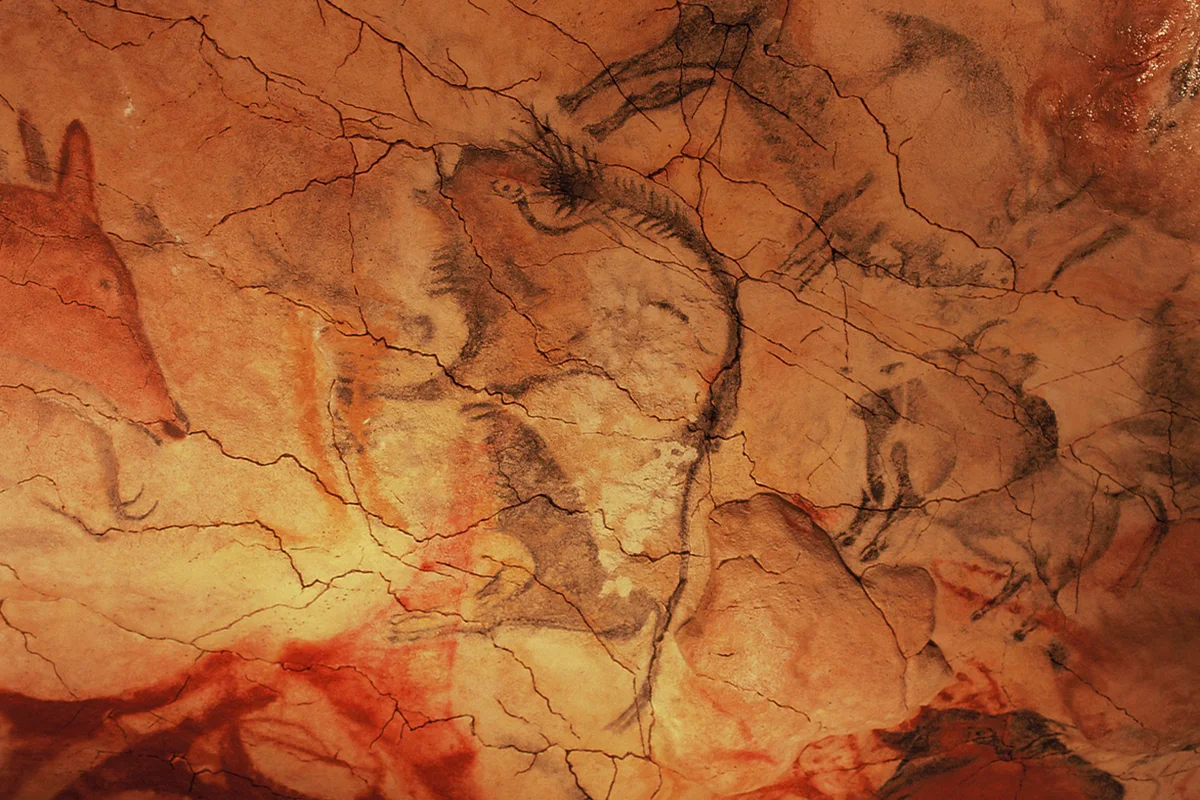
Intertwined Bloodlines: Neanderthal Admixture and Prehistoric Migration Corridors
Extracting authentic ancient genomes directly from parietal art illuminates critical evolutionary crossroads, notably the complex interactions between expanding anatomically modern humans and indigenous Neanderthal populations across Eurasia roughly 40,000 years ago. In selected basal pigment layers, nuclear DNA sequencing revealed elevated frequencies of introgressed archaic Neanderthal alleles.
These genetic signatures correlate precisely with radiocarbon chronologies documenting cultural transitions in the post-glacial archaeological record. Linking genomic profiles directly to decorative conventions grants anthropologists the unprecedented ability to track prehistoric stylistic migrations alongside physical demographic movements across Pleistocene landscapes.
Paleogenomics permanently collapses the historic boundary between material culture and molecular genetics: every brushstroke and blown pigment contour now carries both an artistic vision and a complete biological identity card of its creator.
Key Scientific Discoveries in Cave Art Paleogenomics:
- Ancient human DNA survives encased in saliva and animal fat binders within cave wall mineral matrices.
- Enzymatic hydrogels retrieve macromolecular DNA without scraping or damaging protected UNESCO cultural heritage.
- Genomic profiling confirms extensive participation of women and youth in Upper Paleolithic artistic culture.
- The method paves the way for molecular screening of bone tools, carved figurines, and ornaments worldwide.
The Future of Deep Antiquity: Genomic Audits of Global Archaeological Collections
The triumph of non-destructive parietal paleogenomics unlocks breathtaking possibilities for resurveying millions of prehistoric artifacts curated in museums globally. Engraved mammoth ivory plaques, perforated animal tooth pendants, bone sewing needles, and ochre-stained pestles handled by ancient artisans preserve microscopic traces of cutaneous sebum, keratin, and epithelial cells.
International scientific teams have already commenced non-invasive molecular surveys across rock art sites in southern Africa, the Americas, and Southeast Asia—such as the limestone karst caves of Sulawesi, home to representational art exceeding 45,000 years in antiquity.
In the coming decade, deep-time paleogenomics will construct an unprecedented genealogical atlas of our species, connecting prehistoric artifacts not merely to broad geographical cultures, but to the tangible family narratives of the first visionary artists who ignited the dawn of human civilization.