

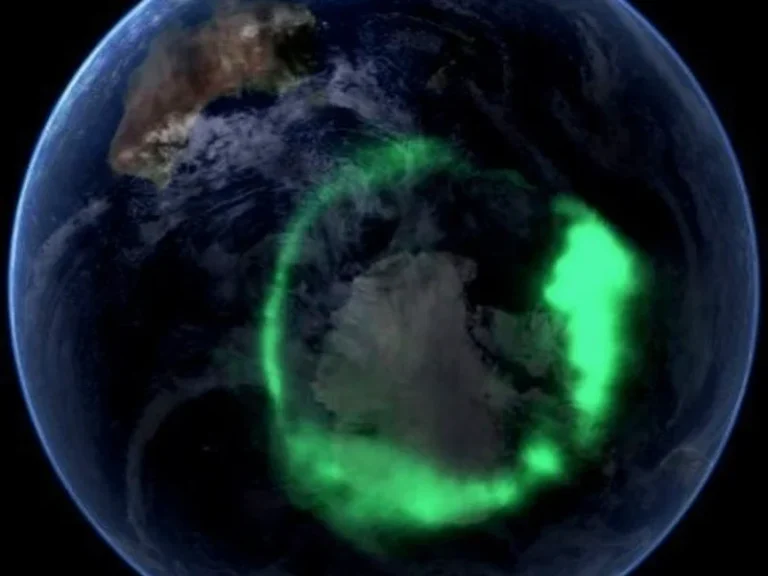

Approximately 42,000 years ago, Earth’s planetary magnetic shield underwent a catastrophic breakdown: the geodynamo churning within the molten outer core suffered an acute instability known in geophysics as the Laschamps geomagnetic excursion. For nearly a millennium, magnetic field strength plummeted to an alarming six percent of contemporary values. Today, Adams event geomagnetic reversal Laschamps excursion kauri trees ozone layer analyses stand as a monumental breakthrough: through high-precision carbon dating of ancient subfossil trees preserved in New Zealand peat bogs, scientists demonstrated that unshielded cosmic radiation stripped the ozone layer, triggered global atmospheric electrical storms, and drove prehistoric humans into deep subterranean sanctuaries.
The Laschamps Anomaly: Anatomy of Geodynamo Destabilization
Earth’s protective magnetosphere is sustained by convective currents of molten ferromagnetic iron and nickel circulating throughout the outer core roughly 1,800 miles beneath the surface.
Paleomagnetic analyses of volcanic basalt in Laschamps, France, originally established that roughly 41,000 to 42,000 years ago, Earth’s magnetic polarity underwent a transient reversal before returning to its normal alignment.
The critical discovery made by modern researchers is that during this transitional interlude, field strength dropped to less than six percent of modern baselines.
This failure left the biosphere entirely vulnerable to high-velocity solar wind ions, coronal mass ejections, and high-energy galactic cosmic rays.
Earth’s magnetic shield typically concentrates ionizing particles within the toroidal Van Allen radiation belts. When dipole field intensity collapsed beneath the six percent mark, the Van Allen belts disintegrated entirely, permitting isotropic cosmic ray flux to saturate the lower stratosphere and troposphere.
Paleomagnetic reconstructions demonstrate that the geodynamo transitioned from an orderly dipolar geometry into a chaotic multipolar regime, creating numerous transient, drifting magnetic poles scattered across mid-latitudes and equatorial regions.
This geomagnetically disordered state altered ionospheric current loops, inducing immense telluric electrical currents and precipitating continuous global electrical storms across continental landmasses.
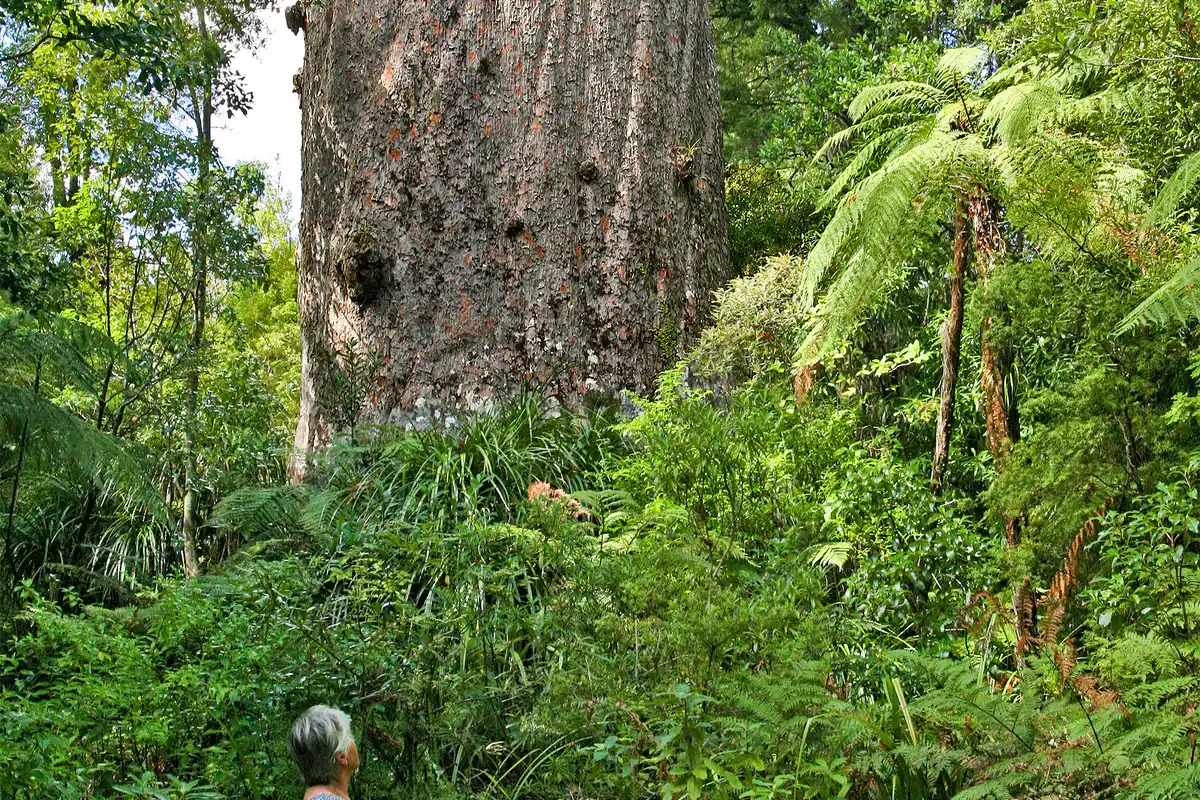
New Zealand Kauri Trees: A Dendrochronological Rosetta Stone
For decades, paleoclimatologists were unable to correlate the Laschamps excursion with ecological records due to imprecise radiocarbon resolution in marine sediment cores.
A major breakthrough occurred when giant subfossil kauri trees (Agathis australis) were excavated from anaerobic peat bogs on New Zealand’s North Island, spanning over 1,700 continuous annual growth rings.
Because trees incorporate atmospheric radiocarbon directly during photosynthetic respiration, researchers measured Carbon-14 (14C) concentrations ring by ring.
The data revealed an immense, prolonged spike in atmospheric 14C and Beryllium-10, pinpointing the exact chronology of cosmic ray bombardment across the atmosphere.
The dense resinous chemistry of New Zealand kauri timber safeguarded subfossil trunks from fungal decay across millennia within waterlogged bogs. High-precision laser-ablation mass spectrometry across consecutive rings enabled the reconstruction of annual atmospheric chemistry spanning the critical interval between 41,500 and 41,000 BCE.
Corroborating data from Greenland and Antarctic deep ice cores confirmed identical, synchronous spikes in cosmogenic Beryllium-10 (10Be) flux, corroborating the planetary breadth of the Adams Event radiation crisis.
During the Laschamps excursion, Earth’s magnetosphere lost over 94% of its shielding capacity.
Annual growth rings in subfossil New Zealand bogs accurately documented the spike in atmospheric Carbon-14.
Nitrogen oxide cascades systematically dismantled the stratospheric ozone layer, allowing lethal UV radiation.
Lethal radiation drove humans into deep caves, precipitating an explosion of cave art and ochre sunscreens.
Stratospheric Ionization and Catastrophic Ozone Depletion
Supercomputer climate models revealed the disastrous cascade triggered by unhindered cosmic radiation.
Energetic protons ionized atmospheric nitrogen and oxygen in the upper stratosphere, producing substantial concentrations of nitrogen oxides (NOx).
These chemical radicals catalyze rapid ozone (O3) destruction, decimating Earth’s stratospheric ultraviolet barrier.
Lethal UV-B and UV-C solar flux penetrated unchecked to ground level, while auroral displays descended into tropical latitudes, transforming the night sky into a luminous, electrified expanse punctuated by superbolt electrical storms.
Stratospheric ozone destruction exposed terrestrial ecosystems to unmitigated solar UV-B and UV-C radiation. Terrestrial vegetation suffered severe chlorophyll degradation and cellular actinic damage, disrupting foundational trophic webs across the southern hemisphere.
Simultaneously, auroral light emission descended into tropical zones, transforming twilight skies into violent, luminous phosphorescent displays as solar plasma directly energized atmospheric gases.
Marine micropaleontological sediment analysis reveals that the loss of the stratospheric ozone filter triggered extensive genomic mutagenesis across epipelagic phytoplankton communities. This disruption of foundational marine primary productivity impaired the oceanic biological carbon pump, destabilizing global biogeochemical cycles and generating secondary climatic anomalies for centuries.
«The Laschamps excursion instigated such widespread environmental disruptions that we designated it the Adams Event — honoring science fiction visionary Douglas Adams, whose famous number 42 proved an uncanny answer to the ultimate crisis of planetary survival.»
Alan Cooper, Professor of Paleogenomics, South Australian Museum
Climatic Upheaval, Megafaunal Extinction, and Cave Sanctuaries
Ozone destruction severely altered planetary atmospheric jet streams and tropical convergence zones, causing severe droughts across Australia and South America.
This ecological stress directly triggered the extinction of Australia’s giant megafauna, including the massive marsupial Diprotodon and colossal flightless Genyornis.
For hominins, including Neanderthals and anatomically modern Cro-Magnons, daylight exposure caused severe actinic burns, retinal damage, and skin cancers.
Consequently, archaeologists observe a sudden, synchronistic explosion of cave occupancy and figurative art worldwide 42,000 years ago, alongside the heavy use of red ochre as a mineral sunscreen.
For hominin populations, the Adams Event acted as an acute evolutionary bottleneck. Solar UV radiation induced photokeratitis and malignant cutaneous damage, compelling populations to adopt subterranean habitation patterns.
This behavioral migration sparked an archaeological renaissance: troglodytic cave networks across Europe and Australasia became permanent communal hubs, accompanied by the intensive application of iron-oxide ochre pastes as photoprotective sunblocks.
- The Laschamps geomagnetic excursion persisted for approximately 800 years before magnetic poles stabilized.
- Spectacular auroral displays illuminated tropical latitudes due to the collapse of the Van Allen belts.
- Extinction of Australian Pleistocene megafauna directly correlated with severe radiation and aridity.
- Red mineral ochre (iron oxide) functioned as an ancient ultraviolet photoprotective ointment for early hunters.
Contemporary Vulnerabilities: Lessons for High-Tech Infrastructure
Deciphering the Adams Event provides vital foresight for modern civilization’s technological dependencies.
Over the past century and a half, Earth’s dipole field has diminished by approximately ten percent, while the South Atlantic Anomaly continues to widen.
In an interconnected world dependent upon orbital satellites, GPS networks, and terrestrial power distribution grids, understanding magnetospheric variations is indispensable for space weather resilience. Also read our related investigative feature on cellular mechanisms of biological tissue regeneration and survival.