

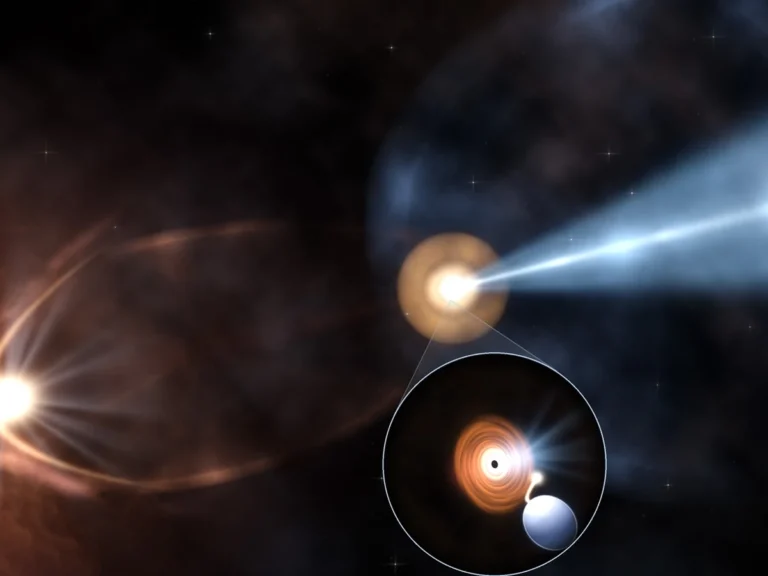

An international team of astrophysicists has reported the discovery of the most compelling candidate yet for a “microblazar” in cosmic history. The enigmatic object, cataloged as IRAS 18293-0941 and located within our own Milky Way galaxy, blasts a powerful jet of particles and high-energy radiation directed straight toward Earth. This landmark observation provides long-awaited evidence for a phenomenon predicted by theorists decades ago.
What Are Blazars and Why Have Microblazars Remained Hidden?
Blazars are among the most luminous and violent engines in the known universe. In astrophysical terms, they represent a class of quasars—supermassive black holes residing in the nuclei of distant galaxies that feed on vast quantities of surrounding matter and eject particles at near-light speeds through colossal, opposing relativistic jets. When one of these high-velocity jets happens to point directly at Earth, astronomers classify the object as a blazar.
Over the past few decades, researchers have frequently cataloged microquasars—stellar-mass binary systems where a black hole or neutron star siphons material from an orbiting companion star. However, the miniaturized counterpart of a blazar—a microblazar whose relativistic beam shines straight into our line of sight—had never been definitively detected until now.
“It is the first time that we have a serious candidate. Until now, microblazars existed exclusively as theoretical concepts on paper.”
Josep Martí, lead author and astronomer at the University of Jaén in Spain
Inside IRAS 18293-0941: A Natural Particle Accelerator in the Milky Way
IRAS 18293-0941 is situated roughly 12,000 light-years from Earth, nestled behind a dense veil of interstellar dust within the plane of the Milky Way. The system is a close binary configuration in which a stellar-mass black hole orbits a blazing giant star every 11 Earth days.
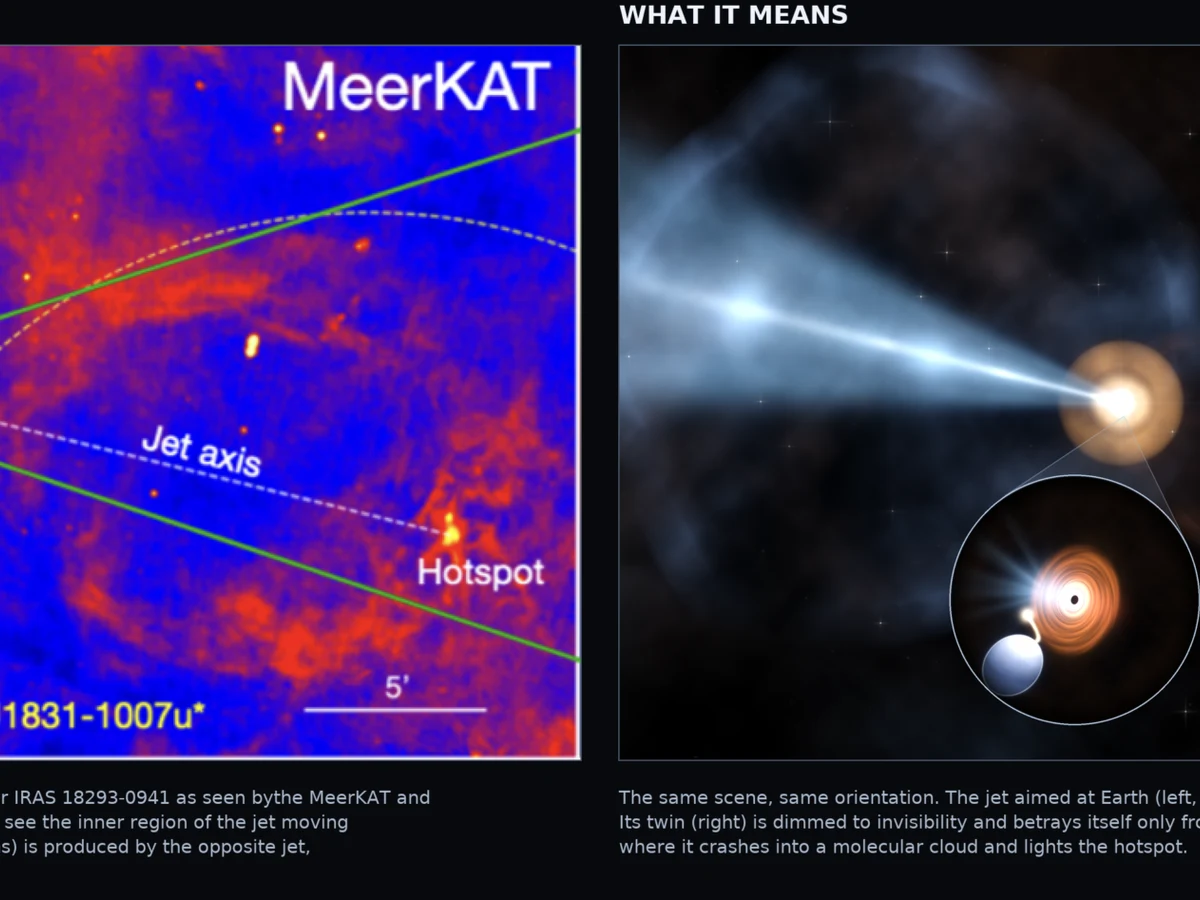
The intense gravitational pull of the black hole continuously draws matter from the stellar companion, creating an accretion disk of superheated plasma. A fraction of this matter is channeled away in twin relativistic beams, one of which flares directly toward our solar system, triggering dramatic Doppler boosting.
Key Metrics of the Newly Discovered Microblazar:
- Orbital Period: 11-day binary cycle.
- Galactic Distance: Approximately 12,000 light-years within the Milky Way.
- Observational Arsenal: The European VLBI Network (EVN), MeerKAT radio array in South Africa, Calar Alto Observatory in Spain, and archival Very Large Array (VLA) data.
- Opposing Hotspot: Clear signatures of the counter-jet colliding with surrounding interstellar gas clouds.
The Mystery of the Missing Variability
According to theoretical models, microblazars should display rapid variations in brightness, as Doppler boosting amplifies subtle shifts within the jet beam. Yet multi-epoch observations of IRAS 18293-0941 revealed surprisingly steady luminosity.
According to the research team, this steady emission is likely caused by the dense cloud of circumstellar gas shrouding the binary pair. This thick envelope acts as a natural damper, evening out rapid photometric fluctuations before the light escapes into space.
Studying energetic cosmic objects is fundamental to understanding our universe: we previously reported on how the James Webb Telescope discovered the oldest black hole in the universe, but exploring nearby galactic laboratories allows astronomers to test relativistic physics with unprecedented resolution.
Why Microblazars Are Vanishingly Rare
The evolutionary phase during which a binary system forms energetic relativistic jets is remarkably short—lasting only tens of thousands of years. Detecting one requires catching the star at precisely the right stage while simultaneously having its jet alignment point directly at Earth.
“This presents a previously overlooked mechanism for generating some of the highest energy emissions observed. Microblazars may power some of the universe’s most energetic processes.”
Itumeleng Monageng, astrophysicist at the University of Cape Town
Sources: Research published by an international team in Astronomy & Astrophysics (DOI: 10.1051/0004-6361/202661105).