

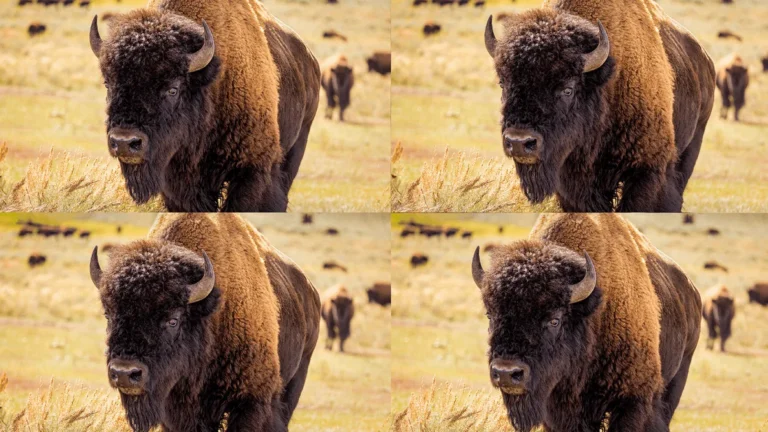

At first glance, “Buffalo buffalo Buffalo buffalo buffalo buffalo Buffalo buffalo” looks like a stuck keyboard or an absurd tongue twister. Yet linguists cherish the Buffalo buffalo sentence as one of the sharpest demonstrations in the English language of how lexical ambiguity and syntactic recursion can turn eight identical words into a completely grammatical statement.
Three Meanings, One Word: How the Linguistic Illusion Works
The secret behind the trick—as highlighted by IFLScience—relies on a rare triple overlap in American English, where a single spelling functions seamlessly as a proper noun adjunct, a plural animal noun, and a transitive verb.

First, capitalized Buffalo refers to the city of Buffalo, New York, acting as a noun adjunct meaning “from Buffalo.” Second, lowercase buffalo names the animal—the American plains bison (Bison bison bison). Crucially, “buffalo” can serve as its own unmarked plural without adding “-es,” matching the singular form.
Third, lowercase buffalo is also an established transitive verb meaning “to puzzle, confuse, mystify,” or “to intimidate and bully by a display of power.” Because English also omits plural verb endings in the simple present tense, all three roles look identical on the page.
Decoding the Grammar: Reduced Relative Clauses in Action
Once you recognize a hidden grammatical shortcut known as a reduced relative clause—the same rule that lets speakers drop “that” or “whom” in “the people [whom] I met”—the Buffalo buffalo sentence snaps into crystal clarity. Swapping each role with an unambiguous synonym (“New York” for the city, “bison” for the animals, and “intimidate” for the verb) immediately unlocks the meaning.
The opening cluster, “Buffalo buffalo [whom] Buffalo buffalo buffalo,” forms one compound noun phrase acting as the subject: “Bison from Buffalo [that other] bison from Buffalo intimidate.” The sixth word, “buffalo,” serves as the sentence’s main verb: “themselves intimidate.” Finally, the closing pair “Buffalo buffalo” supplies the direct object: “[still other] bison from Buffalo.”
Put all three pieces together and the sentence reads cleanly: “Bison from Buffalo, New York, who are intimidated by other bison from Buffalo, also intimidate bison from Buffalo.” Appropriately enough, even biologists could not resist repetition when naming the plains subspecies Bison bison bison.

«Theoretically, you could construct a grammatically valid sentence of practically any length made entirely from the single word buffalo.»
IFLScience linguistic breakdown citing Steven Pinker (Steven Pinker) and William J. Rapaport (William J. Rapaport)
From Dmitri Borgmann to Steven Pinker: Origins of the Wordplay
According to linguistic records, recreational wordsmith Dmitri Borgmann (Dmitri Borgmann), founder of the journal Word Ways, published an early four-word version—“Buffalo buffalo buffalo buffalo”—in his 1967 book Beyond Language: Adventures in Word and Thought.
Independently in 1972, computer scientist, philosopher, and linguist William J. Rapaport (William J. Rapaport) of the State University of New York at Buffalo explored similar recursive chains inspired by “Dogs dogs dog dog dogs.” Rapaport crafted five- and ten-word Buffalo constructions and introduced them to the academic LINGUIST List in 1992.
The classic eight-word version achieved global fame two years later when cognitive scientist Steven Pinker (Steven Pinker) featured it in his 1994 bestseller The Language Instinct, crediting his former student Ann Senghas (Ann Senghas) with formulating that specific eight-word sequence.
One spelling acts simultaneously as a New York city name, an invariant plural animal noun, and a transitive verb meaning “to intimidate.”
English allows speakers to drop relative pronouns inside object relative clauses, fusing adjacent noun phrases together.
Formal grammar permits repeating the nested structure indefinitely—only human working memory imposes a practical cap.
Popularized by Steven Pinker in 1994, the phrase remains a staple benchmark for linguistics classes and AI syntax parsers.
Garden Paths and Working Memory: Why the Buffalo Buffalo Sentence Trips Our Brains
If the Buffalo buffalo sentence obeys every rule of English syntax, why does reading it feel like hitting a mental brick wall? Psycholinguists point to two fascinating cognitive bottlenecks that expose how human language processing actually works under the hood: garden-path parsing and center-embedded recursion.
Human brains parse language incrementally in real time, generating rapid probabilistic predictions about what grammatical role the next word should fill. When we read “Buffalo buffalo,” working memory immediately locks onto a familiar adjective-plus-noun subject and waits for a verb. Encountering a second “Buffalo buffalo” shatters that expectation and forces an immediate mental backtrack, requiring listeners to juggle multiple open nested clauses simultaneously before reaching the main predicate.
Theoretically, English recursion allows speakers to string together a grammatically valid chain of 10, 100, or even a thousand “buffalos” without violating formal syntax, though human short-term memory breaks down after just two nested levels. Notice too how spoken prosody—subtle pauses, pitch drops, and vocal stress—effortlessly disambiguates structures in speech that look baffling on a silent page. Exploring how human brain architecture evolved to handle complex cognition and language is also central to our feature on how ancient Neanderthal DNA still shapes modern brain structure.
- It proves syntax operates independently of vocabulary variety: grammar rules can parse eight identical words in sequence.
- Dmitri Borgmann (Dmitri Borgmann) published a four-word precursor in 1967, followed by William J. Rapaport’s longer versions in 1972.
- Ann Senghas (Ann Senghas) is credited by Steven Pinker in The Language Instinct for the famous eight-word formulation.
- Garden-path hesitation happens because predictive parsing expects a verb immediately after the first two words.