



Evolutionary geneticists at the Max Planck Institute for Evolutionary Anthropology and Karolinska Institutet have uncovered a striking legacy of ancient interbreeding: a specific segment of Neanderthal DNA carried by many modern humans slightly shrinks the occipital lobe of the brain while lowering schizophrenia risk by up to 10 percent—all without impairing cognitive ability.
What Hugo Zeberg and Svante Pääbo’s Team Discovered
Published in the Proceedings of the National Academy of Sciences (PNAS), the study was led by Dr. Hugo Zeberg and Nobel laureate Svante Pääbo. The researchers set out to investigate how specific genetic variants inherited from Neanderthals subtly influence the structural anatomy of the living human brain.
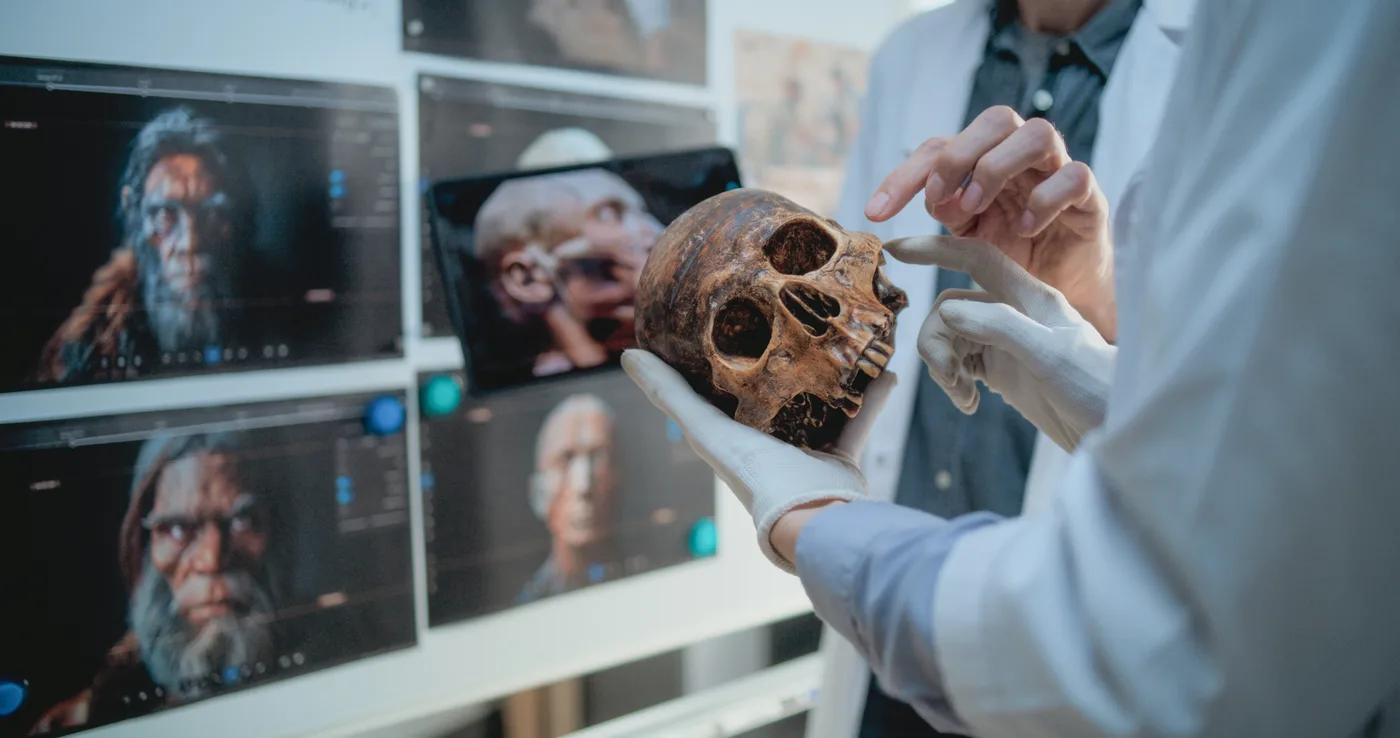
By mining neuroimaging and genetic records from the Oxford BIG40 server—covering tens of thousands of UK participants—the team identified a consistent association between a Neanderthal-derived allele on chromosome 14 and structural differences at the back of the cerebral cortex.
As reported by IFLScience, the effect does not stem from a foreign Neanderthal protein, but rather from a regulatory DNA switch that alters how a modern human gene is expressed.
How Neanderthal DNA Near DAAM1 Alters the Occipital Lobe
The culprit is a 4-base-pair deletion in a regulatory sequence near the gene DAAM1. Present in all high-coverage Neanderthal genomes sequenced to date—yet absent in Denisovans—this stretch of Neanderthal DNA entered the modern human gene pool tens of thousands of years ago and persists in populations outside sub-Saharan Africa.
DAAM1 plays a critical role in cytoskeletal organization and neural wiring during brain development. Altered expression of this gene correlates with a modest, measurable reduction in the volume of the occipital lobe, the brain region dedicated to visual processing and mental imagery.
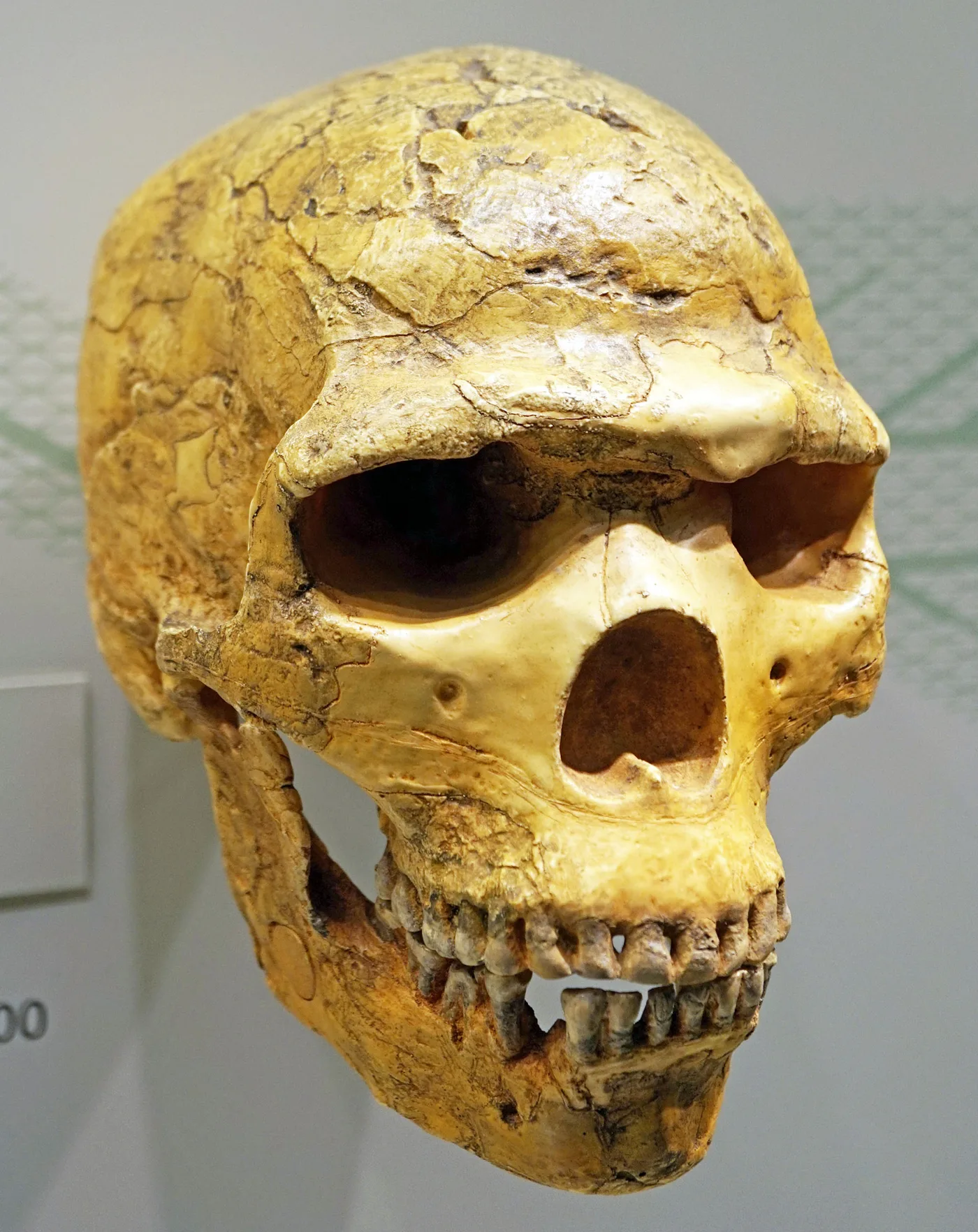
People carrying one copy of the variant show an average reduction of 0.85 cubic centimeters in occipital lobe volume, while homozygous carriers with two copies exhibit a 1.7-cubic-centimeter decrease. Ironically, Neanderthals themselves had larger, more elongated occipital regions than modern Homo sapiens.
«The changes aren’t caused by a Neanderthal gene itself, but by the way an ancient regulatory sequence modifies how our own human DAAM1 gene is expressed.»
Dr. Hugo Zeberg, Max Planck Institute for Evolutionary Anthropology
Up to 10% Lower Schizophrenia Risk With Zero Cognitive Penalty
The most intriguing clinical finding involves psychiatric health. Statistical modeling revealed that each copy of the Neanderthal variant near DAAM1 lowers an individual’s risk of developing schizophrenia by roughly 5 percent, scaling to nearly a 10 percent risk reduction in people carrying two copies.
Crucially, this structural trade-off carries no detectable penalty for intelligence or everyday cognition. Across tens of thousands of individuals, each copy accounted for a negligible difference equivalent to roughly two weeks of schooling over an entire lifetime—statistically indistinguishable from zero impact.
Modern biomedical research is increasingly pinpointing how subtle molecular switches govern complex conditions, as seen in our recent reports on an AI-designed protein that reactivates defective insulin receptors and blood biomarkers capable of forecasting heart attack and stroke risk 30 years in advance.
A 4-bp Neanderthal deletion on chromosome 14 regulates modern human gene expression.
Two copies reduce occipital lobe volume slightly without disrupting visual function.
Homozygous carriers show roughly 10% lower odds of developing schizophrenia.
Biobank data from tens of thousands confirms no meaningful drop in intelligence.
Why Ancient DNA Acts Opposite to Neanderthal Skull Anatomy
The mismatch between fossil anatomy and modern brain scans intrigued the researchers. Because Neanderthal crania featured a prominent occipital bun and enlarged visual cortex, one might expect Neanderthal DNA to expand the back of the brain rather than shrink it.
However, genetic regulation depends heavily on the surrounding genomic background. In modern Homo sapiens, the same regulatory deletion interacts with thousands of modern human genetic differences, producing a subtle pruning or down-regulation in occipital volume that may stabilize neural circuits against schizophrenia.
Biochemically, DAAM1 coordinates the actin cytoskeleton that guides axon growth and shapes dendritic spines during fetal brain development. Even a slight shift in how densely those visual-cortex connections branch can trim overall occipital tissue volume by a fraction of a percent while buffering developing neural networks against the synaptic dysregulation often linked to psychotic disorders.
Equally important, these findings challenge the simplistic notion that archaic DNA is uniformly detrimental: evolutionary history instead left modern humans with nuanced biological trade-offs where subtle cortical remodeling pairs with measurable protection against severe psychiatric illness.
Comparative genomics further underscores that different human populations carry distinct combinations of ancient regulatory elements, making large-scale biobank imaging essential for decoding how deep evolutionary history shapes modern brain health.
- A Neanderthal regulatory sequence near DAAM1 alters human gene activity rather than introducing a foreign protein.
- Modest occipital volume reductions (0.85–1.7 cm³) correlate with up to 10% lower schizophrenia risk.
- The discovery bridges evolutionary genetics and psychiatry without any negative impact on cognition.
Implications for Evolutionary Medicine and Neuroscience
Zeberg and Pääbo’s findings demonstrate that archaic hominins did not simply vanish—bits of their regulatory genome continue to shape human neurobiology and psychiatric resilience today.
Roughly 50,000 to 60,000 years ago, interbreeding after Homo sapiens expanded out of Africa left 1 to 2 percent Neanderthal ancestry in modern non-African populations. While natural selection purged many archaic segments over millennia, specific regulatory switches persisted where they offered subtle advantages in immune defense, metabolism, or neural circuit stability.
Future studies using brain organoids and single-cell sequencing will clarify exactly which visual-cortex neurons respond to DAAM1 modulation, potentially revealing new biological pathways for preventing schizophrenia without compromising cognitive performance.