

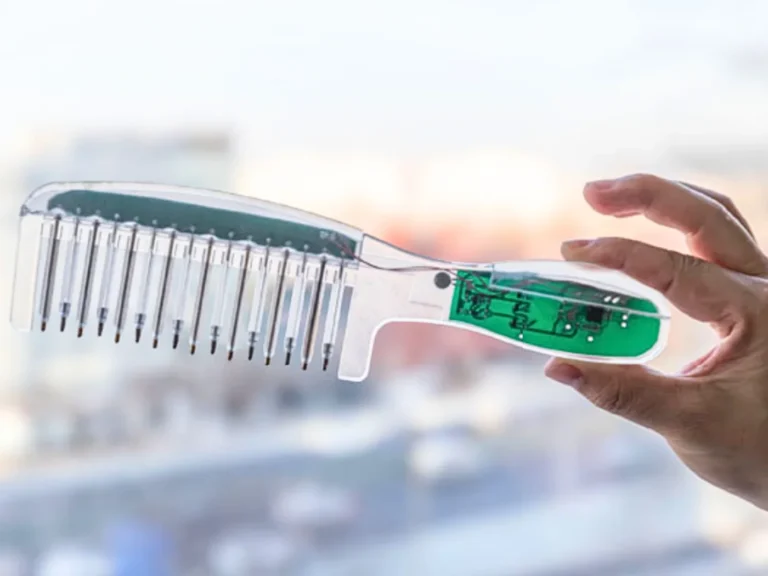

Androgenetic alopecia, commonly known as male- or female-pattern baldness, has frustrated dermatologists and afflicted hundreds of millions of people worldwide for generations. Existing pharmaceutical therapies often demand indefinite daily compliance, risk systemic hormonal disruptions, or struggle to penetrate the skin’s tough, hydrophobic lipid barrier. Now, bioengineers have unveiled an experimental electric comb for hair loss named Detangle that restored nearly 100% of lost fur on balding mice within just four weeks, radically outperforming standard gold-standard pharmaceuticals.
The Pathology of Alopecia: Why Conventional Topical Therapies Struggle
Pattern hair loss is orchestrated by a destructive convergence of endocrine signaling, genetic susceptibility, and microvascular starvation. In genetically predisposed individuals, circulating testosterone is converted by the membrane-bound enzyme 5-alpha-reductase type 2 (SRD5A2) into dihydrotestosterone (DHT). When DHT binds to androgen receptors located in the dermal papilla cells at the root of the hair follicle, it initiates progressive miniaturization.
During miniaturization, the active growth phase of the hair cycle (anagen) dwindles from several years to mere weeks, while the resting phase (telogen) elongates. Concurrently, the vital microcapillary network cradling the follicle bulb atrophies, starving hair follicle stem cells of oxygen and essential nutrients.
Simultaneously, surrounding tissue accumulates cellular senescence markers and transforming growth factor-beta (TGF-β), driving progressive perifollicular fibrosis. This extracellular stiffening physically constricts the follicle shaft, preventing the re-emergence of robust terminal hairs.
Conventional frontline therapies suffer from stark clinical limitations. Topical minoxidil primarily acts as a non-specific vasodilator, exhibiting poor stratum corneum penetration and requiring daily lifelong application that frequently induces allergic dermatitis. Oral finasteride inhibits 5-alpha-reductase, but circulating systemically throughout the body, it poses non-trivial risks of endocrine imbalance, mood disorders, and sexual dysfunction. Bypassing the stratum corneum—a hydrophobic shield of cornified keratinocytes and intercellular lipids—with targeted genetic therapies has historically necessitated painful, invasive clinical microneedling or scalp injections.
The Detangle Architecture: Staggered Teeth and Contact Electroporation
Taking playful inspiration from the Rapunzel legend and Disney’s animated film Tangled, researchers from Beihang University in Beijing and the City University of Hong Kong engineered a bioelectronic grooming instrument called Detangle. Their findings were recently published in the prestigious journal Nature Communications.
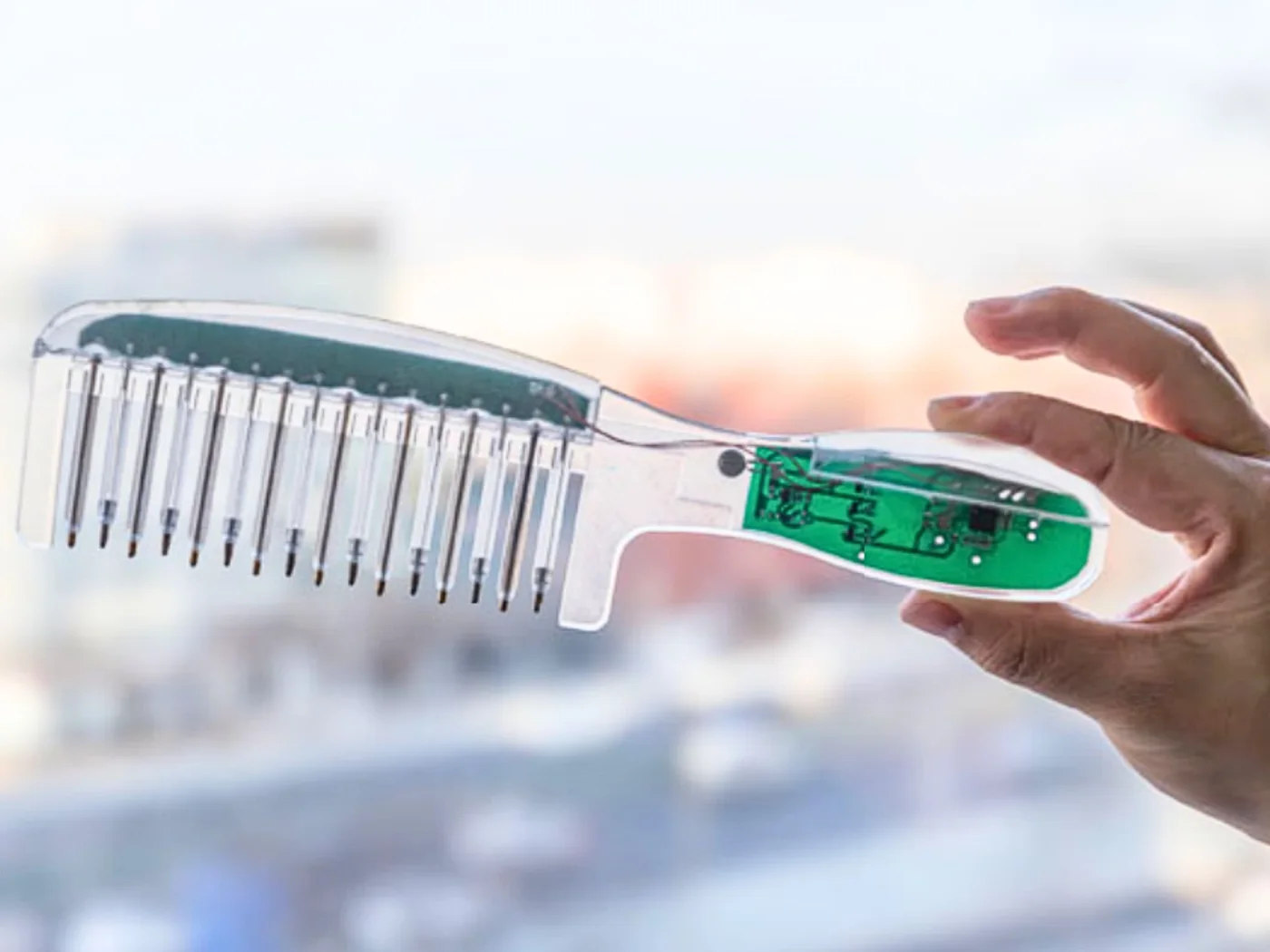
Superficially, Detangle resembles a sleek personal hairbrush. Internally, its handle houses a microelectronic pulse-control circuit board, while its bristle array features an alternating geometry of electrodes and microfluidic dispensers. The longer teeth gently furrow and stretch the skin during combing, while the interspersed shorter teeth house contact-activated therapeutic reservoirs operating similarly to ballpoint pen refills.
This height differential is mathematically crucial: gliding across the contoured scalp generates a localized, directional pulsed electric field more than 2.5 times stronger than flat electrode arrays. The brief electrical pulses trigger localized electroporation—transiently destabilizing lipid bilayers to form nanoscale hydrophilic pores in follicle cell membranes. This enables therapeutics to penetrate approximately 9 times deeper into follicular dermal papillae than passive topical solutions.
Moreover, the electric pulses activate voltage-gated calcium channels across cell membranes. The influx of intracellular Ca2+ ions stimulates the canonical Wnt/β-catenin signaling pathway, mobilizing dormant hair follicle stem cells residing in the hair bulge and driving their rapid re-entry into the active proliferative anagen phase.
«By synchronizing mechanical skin deformation with pulsed electrostimulation, we bypassed the stubborn stratum corneum barrier. This localized electroporation delivers targeted genetic therapies deep into the dermal papilla without systemic hormonal consequences.»
Dr. Liu and colleagues, Bioelectronics Research Team, Beihang University
Dual Molecular Cargo: Revascularization and Localized DHT Silencing
While mild microcurrent stimulation inherently invigorates follicular cellular metabolism, the true breakthrough of Detangle lies in synchronizing electric pulses with the deep delivery of a tailored dual-action genetic payload.
The first therapeutic agent is a vascular endothelial growth factor A (VEGFA) plasmid. Driven through cell membranes by electroporation, the plasmid stimulates intense localized angiogenesis, reconstructing a rich microcapillary bed around dormant follicles to restore essential oxygenation.
The second agent is a small interfering RNA (siRNA) specifically engineered to silence the SRD5A2 gene. By degrading the messenger RNA of 5-alpha-reductase type 2 directly inside follicular tissue, the comb halts the local enzymatic conversion of testosterone to DHT. Crucially, because this gene silencing is strictly confined to the dermal papilla, it eliminates DHT without entering systemic circulation, avoiding the endocrine side effects that plague oral medications.
This synergistic combination concurrently neutralizes the underlying hormonal insult while restoring the microvascular pipeline required to sustain long-term terminal hair growth.
In controlled murine models, the Detangle bioelectronic comb restored 97.85% of hair coverage within 4 weeks using treatments spaced every 3 days.
Directional pulsed electric fields induce transient electroporation, transporting therapeutic genetic plasmids 9 times deeper than passive lotions.
Small interfering RNA specifically halts 5-alpha-reductase within follicle tissue, avoiding the systemic hormonal disruptions of oral drugs.
VEGFA plasmids rebuild dense microvascular capillary beds around starved follicles, delivering fresh oxygenation to dividing matrix cells.
Preclinical Results: 97.85% Hair Regrowth Within 28 Days
The efficacy of the Detangle system was evaluated across rigorous preclinical trials on murine models subjected to testosterone-induced androgenetic alopecia. Shaved cohorts were divided into control groups, daily 5% topical minoxidil, oral finasteride, and Detangle electrostimulation combined with the dual genetic payload administered every three days.
The quantitative results were dramatic. By day 28 (four weeks), mice treated with Detangle achieved **97.85% to nearly 100% hair regrowth coverage** across the treated patch.
In stark contrast, mice receiving daily minoxidil achieved approximately 70% hair coverage, while the finasteride cohort hovered near 50%. Histological tissue biopsies confirmed that Detangle dramatically increased follicle density, stimulated anagen-phase re-entry, and substantially thickened individual hair shaft diameters.
Biomechanical tensile evaluations confirmed that the newly regenerated fur exhibited normal eumelanin pigmentation, mature cuticle alignment, and robust tensile strength indistinguishable from unaffected wild-type mice.
- Staggered electrode teeth generate electric fields 2.5x stronger than flat arrays by furrowing the skin during combing.
- Pulsed electroporation delivers non-invasive gene vectors across the stratum corneum barrier without needles.
- The device substantially outperformed minoxidil (97.85% vs 70% regrowth) in pre-clinical murine models.
- The technology is currently pre-clinical; human clinical trials are necessary to confirm safety and therapeutic dosage.
Comparison with Surgical Transplantation and Clinical Horizon
Currently, the definitive surgical remedy for advanced pattern baldness has been autologous hair transplantation via Follicular Unit Extraction (FUE) or Follicular Unit Transplantation (FUT). However, surgical grafting incurs costs in the thousands of dollars, leaves microscopic scarring, and fails to arrest the ongoing genetic loss of native, non-transplanted surrounding follicles.
As documented across advanced fields of cellular biology and regenerative medicine, translating pre-clinical murine success to clinical human efficacy demands meticulous verification.
Human scalp tissue exhibits a thicker epidermis, denser fibrous connective tissue, and significantly deeper follicle bulbs than rodent models. The research team is currently refining pulse amplitudes, frequency intervals, and bristle geometries to commence Phase 1 human safety trials. If validated in clinical trials, the Detangle platform could pioneer a transformative new era of pain-free, home-based bioelectronic hair restoration.