


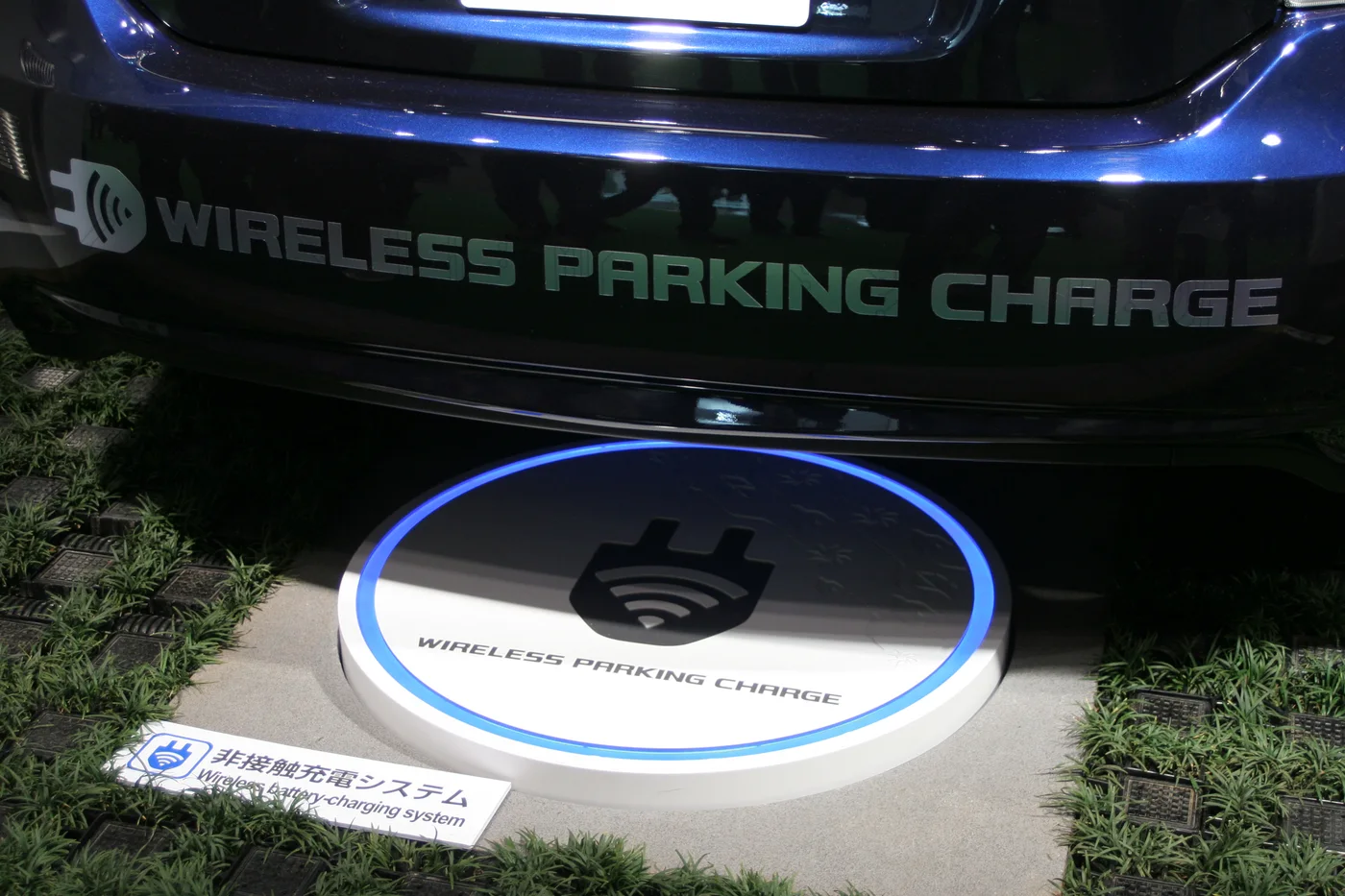
For millions of electric vehicle drivers, the ultimate dream is a future where cumbersome charging cables, stubborn connectors, and crowded public stations vanish entirely, replaced by seamless, hands-free wireless power delivery embedded in parking spaces. Yet the critical technological roadblock to commercialization has always been geometric precision: high-efficiency wireless EV charging demands near-flawless alignment between ground and vehicle coils. Now, engineers have unveiled a breakthrough Ultra-Wideband (UWB) radio positioning system capable of aligning power coils with astounding sub-millimeter precision simply by parking.
Resonant Inductive Physics and the Penalty of Coil Misalignment
Modern high-power wireless electric vehicle charging relies on resonant magnetic inductive coupling (Magnetic Resonance Coupling). A primary transmitting coil embedded beneath the pavement is energized by a high-frequency power inverter (standardized at approximately 85 kHz under SAE J2954 guidelines), transferring energy across a 10 to 25 centimeter air gap to a secondary receiving coil mounted under the chassis.
When the coils are coaxially aligned, energy transfer efficiency routinely exceeds 92% to 94%, matching or even surpassing conventional DC plug-in systems. However, real-world parking rarely achieves laboratory conditions.
If a driver or automated parking system drifts just 5 to 10 centimeters off-center, the magnetic coupling coefficient plunges precipitously. Internal electrical resistance spikes, charging speeds drop dramatically, and stray electromagnetic flux induces parasitic eddy currents that overheat adjacent metal chassis components. Sustaining high-power charging rates (from 11 kW residential pads to 50 kW fleet fast-chargers) necessitates alignment tolerances measured in mere millimeters.
Human drivers routinely struggle to manually park with millimeter accuracy, particularly in confined commercial parking bays, dimly lit subterranean structures, or across slick winter ice.
Sensor Shortcomings: Why Vision Cameras and Magnetic Sensors Stumble
Historically, automotive engineers approached coil guidance through two primary modalities: surround-view optical cameras and low-frequency magnetic gradient sensors.
Magnetic sensors provide decent close-range feedback but function poorly beyond 5 to 8 centimeters of separation, frequently distorted by the heavy steel rebar reinforcing concrete garage floors. Optical computer vision cameras, while capable of identifying ground pads from several meters away, degrade rapidly under hostile environmental conditions: heavy downpours, thick fog, blinding snow, road grime, or autumn leaves obscuring ground markers.
As demonstrated in advanced studies of autonomous robotic engineering and transport, robust operational resilience requires all-weather radio-frequency solutions immune to optical degradation.
Additionally, high-power inductive systems demand rigorous Foreign Object Debris (FOD) detection. Stray conductive items—such as discarded aluminum soda cans, loose keys, or iron bolts—trapped in an 11 kW alternating magnetic field rapidly heat to over 300°C via magnetic induction, posing severe fire hazards. UWB radio sensors double as high-resolution micro-radars, detecting metallic foreign objects prior to energizing the high-power coil.
«We are stepping into a future where EVs charge simply by parking. Radio-frequency positioning eliminates vulnerability to rain, snow, and human parking variability, securing peak electrical transfer efficiency every single time.»
Owen Hughes, Technology & Autonomous Mobility Editor
Borrowing from Digital Car Keys: The Ultra-Wideband (UWB) Architecture
The newly developed system, detailed in the peer-reviewed journal IEEE Transactions on Microwave Theory and Techniques, adapts the core radio-frequency architecture used in modern digital smartphone car keys (Apple CarKey, Ultra-Wideband IEEE 802.15.4z).
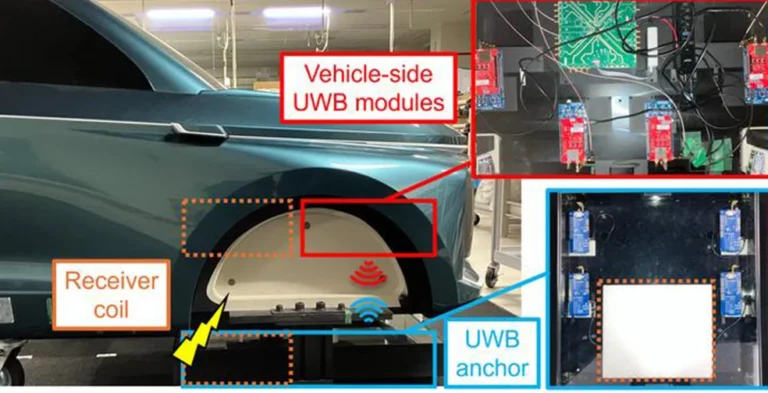
The setup incorporates four miniature UWB transceiver transponders mounted around the vehicle’s underbody receiving coil, communicating with four stationary antennas placed symmetrically around the ground transmitter pad. The system evaluates both Time-of-Flight (ToF) and Angle-of-Arrival (AoA) phase discrepancies in nanosecond radio pulses.
Because UWB pulses occupy massive frequency bandwidths (typically spanning 500 MHz or more), individual signal arrivals can be isolated with picosecond time resolution, completely filtering out multi-path reflections echoing off the metallic undercarriage.
This provides microsecond latency: as an EV approaches a bay, the system immediately pairs with the pad, projecting real-time millimeter guidance vectors onto the head-up display or feeding directly into the automated parking controller.
The 4-antenna UWB array measures picosecond Time-of-Flight signals, pinpointing the receiving coil with 2.32 mm spatial precision and 0.25° angular alignment.
Unlike vision sensors, ultra-wideband radio waves easily penetrate torrential rain, slush, mud, darkness, and wet leaves obscuring the pavement pad.
Proprietary calibration algorithms eliminate multi-path signal bounces off the vehicle’s steel undercarriage, slashing overall positioning error by 5x.
Eliminating manual cables and robotic arms allows autonomous ride-hailing fleets to self-align and recharge seamlessly without human intervention.
Sub-Millimeter Precision: Laboratory Proof of Concept
The team’s paramount achievement lies in an adaptive algorithmic calibration model designed to compensate for electromagnetic wave distortion. The vehicle’s heavy aluminum battery enclosure and the ferrite backing plates of the charging coils naturally distort incoming radio wavefronts.
By modeling and suppressing these hardware-induced signal perturbations, the researchers curtailed overall spatial positioning error by more than five-fold.
In rigorous validation trials using a mobile scaled vehicular platform, the system localized the charging coil to within **0.09 inches (2.32 millimeters)** of true physical center, while restricting angular orientation error to under **0.25 degrees**. This ensures the vehicle initiates inductive power transfer at absolute peak magnetic coupling the instant motion ceases.
The system also precisely calibrates vertical clearance along the Z-axis. Under SAE J2954 guidelines, ground clearance is classified into Z1 (100–150 mm), Z2 (140–210 mm), and Z3 (170–250 mm) envelopes. Continuous radio telemetry enables adaptive air suspension systems to adjust ride height dynamically for maximum magnetic flux density.
- Coaxial coil alignment is mandatory to maintain peak 92–94% resonant inductive electrical power transfer efficiency.
- Ultra-Wideband Time-of-Flight radio pulses deliver sub-millimeter guidance immune to rain, dirt, and ambient lighting.
- Angular correction within 0.25 degrees prevents dangerous localized inductive heating of chassis metals.
- The technology directly integrates with existing Level 4 automated valet parking algorithms for production electric cars.
Catalyst for Autonomous Fleets, Highway Charging, and Smart Cities
The implications of millimeter-accurate wireless positioning extend far beyond private driveways. It represents an indispensable milestone for commercial autonomous mobility (robotaxis, delivery pods, and electric transit shuttles). Self-driving fleets require completely hands-off replenishment without relying on robotic mechanical arms or human service attendants.
Looking ahead, this positioning architecture establishes the foundational framework for dynamic “in-motion” wireless charging lanes on electrified highways (Dynamic Wireless Power Transfer, DWPT). Electrified commercial corridors currently trialed in Sweden, Germany, and Detroit could continuously replenish long-haul electric semis traveling at 100 km/h, slashing required battery capacities by up to 50% and fundamentally transforming transportation economics.
The engineering team is currently preparing full-scale outdoor field trials across production electric SUVs, subjecting the transponders to real-world road slush, winter salt, and extreme temperature cycling.