

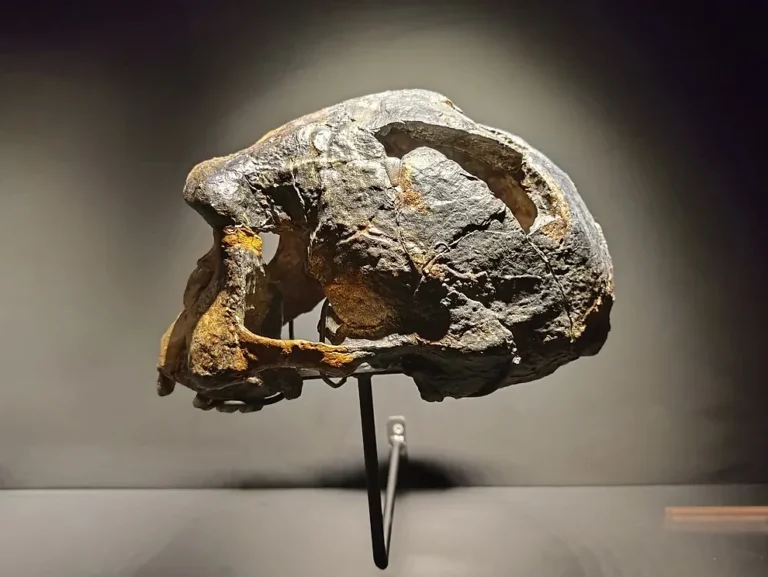

The global paleoanthropological consensus has been dramatically reshaped by a landmark study published in Nature: fossil evidence confirms that Homo erectus in China survived at least 215,000 years longer than established academic paradigms suggested. Rigorous excavations in the Baxian and Naxian karst caves of southern China’s Guangxi region revealed that these archaic hominins not only averted extinction 400,000 years ago during Middle Pleistocene climate oscillations, but masterfully adapted to life within dense, closed-canopy tropical rainforests. Furthermore, their revised chronological timeline directly overlaps with the geographic expansion of the enigmatic Denisovans, illuminating an unprecedented chapter of coexistence, ecological interaction, and probable interspecies hybridization.
Chronological Paradigm Shift: Rewriting Asian Paleoanthropology
For nearly a century, textbook narratives of human evolution positioned the disappearance of Homo erectus on the Asian mainland around 400,000 years ago. Ever since the iconic Zhoukoudian excavations near Beijing unearthed “Peking Man,” anthropologists largely assumed that shifting Middle Pleistocene glacial cycles drove continental populations to extinction. The sole known survivors were thought to be the relict Ngandong hominins on the island of Java in Indonesia, preserved merely by geographic insularity.
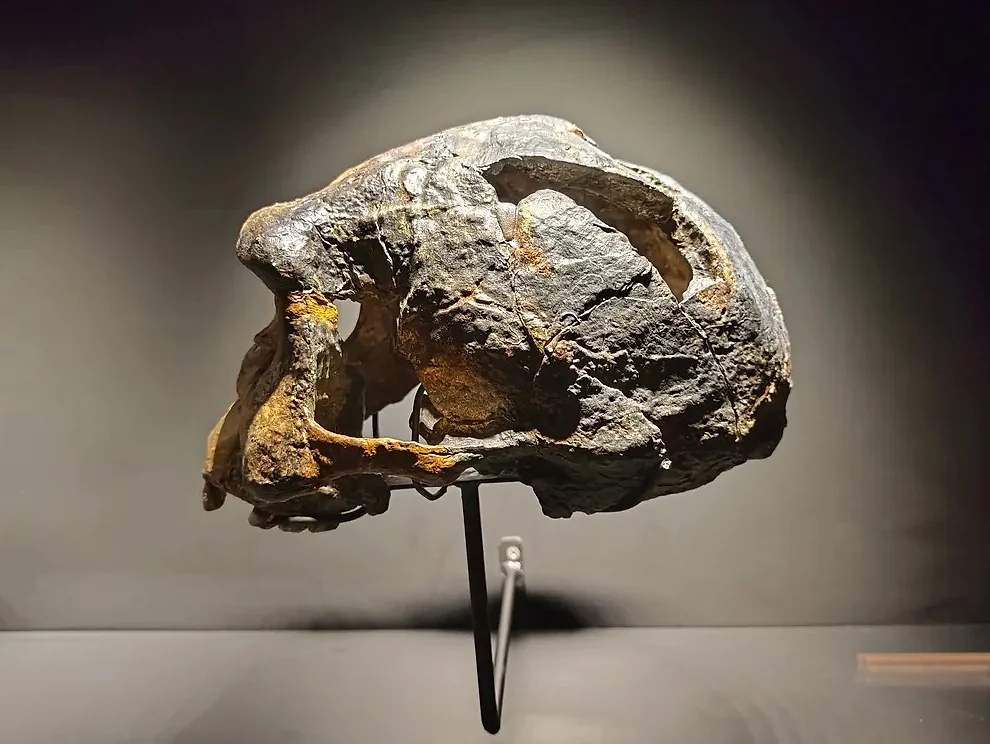
However, companion papers published in Nature by an international research coalition led by paleoanthropologist Dr. Yingqi Zhang of the Institute of Vertebrate Paleontology and Paleoanthropology (IVPP) and geochronologist Dr. Kira Westaway of Macquarie University have shattered that view. Excavations in the Baxian and Naxian karst caves near Chongzuo in the Guangxi Zhuang Autonomous Region recovered well-preserved hominin teeth securely dated to between 324,000 and 184,000 years ago, demonstrating that Homo erectus survived on the Asian mainland for an astounding 215,000 years longer than previously accepted.
Dental Paleoproteomics: Molecular Confirmation of Ancient Lineages
Morphological dental analysis in archaic anthropology can occasionally introduce ambiguity due to overlapping morphological traits among Middle Pleistocene hominins. To achieve indisputable taxonomic certainty, a specialized team headed by paleoproteomics pioneer Dr. Frido Welker at the University of Copenhagen subjected the enamel to ultra-high-resolution tandem mass spectrometry.
Enamel proteins—notably amelogenin and enamelin—possess rigid crystalline protection, enduring for millions of years even in the humid subtropical climate of southern China. Mass spectrometry isolated distinct amino acid sequences identical to Homo erectus reference markers, definitively differentiating the teeth from Neanderthals, Denisovans, and early Homo sapiens.
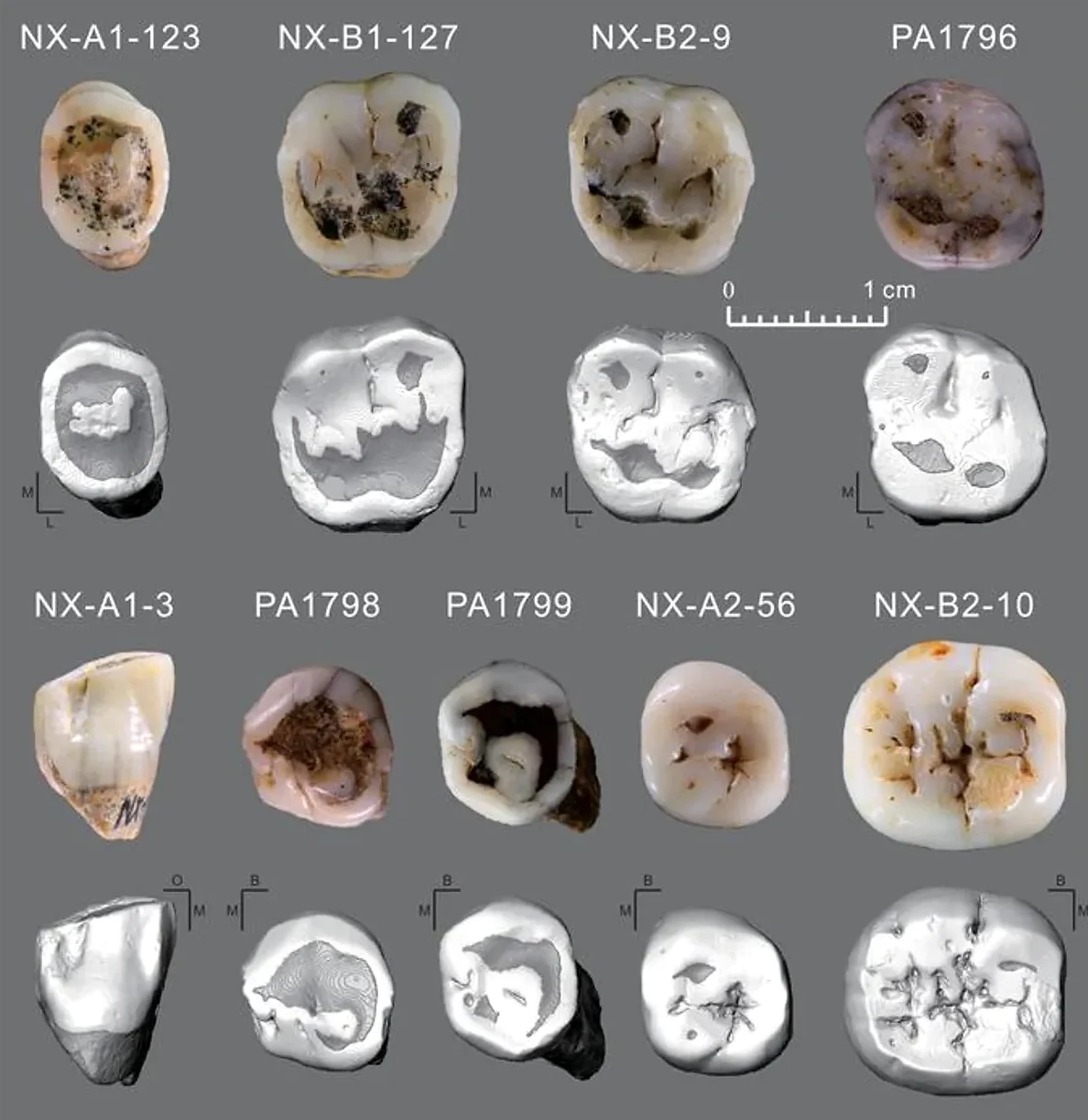
Simultaneously, micro-computed tomography (micro-CT) mapped the enamel-dentine junction (EDJ). The pronounced enamel thickness, expansive pulp chamber geometry, and specific cusp morphology across eight molars matched classic mainland Homo erectus profiles, confirming that the fossils represented authentic descendants of our early ancestors.
«We have long stereotyped Homo erectus as a creature strictly confined to open savannahs who simply vanished when dense forests expanded. The discoveries from Baxian completely shatter that assumption: they were remarkably adaptable, thriving within deep jungle canopies and sharing valleys with other ancient human populations.»
Dr. Kira Westaway, Geochronologist and Professor at Macquarie University
Conquering the Canopy: Debunking the Savanna Limitations of Early Hominins
Perhaps the most startling revelation of the Baxian discoveries lies in their environmental setting. Evolutionary theory has long maintained that dense, closed-canopy tropical rainforests were an impassable barrier for archaic humans. The scarcity of ground-level carbohydrates, predatory hazards, and navigational difficulty were presumed to require advanced technological toolkits—such as projectile weapons, snare traps, and complex syntax—attributed exclusively to modern Homo sapiens.
Environmental reconstructions directed by Dr. Renaud Joannes-Boyau of Southern Cross University overturned this assumption. Alongside human teeth, researchers excavated over 18,000 vertebrate fossils, dominated by obligate closed-canopy species: extinct dwarf giant pandas (Ailuropoda baconi), Malayan tapirs, orangutans (Pongo weidenreichi), and gibbons.
Stable carbon isotope analysis (^13C) revealed a pronounced “canopy effect,” confirming that these hominins sourced their nutrients primarily beneath heavy forest canopies. This proves that Homo erectus possessed the behavioural plasticity to flourish in dense jungle environments hundreds of thousands of years before modern humans arrived.
The international team utilized tandem mass spectrometry to recover ancient protein chains trapped within tooth enamel. Eight of nine teeth yielded distinct peptide biomarkers exclusive to the lineage of Homo erectus.
Carbon and oxygen stable isotope values across hominin teeth and over 18,000 mammalian bones demonstrated continuous foraging under heavy tropical canopy foliage, debunking open-savannah limitations.
The ninth recovered molar features an exceptionally robust crown and root configuration that deviates sharply from Homo erectus, exhibiting close morphological parallels to high-altitude Tibetan Denisovans.
To establish an unshakeable timeline, scientists cross-validated 43 radiometric measurements: post-infrared stimulated luminescence (pIR-IRSL), electron spin resonance (ESR), and speleothem uranium-series dating.
The PA1796 Enigma: Did Homo erectus and Denisovans Mingle in Guangxi?
Considerable scientific interest focuses on a ninth molar designated specimen PA1796. This upper second molar possesses massive bifurcated roots and an intricate occlusal crest pattern that is entirely inconsistent with Homo erectus, modern humans, or Neanderthals.
Instead, PA1796 displays strong morphological affinities with Denisovan dental specimens discovered in Tibet’s Baishiya Karst Cave and Laos’s Tam Ngu Hao 2 cave. This strongly suggests that approximately 200,000 years ago, both Homo erectus and Denisovans inhabited the same karst valley in southern China.
Geneticists have established that indigenous populations across Australasia carry 4% to 6% Denisovan DNA, and Denisovan genomes contain genetic signatures from an unidentified “super-archaic ghost lineage.” The Baxian Cave discoveries provide concrete physical evidence that this ghost lineage could indeed have been late-surviving Asian Homo erectus.
- Homo erectus persisted in southern China between 324,000 and 184,000 years ago, outlasting northern Peking Man populations by over two centuries of millennia.
- Overturned the foundational paradigm that archaic hominins lacked the cultural and ecological flexibility to colonize equatorial rainforest ecosystems.
- Strontium isotope mapping revealed extensive mobility: family troops actively traversed broad mountainous karst corridors rather than remaining sedentary.
- Provides tangible archaeological evidence for direct spatial and temporal overlap between late Homo erectus, Denisovans, and expanding early modern human lineages.
Deep Human Prehistory and Emerging Archaeological Horizons
The Guangxi discoveries showcase that human evolution was not a linear sequence of replacement, but a rich, braided stream of interacting populations. Just as ancient hunting tools in the Arabian desert highlight the adaptive ingenuity of early humans, the cave fossils of southern China prove the remarkable resilience of archaic hominins in diverse ecosystems.
As ongoing excavations extend across karst corridors in China, Vietnam, and Laos, scientists anticipate further revelations regarding Middle Pleistocene hominin interactions, underscoring that our ancestral story was far more interconnected and diverse than previously imagined.