



When the human mind ventures into altered states where ordinary coordinates of time and space dissolve into intricate fractals, the vast majority of individuals encounter an extraordinary cognitive anomaly: a profound paradoxical feeling in psychedelic users leads over 90% of respondents to experience an overwhelming, comforting sensation of “coming home” to places, dimensions, and entities they have never consciously encountered. A landmark investigation published in the peer-reviewed Journal of Psychoactive Drugs represents the first rigorous scientific inquiry into this universal phenomenon. An international team of neuroscientists and cognitive psychiatrists demonstrated that classic psychedelics temporarily decouple two foundational memory systems in the human brain: the feeling of raw familiarity and the contextual retrieval of episodic memory.
The Paradox of the Unfamiliar Home: The Psychology of Homecoming
Classic psychedelic compounds—including psilocybin, LSD, DMT, and mescaline—are globally celebrated for inducing profound subjective novelty. Under their influence, individuals navigate intricate multidimensional geometric fractals, witness ego dissolution, and interact with complex cognitive archetypes. Intuition suggests that entering such radically unfamiliar territory should evoke disorientation, alien detachment, or acute fear.

Yet clinical and naturalistic reports consistently document the exact opposite: rather than feeling alienated, individuals frequently report an overwhelming sensation of returning to the most intimate, sacred, and familiar home in existence. A research team led by Dr. David Wyndham Lawrence of the Temerty Faculty of Medicine at the University of Toronto set out to investigate the neural mechanisms underlying this widespread sensation.
In a comparative study published in the Journal of Psychoactive Drugs, the researchers contrasted everyday déjà vu, vivid autobiographical memories, and psychedelic-evoked familiarity (PEF). The survey results were striking: more than 90% of participants confirmed having experienced intense, undeniable familiarity with entities, visions, or cosmic dimensions they had never encountered in baseline waking life.
The Neurobiology of Recognition: Decoupling Familiarity from Context
To understand how the brain can mistake the unprecedented for the intimate, one must examine the dual-process architecture of human memory. Cognitive neuroscience distinguishes between two independent yet synchronized processes: familiarity (the raw, intuitive feeling of having experienced something before) and recollection (the conscious retrieval of specific context, such as time, place, and accompanying details).
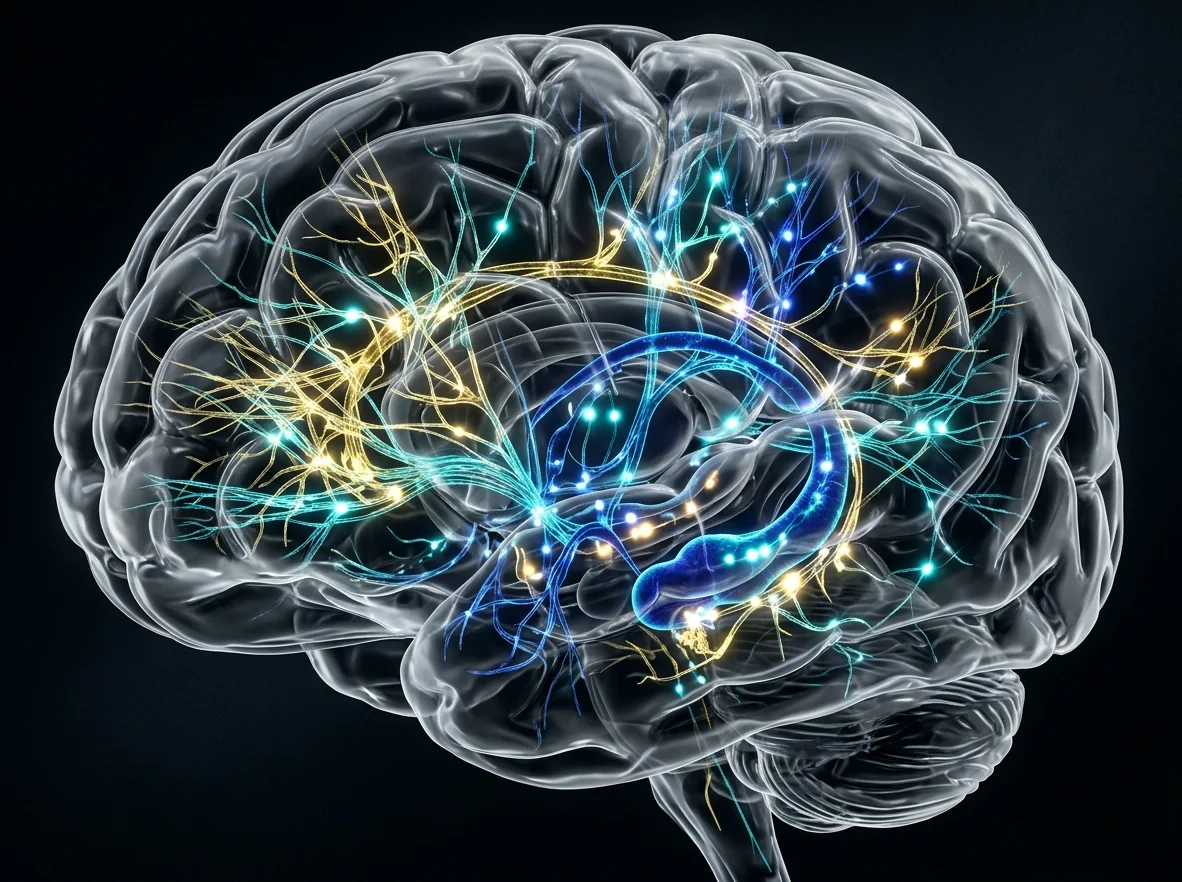
The familiarity signal is generated within the parahippocampal gyrus, specifically the perirhinal cortex. It operates as a rapid, heuristic assessment mechanism that signals recognition in milliseconds. Meanwhile, the hippocampus acts as the librarian, retrieving the contextual dossier. Under normal physiological conditions, these circuits operate in tight coordination to prevent false recognition.
As co-author Dr. Manoj K. Doss of Dell Medical School at the University of Texas at Austin explains, psychedelics disrupt this balance. By binding to serotonin 5-HT2A receptors, these compounds trigger intense neural firing across parahippocampal networks, flooding consciousness with a pure familiarity signal. Because the hippocampus finds no corresponding episodic memory in storage, this sensation of deep belonging is mapped onto whatever surreal imagery is currently occupying the mind.
«What makes this phenomenon truly remarkable is that this acute sense of familiarity occurs in the middle of completely alien, surreal landscapes. It does not feel like typical déjà vu, which is eerie and brief; psychedelic familiarity is experienced as a profound, authentic truth about existence, as if one has finally remembered something fundamental.»
Dr. David Wyndham Lawrence, M.D., Temerty Faculty of Medicine, University of Toronto
Everyday Déjà Vu vs. Psychedelic Familiarity: A Crucial Distinction
While people frequently equate this phenomenon with standard déjà vu, Dr. Akira Robert O’Connor of the University of St Andrews—a leading global authority on the neuroscience of déjà vu—points to critical empirical differences between the two states.
Everyday déjà vu is defined by cognitive conflict. When someone visits a foreign city and feels an eerie sense of familiarity, they immediately recognize the glitch: “I know I have never been here before, so my brain is making a mistake.” Frontal executive networks rapidly assess the error and dampen the feeling within seconds.
In contrast, psychedelic-evoked familiarity is experienced without conflict. Participants do not perceive the feeling as a glitch, but rather as an awakening or the lifting of a cosmic amnesia. Furthermore, while typical déjà vu dissipates in seconds, psychedelic familiarity can persist for hours, accompanied by profound emotional catharsis and tears of joy.
The parahippocampal cortex triggers isolated familiarity signaling independently of the hippocampus, which normally provides context regarding when and where an event took place, producing raw recognition.
Agonism of cortical 5-HT2A receptors destabilizes the default mode network (DMN) and loosens sensory gating, blurring boundaries between external stimuli and the foundational sense of self.
Over 90% of study participants described the experience as returning to a primal home or remembering something eternal, providing profound emotional security rather than disorientation.
Clinical neuroscientists believe this intense feeling of primal safety alleviates existential dread in patients suffering from major depressive disorder, PTSD, and end-of-life anxiety.
Predictive Processing: The Relaxation of High-Level Priors
Another compelling framework explaining PEF stems from the predictive processing model of brain function. The brain operates as a prediction engine, constantly forecasting incoming sensory data based on prior internal models. When sensory input deviates from expectation, the system generates a “prediction error” to flag novelty.
Under the REBUS (Relaxed Beliefs Under Psychedelics) model, 5-HT2A receptor agonists reduce the precision of high-level cognitive constraints and prior assumptions. In this state of relaxed neural gating, sensory input is no longer treated as conflicting or unexpected. Everything perceived is effortlessly assimilated as natural, harmonious, and anticipated, generating the compelling subjective illusion that the scenario has always been known.
- A comprehensive cross-sectional study revealed that over 90% of psychedelic users consistently report profound feelings of familiarity during altered states.
- Unlike everyday déjà vu, which is recognized as an error, PEF is felt as emotionally authentic, transcendent, and profoundly reassuring.
- Neuroimaging models suggest psychedelics trigger hyperactive familiarity signaling in the parahippocampal gyrus while episodic memory retrieval remains quiet.
- The intensity of this paradoxical familiarity correlates positively with sustained long-term improvements in psychological well-being and therapeutic outcomes.
Therapeutic Implications: Finding Solace in the Primal Self
Deciphering the neuroscience of psychedelic familiarity holds profound implications for clinical medicine. Academic centers worldwide are actively researching psychedelic-assisted psychotherapy for treatment-resistant depression, post-traumatic stress disorder, and end-of-life anxiety. Just as advances in neural decoding unravel brain patterns, mapping consciousness states empowers clinicians to optimize therapeutic outcomes.
The feeling of “coming home” serves as a powerful psychological buffer against existential distress. Individuals trapped in chronic isolation, trauma, or despair experience a profound, embodied reassurance that fundamentally reframes their emotional outlook. This visceral sense of safety fosters enduring neuroplasticity, offering lasting relief long after the acute pharmacological effects subside.