

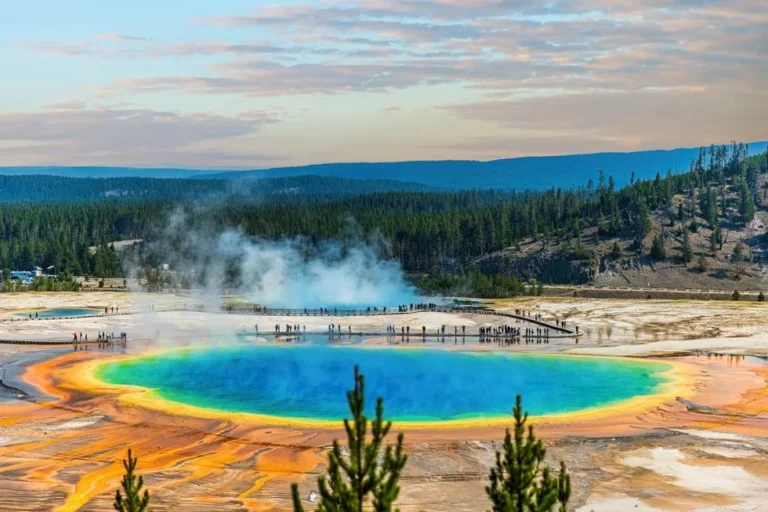

Across the volcanic expanses of North America, Yellowstone geothermal pools present one of nature’s most mesmerizing optical spectacles: while the scorching epicenters of deep hydrothermal vents radiate an intense electric blue glow, their surrounding shallow runoff terraces erupt in vivid concentric rings of yellow, orange, emerald, and russet. Far from mere aesthetic coincidence, this breathtaking natural canvas is governed by an exquisite interplay of molecular quantum optics, hydrothermal silica geochemistry, and the extraordinary evolutionary adaptations of heat-loving extremophile microorganisms.
The Physics of Pure Light: Why the Hottest Yellowstone Geothermal Pools Glow Electric Blue
A persistent popular misconception suggests that large bodies of natural water appear blue merely by mirroring the clear daytime sky. However, at iconic hydrothermal landmarks like Sapphire Pool in Biscuit Basin or the vast boiling center of Grand Prismatic Spring, the striking electric blue hue persists unabated even beneath dense cloud cover and heavy atmospheric mist. The true genesis of this coloration lies in the fundamental optical mechanics of the water molecule (H₂O) itself.
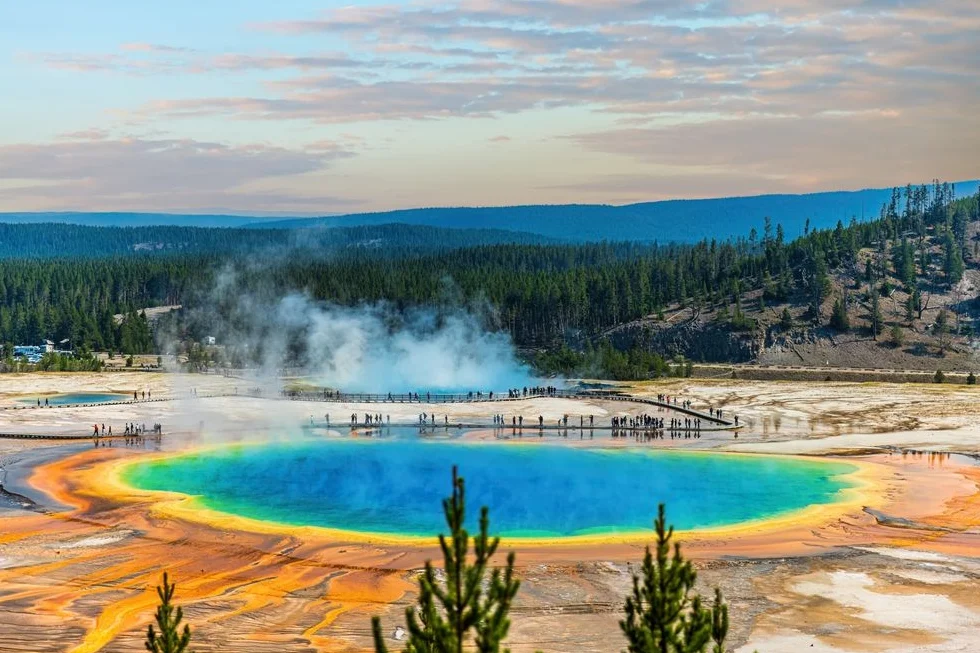
Clean water acts as a selective spectral filter. As white sunlight penetrates deep into a crystal-clear spring, the red, orange, and yellow wavelengths are absorbed by overtone vibrational transitions of the covalent O-H bonds far more aggressively than shorter blue and violet wavelengths. By the time sunlight penetrates several meters into the vent, red photons are thoroughly stripped away, leaving only pure, scattered blue light. Earlier, we explored how precise laboratory analyses illuminate the hidden mechanisms of natural systems.
This optical effect is dramatically magnified by colloidal silica deposits. Superheated water circulating deep within the Yellowstone caldera dissolves silica from subterranean rhyolite volcanic rock under extreme pressure. As the water surfaces and cools, silicon dioxide (SiO₂) precipitates onto the pool basin floor as pristine, reflective siliceous sinter (geyserite). This bright white mineral floor acts as an ideal diffuse reflector, bouncing the filtered blue light back up through the column to create an incandescent, electric luminescent glow.
Beyond intrinsic vibrational absorption, submicron colloidal silica suspensions introduce significant Rayleigh scattering within the water column. Nanoscale silica clusters measuring under 100 nanometers remain suspended in the convective upwellings. Because Rayleigh scattering intensity scales inversely with the fourth power of the wavelength (1/λ⁴), short blue photons are scattered at high angles nearly ten times more effectively than red light, imparting a mesmerizing opalescent radiance to the thermal water.
The Barrier of Thermal Sterility: Why Boiling Centers Remain Crystal Clear
Why do the deep centers of these springs remain perpetually crystalline rather than becoming murky with algal blooms or organic debris? The answer lies in lethal thermodynamic conditions. In central vents, where subterranean water surges from magma-heated chambers, water temperatures routinely reach 90°C to 93°C (194°F to 200°F)—which, at Yellowstone’s high elevation of over 2,200 meters (7,300 feet), represents the localized boiling point.
Across all biological systems on Earth, the absolute upper thermal limit for photosynthetic life (chlorophyll function) is precisely 73°C (163°F). Beyond this threshold, chlorophyll pigments disintegrate, and the complex protein assemblies required for light-harvesting irreversibly denature. No photosynthetic organism or microscopic algae can survive in the boiling core of Sapphire Pool.
This fierce thermal sterility keeps the core pristine. Bereft of biological biomass, cellular suspensions, or masking organic pigments, the water behaves as an unadulterated physical optical medium, allowing Rayleigh scattering and intrinsic molecular absorption to display their pure chromatic splendor.
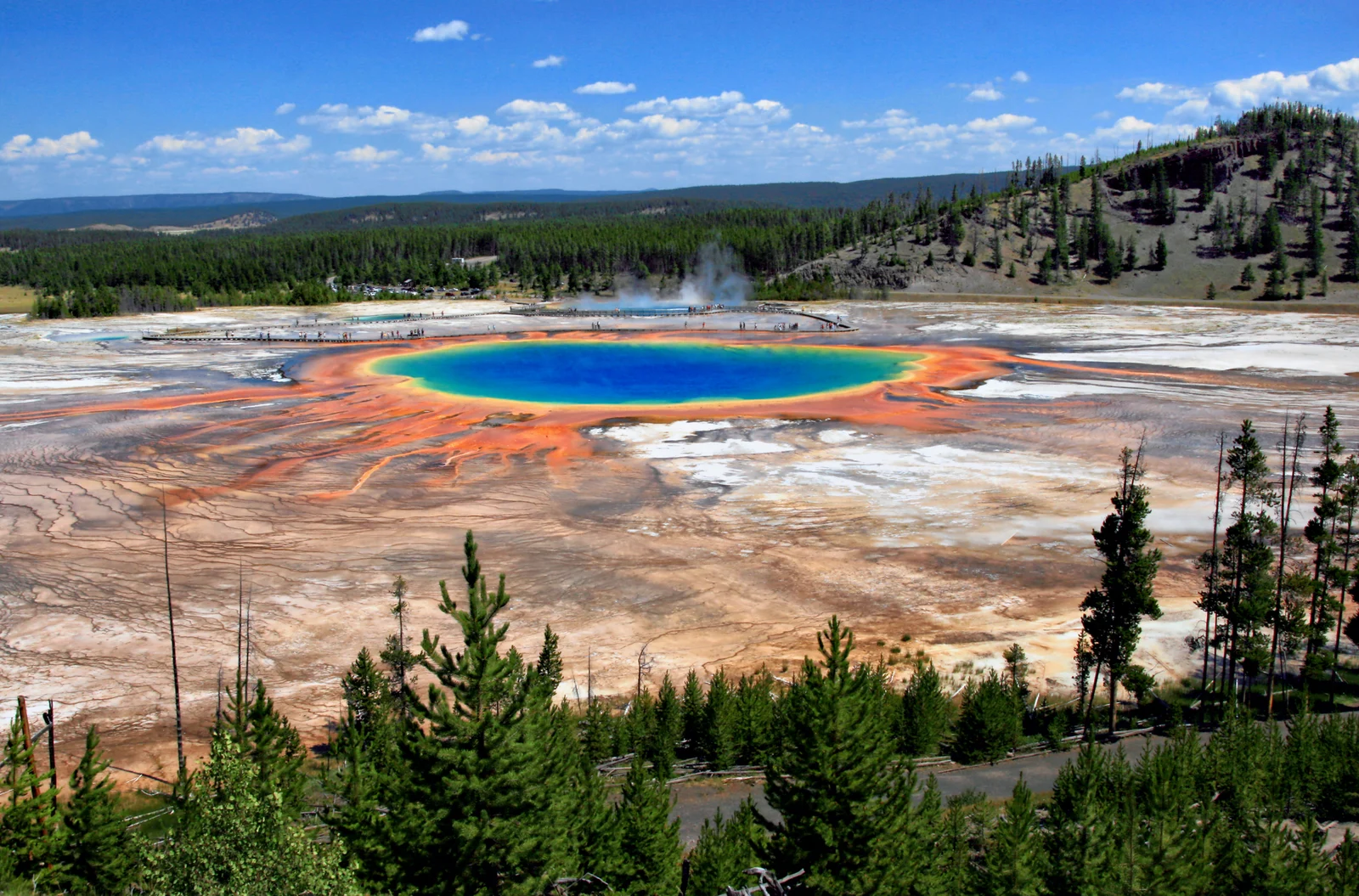
«Yellowstone’s thermal springs serve as both a living window into Earth’s primordial past and a natural optical prism, where extreme hydrothermal gradients strictly dictate the physics of light absorption and the boundaries of life.»
From scientific publications by the U.S. Geological Survey (USGS) and Yellowstone Center for Resources
The Rainbow Explosion of Thermophiles: Life Along the Thermal Gradient
The chromatic transformation unfolds as boiling water steadily flows outward over the basin’s rims. Spreading across broad, shallow terraced runoff channels, the water cools along a gradual temperature gradient from 90°C down to 40°C. This gradient fosters a diverse continuum of ecological zones, each populated by trillions of specialized thermophilic (heat-loving) bacteria and archaea.
Each thermophilic species occupies a strictly defined temperature bracket. Right at the biological frontier of 70°C to 73°C, the first microbial mats appear, dominated by the cyanobacterium *Synechococcus*. To protect their photosynthetic machinery from the intense high-altitude ultraviolet radiation of the Rocky Mountains, these microbes synthesize immense quantities of carotenoid pigments (such as beta-carotene and zeaxanthin), imparting a brilliant golden-yellow hue to the inner rings.
As the thermal stream cools further to 60°C–65°C, green non-sulfur bacteria (*Chloroflexus*) integrate into the mats, introducing rich amber and fiery orange overtones. Out in the cooler peripheral channels below 50°C, other cyanobacteria (*Phormidium* and *Calothrix*) take over, their high concentrations of green chlorophyll and dark phycobilin pigments painting the edges in deep olive, terracotta, and rich chocolate browns.
Astrobiologists from NASA frequently deploy to Yellowstone’s hydrothermal basins to investigate extremophile microbial mats as premier terrestrial analogs for ancient life on early Mars or within the subsurface oceans of Europa and Enceladus. As dissolved silica precipitates through the bacterial mats, lower cellular layers undergo rapid silicification, generating modern living stromatolites. Decoding these biosignature preservation pathways directly guides the Mars 2020 Perseverance rover science team in scrutinizing sedimentary rock cores from Jezero Crater.
Water molecules selectively absorb long red wavelengths, scattering short blue photons back to create an intense blue hue.
White geyserite (SiO₂) deposits lining the basin act as a natural mirror, reflecting filtered blue light upward to observers.
Vent temperatures exceeding 90°C surpass the 73°C limit for photosynthetic life, maintaining absolute water clarity.
Yellowstone’s Thermus aquaticus provided the heat-resistant Taq polymerase that revolutionized global DNA research.
Thomas Brock’s Discovery and the DNA Revolution: Thermus aquaticus
The exploration of Yellowstone’s heat-loving extremophiles yielded one of the most consequential milestones in the history of biological science. In 1966, microbiologist Thomas D. Brock and his student Hudson Freeze isolated a novel bacterium from Mushroom Spring capable of thriving at 75°C. They named the organism *Thermus aquaticus*.
Two decades later, biochemist Kary Mullis harnessed a heat-resistant enzyme from this bacterium—the now-famous Taq DNA polymerase—to automate the Polymerase Chain Reaction (PCR). Prior to this discovery, PCR required laborious manual replenishment of enzymes after every thermal denaturation cycle at 95°C, because conventional biological enzymes instantly decomposed.
Taq polymerase, tempered by Yellowstone’s boiling subterranean waters, easily withstands repeated high-temperature heating cycles without degrading. This single enzyme revolutionized modern molecular biology, criminal forensics, genetic sequencing, and pathogen diagnostics, earning Mullis the Nobel Prize and proving that fundamental observations of natural wonder can spark global technological revolutions.
- The electric blue color of deep vents is pure quantum physics: molecular water absorption and white silica reflection.
- Thermal conditions above 73°C act as a natural sterilizer, destroying chlorophyll and maintaining immaculate water clarity.
- Rainbow peripheral rings are formed by microbial carotenoid shields adapted to specific thermal gradient bands.
- Yellowstone extremophiles provided the critical Taq polymerase enzyme that enabled automated PCR genetic analysis.
Preserving a Delicate Geothermal Sanctuary
Yellowstone’s hydrothermal features are dynamic, living landscapes susceptible to subtle environmental and anthropogenic shifts. The chromatic intensity of the runoff rings varies naturally with seasonal sunlight; during winter months, thermophiles upregulate chlorophyll production to capture dimmer ambient light, shifting orange zones toward darker bronzes and greens.
Tragically, human carelessness has compromised some of these natural treasures. The renowned Morning Glory Pool was once celebrated for its deep sapphire-blue clarity. However, over decades of tourism, thousands of coins, stones, and trash thrown into the vent partially choked the underground conduit. Water circulation slowed, temperatures dropped, and cooler-water phototrophic bacteria colonized the pool, irrevocably transforming its optical blue into murky greens and browns.
The National Park Service enforces strict protective measures to safeguard these irreplaceable geothermal springs, ensuring that the exquisite union of optical physics and ancient microbiology continues to inspire future generations.