

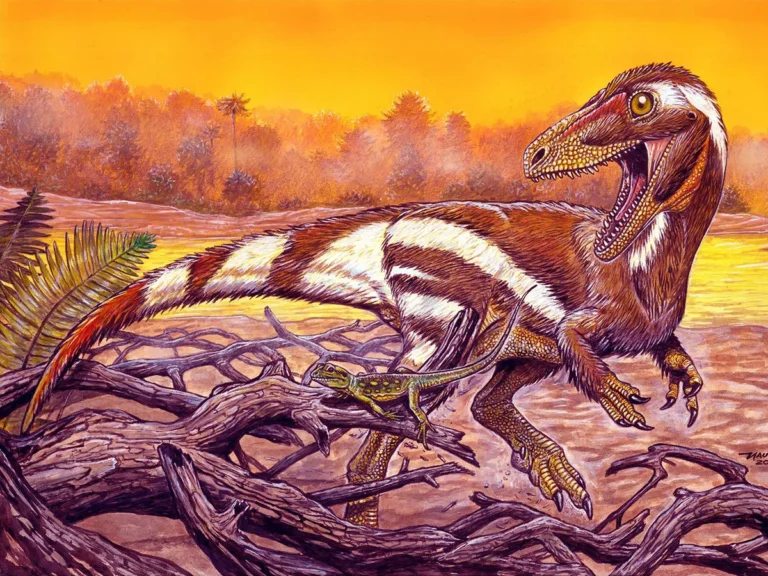

Global science media has erupted once more over stunning biological discoveries from deep time: an authoritative international dinosaur blood scientific study published in the Proceedings of the National Academy of Sciences (PNAS) has delivered definitive geochemical evidence of preserved heme—the oxygen-binding iron core of hemoglobin—trapped inside the fossilized bones of the Early Cretaceous theropod Aratasaurus museunacionali.
Sensational Discovery from Brazil: A dinosaur blood scientific study on Aratasaurus
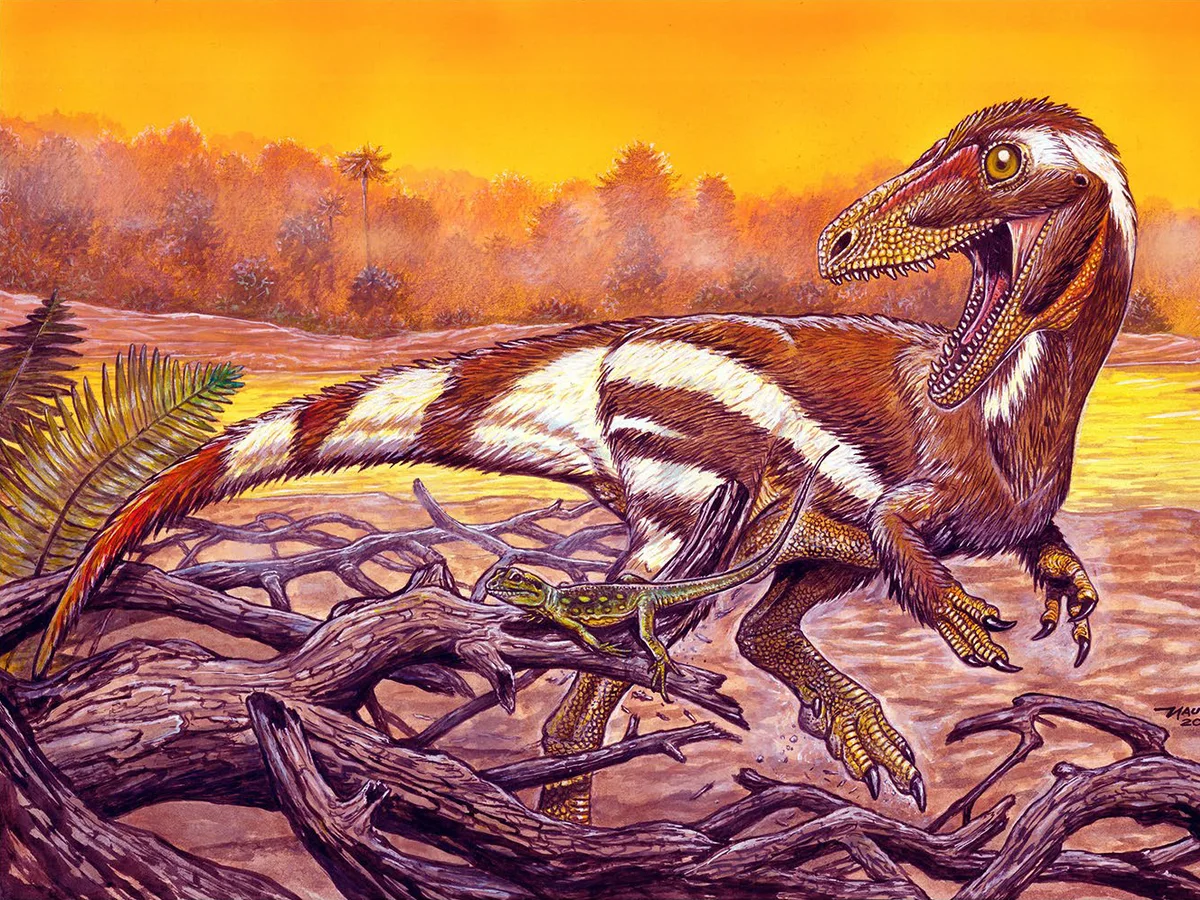
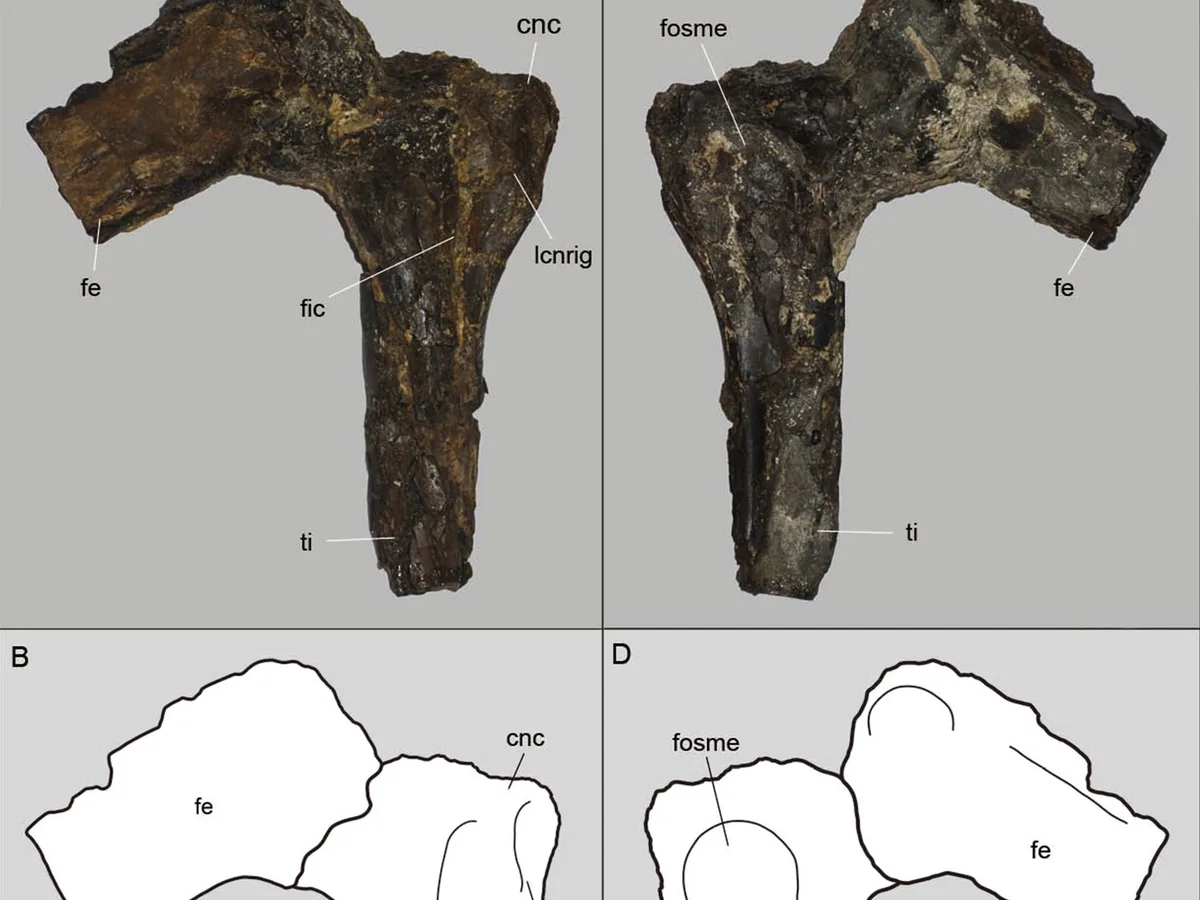
While breathless tabloid headlines immediately invoke visions of Michael Crichton’s Jurassic Park, the true scientific breakthrough is far more sophisticated and grounded in cutting-edge molecular geochemistry. The discovery centers on the fossilized right hindlimb of Aratasaurus museunacionali (holotype specimen MPSC R 2089), excavated from the limestone concretions of the Romualdo Formation in the Araripe Basin of northeastern Brazil. This medium-sized coelurosaurian theropod roamed Gondwana approximately 115 million years ago during the Early Cretaceous epoch.
An international research team led by organic geochemist Professor Kliti Grice (Kliti Grice) from Curtin University in Australia, alongside paleontologists from the Federal University of Rio de Janeiro, conducted ultra-high-resolution petrographic and geochemical analyses of the cortical bone. Nestled within the fossilized vascular canals, the team documented thousands of microscopic ovoid structures measuring 7 to 9 micrometers across, bearing anatomical morphology identical to the nucleated erythrocytes of modern avian and crocodilian archosaurs.
To overcome decades of skepticism regarding whether such microstructures represent geological pseudofossils or modern bacterial biofilms, the researchers deployed high-performance liquid chromatography–mass spectrometry (HPLC-MS), micro-Raman spectroscopy, and transmission electron microscopy (TEM). Investigating deep-time biological preservation continually reshapes how paleontologists interpret evolutionary milestones, a theme similarly highlighted in our investigation of how planetary environmental thresholds govern long-term biological survival.
The Chemical Fingerprint of Heme B: What Did Scientists Actually Discover?
The decisive triumph of the study lies in the unequivocal identification of heme B (iron-protoporphyrin IX) and its diagenetic breakdown derivatives. Heme is a resilient heterocyclic porphyrin complex that coordinates a central ferrous iron atom, functioning as the prosthetic group in hemoglobin and myoglobin responsible for reversible oxygen transport and blood pigmentation.
Resonance Raman spectra demonstrated unambiguous molecular vibrational signatures unique to iron-porphyrin bonds localized strictly within the vascular canals, while the surrounding apatite and calcite matrix exhibited zero organic signal. This spatial concordance establishes the endogenous biological origin of the biomolecules: they are genuine metabolic components of the dinosaur itself, rather than environmental contaminants or microbial artifacts.
Crucially, biochemists emphasize that this is not liquid, flowing blood. The original globin protein chains have largely denatured and polymerized into insoluble organic complexes, while the cellular membranes have been replaced by microcrystalline minerals. What remains is a preserved geochemical cast anchored by durable porphyrin complexes.
«Our geochemical analyses conclusively demonstrate that heme B derivatives survived inside the vascular canals of Aratasaurus bones. This milestone expands the horizons of paleoproteomics into deep geological time.»
Prof. Kliti Grice (Kliti Grice), Professor of Organic Geochemistry and Director of the WA Organic and Isotope Geochemistry Centre, Curtin University
The Hausmannite Mineral Shield: Surviving 115 Million Years of Deep Time
Conventional twentieth-century taphonomy held that organic biomolecules inevitably decay within thousands of years due to oxidative hydrolysis, microbial consumption, and thermal degradation. How did sensitive porphyrins withstand 115 million years of geological upheaval?
The answer lies in the unique depositional setting of the Romualdo Formation. The carcass was rapidly entombed in an anoxic, hypersaline lagoon where diagenetic fluids were supersaturated with manganese. Micro-analytical mapping revealed that the blood-like microstructures were hermetically sealed by the manganese oxide mineral hausmannite (Mn₃O₄).
Manganese oxides acted as a geocatalytic preservative shield. The presence of transition metal ions (manganese and heme-derived iron) stimulated rapid oxidative protein cross-linking (Maillard-like and Fenton reactions), converting vulnerable cellular proteins into insoluble, rot-resistant polymeric kerogen. Subsequent crystallization of dense hausmannite encased the vascular channels, locking out groundwater and oxygen for over a hundred million years.
The geological age of the Aratasaurus museunacionali limb fossil unearthed in Brazil’s Romualdo Formation.
Spectroscopy and mass spectrometry verified the presence of hemoglobin iron-porphyrin cores in bone canals.
Manganese oxide mineralization (Mn₃O₄) hermetically shielded cellular structures from oxidative decay.
With a 521-year DNA half-life, zero genetic material survived, making dinosaur resurrection impossible.
The Legacy of Mary Schweitzer: From Hell Creek T. rex to Deep-Time Proteomics
The groundbreaking findings in Aratasaurus build upon decades of pioneering research initiated by American paleontologist Mary Schweitzer (Mary Schweitzer). When Schweitzer first reported flexible, branching microvascular channels and osteocyte-like cells inside a 68-million-year-old Tyrannosaurus rex femur from Montana’s Hell Creek Formation in the early 2000s, her claims sparked fierce debate across evolutionary biology.
Skeptics argued that the pliable organic structures were biofilms generated by invasive modern bacteria. However, subsequent chemical spectroscopy, antibody assays, and now the Curtin University team’s multi-instrumental validation of Aratasaurus establish beyond doubt that iron acts as a natural formaldehyde-like fixative, stabilizing soft tissues against microbial decay.
Today, paleoproteomics allows researchers to sequence ancient collagen peptides and osteocalcin, confirming evolutionary relationships with molecular precision. These molecular phylogenies definitively validate anatomical cladograms: non-avian theropods share direct ancestral protein sequences with living birds, bridging paleontology and molecular genetics.
- Researchers identified molecular remnants of iron-binding heme pigments, not liquid blood.
- The study dismantles outdated taphonomic assumptions that biological macromolecules cannot survive beyond 1 million years.
- Manganese oxide mineralization in an anoxic ancient lagoon provided the exceptional preservation matrix.
- Stable isotope analysis of heme can now resolve long-standing debates regarding dinosaur metabolic rates and endothermy.
The Jurassic Park Myth: Why Dinosaur DNA Is Gone Forever
Inevitably, public discussion turns to cloning: can scientists extract the genome of Aratasaurus to resurrect extinct Mesozoic reptiles? Molecular biology provides an unequivocal and definitive answer: cloning dinosaurs is physically and biochemically impossible.
The reason stems from the fundamental thermodynamic disparity between iron-porphyrin rings and deoxyribonucleic acid (DNA). Rigorous kinetic studies on ancient bone degradation (notably the landmark work of Morten Allentoft) established that the in vitro half-life of DNA phosphodiester bonds is roughly 521 years. Even preserved under ideal conditions at -5 °C in sub-zero permafrost, every single nucleotide bond fully degrades within 6.8 million years. Because non-avian dinosaurs vanished 66 million years ago, their genomic blueprint has been erased into atomic dust.
Nevertheless, the implications for evolutionary paleontology are monumental. Recovering endogenous heme unlocks the frontier of “deep-time paleoproteomics.” By measuring iron and nitrogen stable isotope ratios within dinosaur heme, scientists can reconstruct the core body temperature of Mesozoic theropods—definitively settling the debate over warm-blooded dinosaur metabolism—as well as their respiratory efficiency in high-CO₂ paleo-atmospheres.