

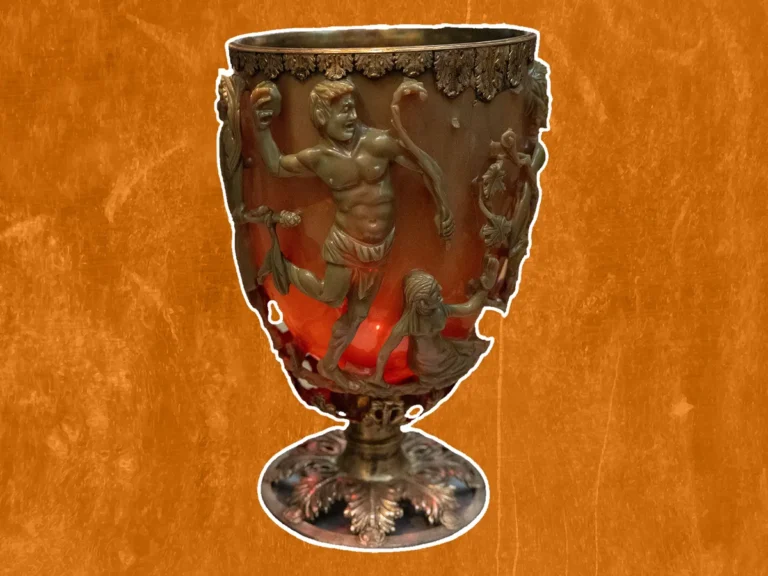

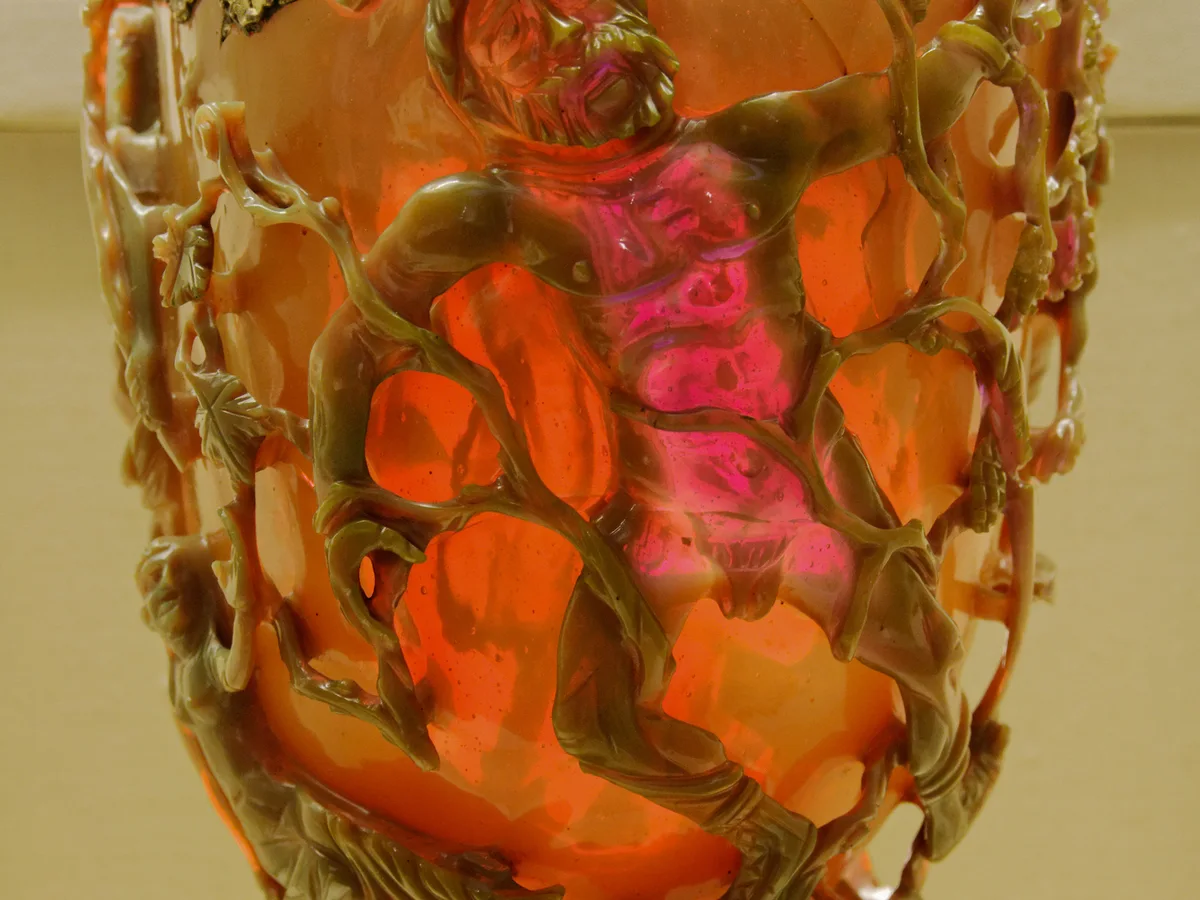
The celebrated 4th-century Lycurgus Cup, housed in the British Museum, stands as one of the most astonishing technological and artistic paradoxes of classical antiquity. Under standard direct lighting, this Roman cage-cup appears opaque, displaying an earthy jade-green hue. However, when illuminated from behind or when a light source is placed within the chalice, the goblet transforms instantaneously, radiating a translucent, incandescent ruby-red glow. Only at the close of the 20th century did scientists employing transmission electron microscopy reveal that ancient Roman artisans had anticipated modern solid-state physics by more than 1,600 years through the intuitive synthesis of noble metal nanotechnology.
From Rothschild Collection to the British Museum: History of an Enigma
The precise archaeological discovery site of the vessel remains an enduring historical mystery: scholars cannot definitively establish which Roman province, imperial palace, or aristocratic tomb preserved the chalice across antiquity. The artifact emerged into European scholarly prominence during the mid-19th century, when it was acquired by the Rothschild banking dynasty. In 1958, the British Museum purchased this masterwork from Baron Victor Rothschild, inaugurating a new era of systematic scientific inquiry.
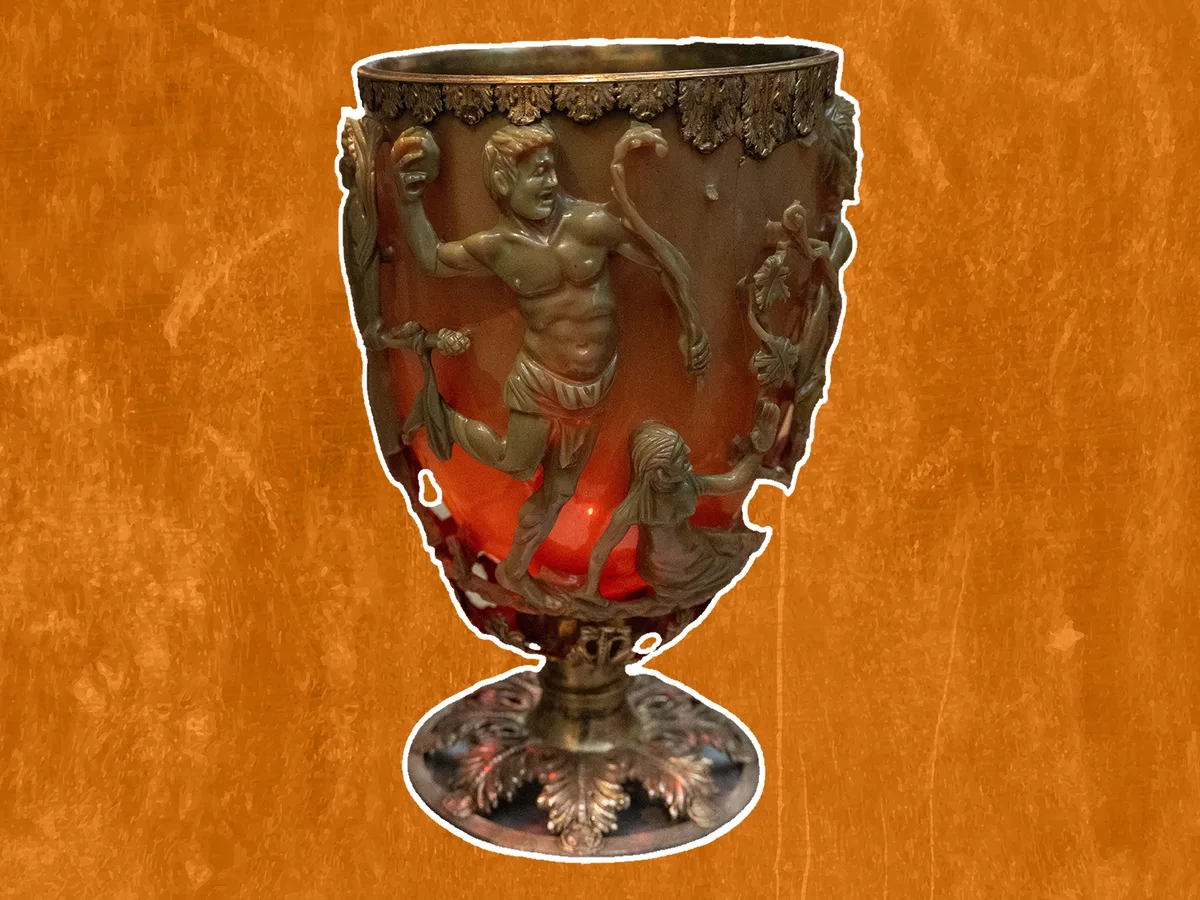
The goblet stands 15.9 centimeters (6.3 inches) tall, with a rim diameter of approximately 13 centimeters, and weighs 700 grams. It represents a rare surviving specimen of an openwork cage-cup (vasa diatreta). Rather than blowing the delicate relief into molds, Roman lapidary craftsmen sculpted the intricate design by meticulously grinding away thick-walled blank glass cylinders using specialized abrasive wheels. They left minute glass struts to connect the figurative relief to the inner core, achieving the breathtaking illusion of a freestanding sculptural cage. The gilt-bronze foliage rim and fluted base are 18th-to-19th-century restoration embellishments.
The mythological narrative carved into the glass captures a moment of retribution. The frieze illustrates the punishment of King Lycurgus of Thrace, who enraged Dionysus, god of wine and celebration, by driving the deity into the sea with an ox-goad. However, Dionysus’s loyal priestess, Ambrosia, transformed herself into a vigorous grapevine, coiling around Lycurgus and immobilizing the tyrant while satyrs and panthers tormented him. The dichroic color shift from olive green to blood red serves as an extraordinary chromatic metaphor for the ripening of grapes into fermented wine during imperial revels. In material culture history, research into natural mineral preservation shields on prehistoric artifacts highlights how ancient craftsmen intuitively mastered the chemical interactions of raw geologic materials.
The Physics of Dichroism: Surface Plasmon Resonance and 70nm Colloids
For decades, the physical mechanism behind the goblet’s dramatic dichroism puzzled materials scientists. Early theories attributed the color shift to organic dyes, cupric compounds, or trace cobalt contaminants. However, pioneering spectrographic studies in the 1960s directed by archaeologist Donald B. Harden and chemist Jocelyn Toynbee detected the perplexing presence of minute noble metal residues.
In 1990, physicists analyzing a microscopic fragment of the cup using Transmission Electron Microscopy (TEM) finally decoded the secret. Embedded within the soda-lime-silica glass matrix are billions of sub-microscopic colloidal alloy nanoparticles composed of gold and silver in an approximate ratio of 3 to 7, along with trace copper. The average diameter of these spherical particles is approximately 70 nanometers—roughly one-thousandth the thickness of a strand of human hair.
When light strikes the goblet externally, the metal nanoparticles preferentially scatter shorter wavelengths of the visible spectrum (blue and green light), producing a turbid jade-green reflection. Conversely, when light transits directly through the glass wall, a quantum phenomenon known as Surface Plasmon Resonance (SPR) takes place: conduction electrons oscillating collectively on the surface of the gold nanoparticles strongly absorb green light, permitting only long-wavelength red photons to pass through unhindered. Consequently, the human eye perceives an intense, translucent ruby-red radiance.
«The Lycurgus Cup represents the zenith of Roman craftsmanship, uniting the mythological drama of Dionysus with an intuitive mastery of noble metal nanostructures. The Romans created true nanotechnology sixteen centuries before the term was coined.»
Kristina Killgrove, Bioarchaeologist and Staff Science Writer at Live Science
Accidental Fluke or Deliberate Chemistry? Roman Nanocraftsmanship
Archaeologists and materials scientists have long debated whether Roman glassmakers mastered this optical formulation intentionally or whether the Lycurgus Cup resulted from an accidental studio contamination. The concentration of precious metals is exceedingly sparse: approximately 40 parts per million of gold and 300 parts per million of silver (0.004% gold and 0.03% silver by weight). With such micro-dosages, a deviation of merely a few milligrams would either produce murky brown slag or revert the glass to standard transparency.
Historical documentation strongly supports the thesis of deliberate production. A surviving 2nd-century letter attributed to Emperor Hadrian to his brother-in-law Servianus references a precious diplomatic gift: ‘I have sent you chameleon drinking-cups (allassontes) that change color, given to me by the priest of the temple; I wish you to use them on banquet days.’ Furthermore, fragment clusters of matching dichroic glass preserved in international museum archives corroborate the existence of specialized Roman workshops.
Roman alchemists likely dissolved leaf gold into silver chloride, introducing the mixture into molten glass flux before subjecting the batch to prolonged, controlled thermal annealing to precipitate uniform colloidal crystallization. Much like the iconic prints of Katsushika Hokusai merged novel synthetic colorants with virtuoso woodblock carving, the creators of the Lycurgus Cup wedded pyrotechnic chemical mastery with lapidary stone-cutting artistry.
The goblet appears opaque jade-green under direct reflected light, but shines an incandescent ruby-red when lit from behind.
The optical phenomenon is driven by colloidal gold-silver alloy nanoparticles (3:7) dispersed in the glass at just 0.004% concentration.
Meticulously carved from a single thick glass cylinder: sculpted mythological figures connect to the inner vessel via tiny glass bridges.
The cup’s surface plasmon resonance now powers cutting-edge ‘Lab-on-a-Chip’ diagnostic tools for detecting disease in single blood droplets.
Modern Replications: Reverse-Engineering Ancient Roman Nano-Recipes
Modern attempts to replicate the Lycurgus Cup’s dichroic glass have mobilized premier materials laboratories. In the mid-20th century, scientists at the Corning Museum of Glass synthesized gold-silver colloidal glass batches, but produced only amethyst gradations. A decisive breakthrough occurred recently when researchers at the University of Sheffield in the United Kingdom successfully reverse-engineered the thermal precipitation kinetics of the original Roman composition.
The Sheffield team mapped the exact cooling curve governing the nucleation of gold-silver nanoparticles within a silica melt, commissioning a contemporary master glassmaker to craft new vessels displaying authentic green-to-red dichroism. In 2020, materials engineers extended this frontier by infusing gold nanoparticles into photopolymer resins for additive manufacturing, 3D-printing dichroic objects that mimic the Roman optical shift.
These empirical replications confirmed that ancient Roman artisans possessed extraordinary empirical control over pyrotechnic variables. Without pyrometers, electron microscopes, or optical spectrometers, craftsmen accurately deduced the precise nucleation threshold solely by reading kiln color, achieving feats of nanotechnology that modern physics only resolved 1,600 years later.
- Surface Plasmon Resonance (SPR): 70nm noble metal nanoparticles selectively scatter short blue-green light while absorbing green on transmission;
- Micro-Precision Formulation: 40 parts gold and 300 parts silver per million required meticulous chemical purity during smelting;
- Openwork Diatreton Artistry: Months of painstaking lapidary grinding on thick glass without breaking fragile connecting bridges;
- Environmental Refractive Sensitivity: Filling the vessel with liquid shifts transmission spectra, prefiguring modern plasmonic biosensors.
From Imperial Banquets to Modern Medicine: The Legacy of Plasmonic Sensing
Investigating the Lycurgus Cup has exerted a transformative influence on modern nanophotonics and clinical diagnostics. The Surface Plasmon Resonance of metallic nanoparticles is exquisitely sensitive to the refractive index of adjacent dielectric media. Introducing a liquid into a dichroic receptacle subtly alters the local dielectric environment, shifting the plasmonic resonance band and visibly changing the transmitted wavelength.
Biomedical engineers are utilizing this exact Roman mechanism to engineer ultra-sensitive ‘Lab-on-a-Chip’ plasmonic sensors. Microfluidic devices embedded with gold-silver nanostructures can detect trace concentrations of viral RNA, pathogenic antigens, or oncological biomarkers in a single droplet of blood within seconds, signaled by instantaneous chromatic shifts.
The Lycurgus Cup stands as a timeless monument to the seamless unity of aesthetic genius and material innovation. Crafted to dazzle guests at imperial feasts, it survived the collapse of antiquity, preserved the secrets of ancient nanotechnology across epochs, and today illuminates the path toward transformative breakthroughs in modern medical diagnostics.