

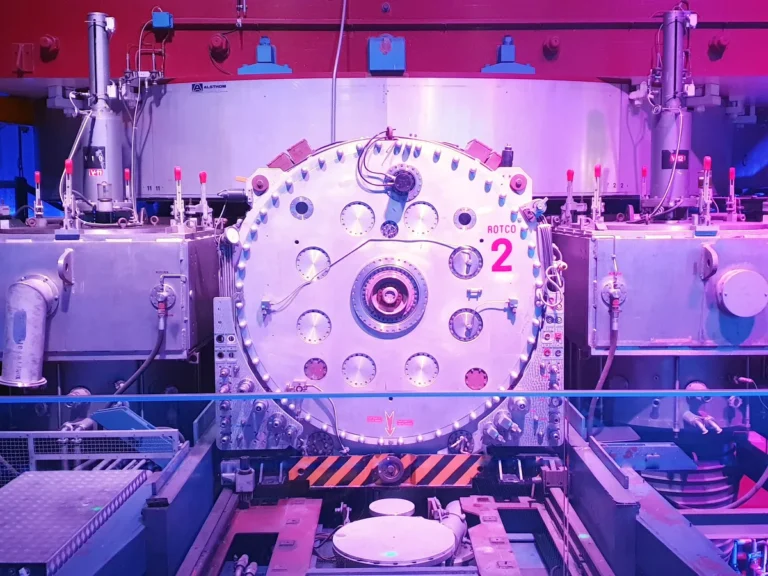

The elusive realm of antimatter, the mirror counterpart to the matter that constructs our universe, has been harnessed with unprecedented mastery. A research team led by pioneer physicist Professor Gerald Gabrielse at Northwestern University has constructed an ultra-precise ‘one-positron quantum cyclotron.’ By isolating and cooling an individual positron to within a fraction of a degree above absolute zero inside an electromagnetic Penning trap, researchers sustained the antimatter particle in continuous confinement for months on end. This historic experimental milestone allows scientists to observe quantum leaps of an antiparticle with unprecedented clarity, probing the greatest mystery in modern physics: why the universe is composed of matter rather than having annihilated itself at the dawn of time.
The Mirror Cosmos: From Dirac’s Mathematics to Experimental Reality
The theoretical reality of antimatter emerged in 1928 through the mathematical genius of British theoretical physicist Paul Dirac. While synthesizing quantum mechanics with Albert Einstein’s special theory of relativity, Dirac formulated a relativistic wave equation for the electron that yielded two symmetric solutions—one describing standard positive energy states, and an enigmatic second set describing negative energy states. Dirac soon recognized that these negative solutions represented a previously unimagined physical entity: an exact mirror twin of the electron sharing identical rest mass and spin, but bearing an equal and opposite positive electrical charge.
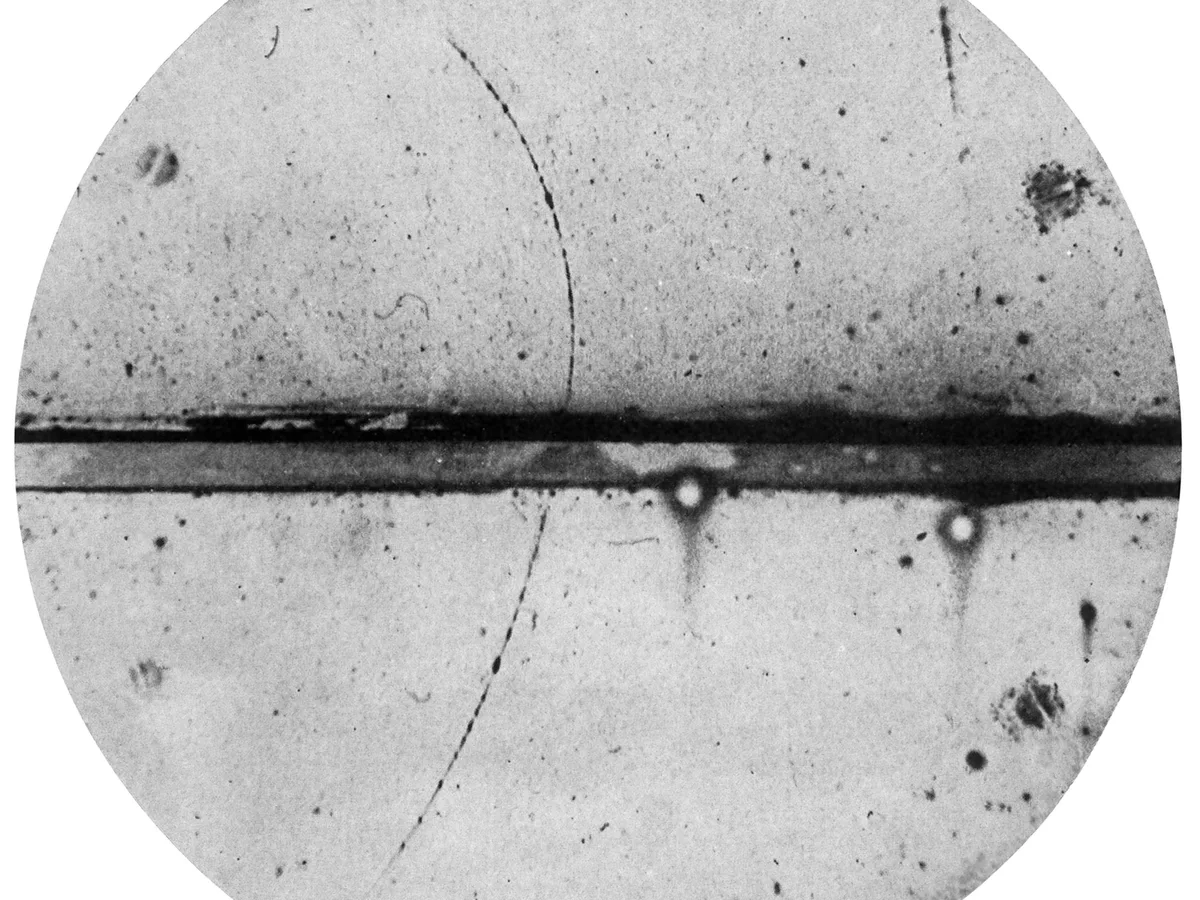
In 1932, American experimentalist Carl D. Anderson validated Dirac’s hypothesis, capturing the curved trajectory of a cosmic-ray particle traversing a lead plate inside a magnetic cloud chamber at Caltech. The discovery of the positron earned both pioneers Nobel Prizes. Yet experimental inquiry into antimatter encountered an intractable physical barrier: the instant an antiparticle contacts ordinary baryonic matter, both annihilate in a blinding flash of high-energy gamma radiation.
Devising an apparatus capable of isolating an antiparticle from environmental atoms for extended durations represented one of the most demanding engineering quests in history. Over four decades, this challenge was systematically dismantled by Professor Gerald Gabrielse, director of the Center for Fundamental Physics at Northwestern University.
The Penning Trap: Architecture of an Electromagnetic Sanctuary
To preserve a single positron in complete isolation, Gabrielse’s team engineered a cylindrical Penning trap suspended within a cryogenic vacuum enclosure. Fabricated from high-purity gold-plated oxygen-free copper, the trap maintains an internal vacuum lower than 10⁻¹⁶ torr—a state of spatial emptiness more pristine than deep interstellar space.
Confinement is achieved by superimposing an electrostatic quadrupole potential with a 5.6-Tesla magnetic field generated by a liquid-helium-cooled superconducting solenoid. The electrostatic field exerts restoring forces along the axial dimension, preventing escape upward or downward, while the Lorentz force produced by the magnetic field constrains transverse motion, driving the positron into a microscopic cyclotron orbit revolving at 150 gigahertz (150 billion revolutions per second).
The critical technological triumph was integrating a dilution refrigerator that chilled the apparatus to 100 millikelvin (-273.05°C). At this near-absolute-zero threshold, thermal excitations vanish. The positron sheds its orbital kinetic energy, dropping into its lowest quantum cyclotron ground state (n = 0), behaving as a pristinely decoupled harmonic oscillator.
Researchers isolated exactly one antiparticle (the positron), entirely eliminating the hazard of catastrophic annihilation against container walls.
Cooling to -273.05°C drained virtually all thermal energy, trapping the antiparticle in its ground quantum cyclotron orbital state.
A superconducting solenoid forced the positron into microscopic cyclotron orbits revolving at approximately 150 billion rotations per second.
Measuring the positron’s magnetic moment (g-factor) with parts-per-trillion precision confirmed the mathematical integrity of the Standard Model.
Months in Solitary: Quantum Non-Demolition Observation
For the first time in physics, an individual antimatter particle remained continuously trapped and studied over a multi-month experimental campaign. Throughout this prolonged confinement, the positron never collided with a single extraneous atom, remaining completely immune to annihilation.
Furthermore, the experimentalists deployed Quantum Non-Demolition (QND) detection protocols. By tracking minute dispersive frequency shifts in the trap’s axial resonance circuit whenever the positron’s quantum spin flipped relative to the magnetic field, the physicists determined the particle’s quantum states without collapsing its primary wave packet.
This extraordinary stability enabled the researchers to measure the positron’s magnetic moment—quantified by its dimensionless g-factor—with an uncertainty smaller than one part per trillion, representing one of the most precise physical measurements ever achieved in human history.
«Confining an individual antiparticle for months at temperatures a hundredth of a degree above absolute zero allows us to measure antimatter properties with precision reaching parts per trillion. If we identify the faintest discrepancy between matter and antimatter, it will upend the foundations of physics.»
Prof. Gerald Gabrielse, Director of the Center for Fundamental Physics, Northwestern University
CPT Symmetry and the Enigma of the Baryon Asymmetry
Why do physicists expend immense resources measuring a solitary antiparticle to twelve decimal places? The answer directly confronts the central paradox of cosmology: the Baryon Asymmetry of the Universe. Under the Standard Model and Big Bang cosmology, the primordial expansion 13.8 billion years ago should have synthesized equal abundances of matter and antimatter.
Had the laws of physics treated both forms of matter with perfect mathematical symmetry, every particle and antiparticle would have annihilated into pure photonic radiation as the early universe cooled. No stars, galaxies, planets, or conscious observers could have emerged. The observable cosmos, consisting almost exclusively of ordinary matter, proves that an infinitesimal asymmetry must distinguish matter from antimatter.
The bedrock foundation of relativistic quantum field theory is the CPT theorem, which dictates that the laws of nature remain strictly invariant under the combined operations of charge conjugation (C), parity reflection (P), and time reversal (T). If CPT holds, the mass, charge magnitude, and g-factor of an electron and positron must be identical. The Northwestern measurements verified parity between electron and positron g-factors to within one part in a trillion, tightening constraints on prospective theories seeking to explain why our universe exists at all.
- Quantum Non-Demolition (QND) measurement: monitoring discrete spin flips without inducing wavefunction collapse;
- Extreme high vacuum: internal pressure levels maintained below 10⁻¹⁶ torr, cleaner than interstellar space;
- Addressing the Baryon Asymmetry Dilemma: investigating why primordial antimatter vanished from the observable universe;
- Empirical confirmation of absolute parity between electron and positron masses and charge magnitudes to 12 decimal places.
The Road to Cold Antihydrogen: The Next Quantum Frontier
The mastery of single-positron quantum cyclotrons provides the foundational technology required for the next phase of antimatter physics: precision spectroscopy of cold antihydrogen. By combining cold positrons with antiprotons decelerated at CERN, physicists assemble complete neutral antimatter atoms.
Immediate future experiments aim to test whether antimatter obeys Einstein’s Equivalence Principle: Does antihydrogen fall in Earth’s gravitational field with the exact gravitational acceleration (g = 9.81 m/s²) as normal hydrogen, or does gravity interact differently with antimatter? The slightest observed divergence would require a profound rewrite of Einstein’s General Theory of Relativity.
Professor Gabrielse’s experimental triumph demonstrates that humanity has mastered the art of taming nature’s most volatile substance. By holding a mirror world motionless in a quantum trap, physics edges ever closer to discovering the cosmic secret that allowed our universe to be born.