



Throughout the history of evolutionary biology, organismal aging and terminal senescence were universally accepted as immutable thermodynamic realities for all multicellular fauna. However, the diminutive hydrozoan jellyfish Turritopsis dohrnii shattered this biological dogma by demonstrating that, under environmental stress or somatic trauma, it possesses the extraordinary capability to completely reverse its life cycle, reverting from a sexually mature medusa back into a juvenile polyp colony through cellular transdifferentiation.

The Mediterranean Anomaly That Defied Biological Entropy
Since the establishment of contemporary gerontology, senescence has been understood as a unidirectional thermodynamic decline. Somatic cell division across metazoan life is inexorably constrained by the Hayflick limit: progressive telomere shortening, cumulative mitochondrial DNA mutations, epigenetic drift, and the accumulation of senescent, pro-inflammatory cells. This trajectory toward biological death seemed an iron law of nature. Yet, in the summer of 1988, German marine biology student Christian Sommer, conducting field surveys along the pristine Ligurian coast of Portofino, Italy, made an observation that radically upended the foundations of developmental biology.
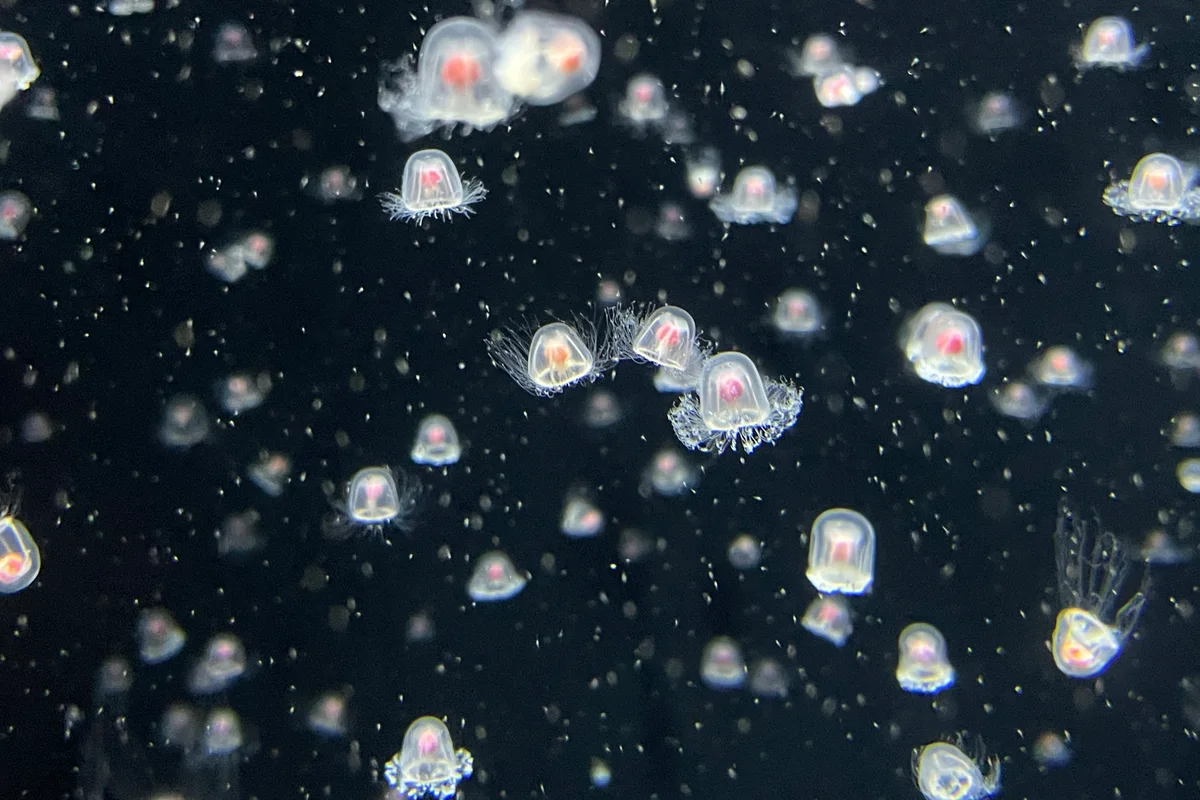
Within his laboratory petri dishes were specimens of Turritopsis dohrnii (historically misclassified as Turritopsis nutricula), a delicate bell-shaped hydrozoan measuring barely 4.5 millimeters in diameter. Exposed to ambient heat stress and left unfed over a weekend, Sommer anticipated finding lysed, decomposed carcasses. Instead, he observed an impossible biological transformation: the adult medusae had completely disappeared, while the bottom of the dish was colonized by thriving juvenile polyps—the primordial sessile colonial phase from which medusae originally bud. The organism had not died; it had systematically wound back its biological clock, transforming itself from an aging adult back into its own embryonic origin. Investigating extreme biological adaptability has long been central to cutting-edge science: as explored on Vinegret.Net in our study of unorthodox biochemical adaptations in extreme environments, living systems evolve astounding survival strategies when challenged by extreme physical stress.
Life Cycle in Reverse: The Rejuvenation Metamorphosis
Under conventional cnidarian ontogeny, sexually mature male and female medusae release gametes into the pelagic water column. Fertilization yields a free-swimming ciliated planula larva, which descends to the seafloor, attaches to hard benthic substrate, and establishes a branching colony of stolons and feeding polyps. Through asexual strobilation, these polyps bud off immature juvenile medusae that grow into solitary, free-swimming adults, subsequently completing their reproductive cycle and dying.
When an adult Turritopsis dohrnii encounters adverse environmental conditions—such as physical mechanical mutilation, osmotic shock, starvation, or temperature spikes—an emergency genetic cascade is triggered. The medusa contracts its bell, inverts its outer umbrella, reabsorbs its tentacles, and sinks to the benthic substrate as a dense, amorphous gelatinous mass called a cyst. Within this protective chitin-covered node, the animal undergoes a complete cellular reset. Rather than succumbing to necrotic death or apoptosis, the somatic tissues of the exumbrella and gastrovascular cavity disassemble and reorganize. Within 72 to 96 hours, a brand new stolon erupts from the cyst, establishing a genetically identical juvenile polyp colony capable of releasing hundreds of new medusae. Because this regenerative loop can theoretically iterate without limit, Turritopsis dohrnii is recognized as the only biologically immortal animal on Earth.
Cellular Transdifferentiation: The Holy Grail of Reprogramming
The cellular engine driving this biological resurrection is transdifferentiation—a rare and potent phenomenon in which fully differentiated, terminal somatic cells shed their specialized identities and convert directly into entirely different functional cell types. In classical vertebrate embryology, cell differentiation is considered an irreversible developmental journey; a differentiated skeletal muscle cell, cardiomyocyte, or neuron cannot naturally reprogram itself without artificial laboratory manipulation (such as the Yamanaka transcription factors that earned the 2012 Nobel Prize).
In Turritopsis dohrnii, however, nature conducts extensive in vivo somatic reprogramming on demand. Mature striated muscle cells of the subumbrella and differentiated cells of the digestive gastrodermis undergo rapid dedifferentiation. They downregulate lineage-specific structural genes, re-enter the mitotic cell cycle, and revert into primitive, multipotent interstitial cells (i-cells). Subsequently, these reprogrammed stem cells redifferentiate into the specialized cell lineages required to construct a functioning polyp: stolon epithelia, cnidocytes (stinging cells), and digestive nutritive cells. This profound somatic fluidity mirrors structural transformations examined on Vinegret.Net in our report on breakthroughs in neuro-interfacing and the plasticity of complex cellular networks.
Cellular Transdifferentiation
Specialized somatic cells of the adult medusa do not merely regenerate; they directly reprogram back into pluripotent stem-like states in vivo.
Epigenetic Genome Reset
During life-cycle reversal, extensive DNA demethylation and non-coding RNA activation erase age-related mutational burden and cellular decay.
Telomerase Hyper-Preservation
Unlike mammalian somatic cells constrained by the Hayflick limit, Turritopsis dohrnii continuously maintains telomere lengths across countless rejuvenation cycles.
Regenerative Medicine Frontier
Decoding the transcriptomic switches of the immortal jellyfish holds revolutionary potential for in situ myocardial regeneration and neurodegenerative therapy.
The Oviedo Genomics Breakthrough: Unlocking the Immortality Code
In a landmark 2022 multi-omics study published in the Proceedings of the National Academy of Sciences (PNAS), an elite research consortium led by Dr. Maria Pascual-Torner and Dr. Carlos Lopez-Otin at the University of Oviedo achieved the first complete de novo nuclear genome assembly of Turritopsis dohrnii, comparing it directly to the closely related but non-immortal hydrozoan Turritopsis rubra.
The comparative genomic analysis exposed remarkable evolutionary adaptations. T. dohrnii possesses extensive gene duplications in DNA repair machinery, specifically within nucleotide excision repair (NER), base excision repair (BER), and high-fidelity DNA polymerase complexes. Furthermore, while mortal species experience systematic telomeric attrition during cellular replication, T. dohrnii maintains hyper-active telomerase reverse transcriptase (TERT) expression across all life stages, completely protecting chromosome terminal caps. Crucially, researchers uncovered massive epigenetic remodeling machinery: histone demethylases, Polycomb repressive complexes, and non-coding microRNAs that selectively silence aging pathways while re-activating embryonic pluripotency networks.
Translational Medicine: From Ocean Cnidarian to Human Therapeutics
While human biology is far too anatomically intricate to ever permit a person to dissolve into a cyst and regenerate from infancy, the core biochemical pathways discovered in Turritopsis dohrnii represent a goldmine for modern regenerative therapeutics.
The most immediate clinical application lies in cardiology and neuro-restoration. Following an ischemic myocardial infarction, human cardiac muscle cannot regenerate; non-contractile collagenous scar tissue forms, frequently culminating in congestive heart failure. By deciphering the transcription factors that govern transdifferentiation in Turritopsis, biomedical engineers aim to develop targeted RNA therapies capable of reprogramming post-infarct cardiac fibroblasts directly into functional, rhythmic cardiomyocytes in situ. Similarly, in neurodegenerative conditions such as Alzheimer’s and Parkinson’s, in vivo transdifferentiation could convert reactive astrocytes into dopaminergic neurons, repairing damaged cerebral networks without donor cell transplantation.
Scientific Epilogue: Re-evaluating the Frontiers of Senescence
The immortal jellyfish Turritopsis dohrnii is far more than a curious marine oddity. It is a profound philosophical and biological beacon, proving that organismal aging is not an inescapable consequence of the laws of physics, but an evolutionary program that can, under specific genomic instructions, be interrupted and reversed. As science continues to unlock the molecular symphony of this tiny hydrozoan, humanity edges ever closer to conquering the devastating degenerative diseases of aging.