

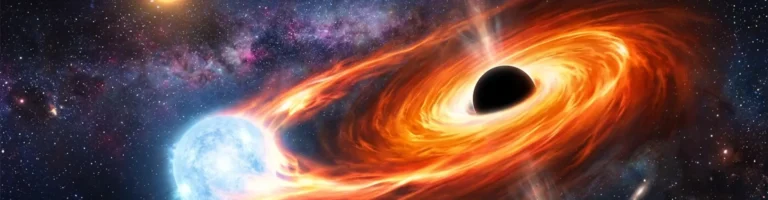

For generations of astrophysicists, the birth of a stellar-mass black hole has been conceptualized as the ultimate violent cataclysm: a ferocious core-collapse supernova explosion that violently expels the progenitor star’s outer stellar envelopes while imparting a massive asymmetrical recoil velocity («natal kick») to the newly formed compact remnant. However, the groundbreaking discovery of the first-ever hierarchical triple system harboring a stellar-mass black hole has shattered this foundational dogma. Astrophysicists from the Massachusetts Institute of Technology (MIT) and Caltech have revealed that the renowned microquasar V404 Cygni retains a distant tertiary companion star, providing decisive empirical evidence that black holes can form through “gentle,” direct gravitational implosion without a destructive supernova explosion.
The Enigma of V404 Cygni: From Historic Nova to Microquasar Benchmark
Situated approximately 8,000 light-years from Earth within the northern constellation of Cygnus, V404 Cygni has long maintained legendary status in observational astronomy. First cataloged as a fluctuating optical variable in the 18th century, it underwent a violent X-ray outburst in 1989, unmasking its true astrophysical nature as an accreting low-mass X-ray binary (LMXB) driven by a black hole containing roughly nine solar masses.
The inner donor star, harboring roughly 0.7 solar masses, orbits the black hole in a tight circular trajectory completed every 6.5 terrestrial days. Tidal forces draw streams of hydrogen gas through the inner Lagrange point L1, feeding a hyper-heated accretion disk where temperatures soar into millions of kelvins. During periodic outburst cycles, the disk unleashes relativistic plasma jets streaming into interstellar space at substantial fractions of the speed of light.
Within the overarching paradigm of the evolution of black holes in the early universe, V404 Cygni has served as a foundational empirical benchmark for accretion physics and jet mechanics, yet its true dynamical architecture remained entirely misunderstood.
For decades, astronomers believed this system comprised an isolated binary pair, oblivious to the fact that a remote stellar sentinel was quietly orbiting far beyond, harboring the definitive chronicle of the black hole’s genesis.
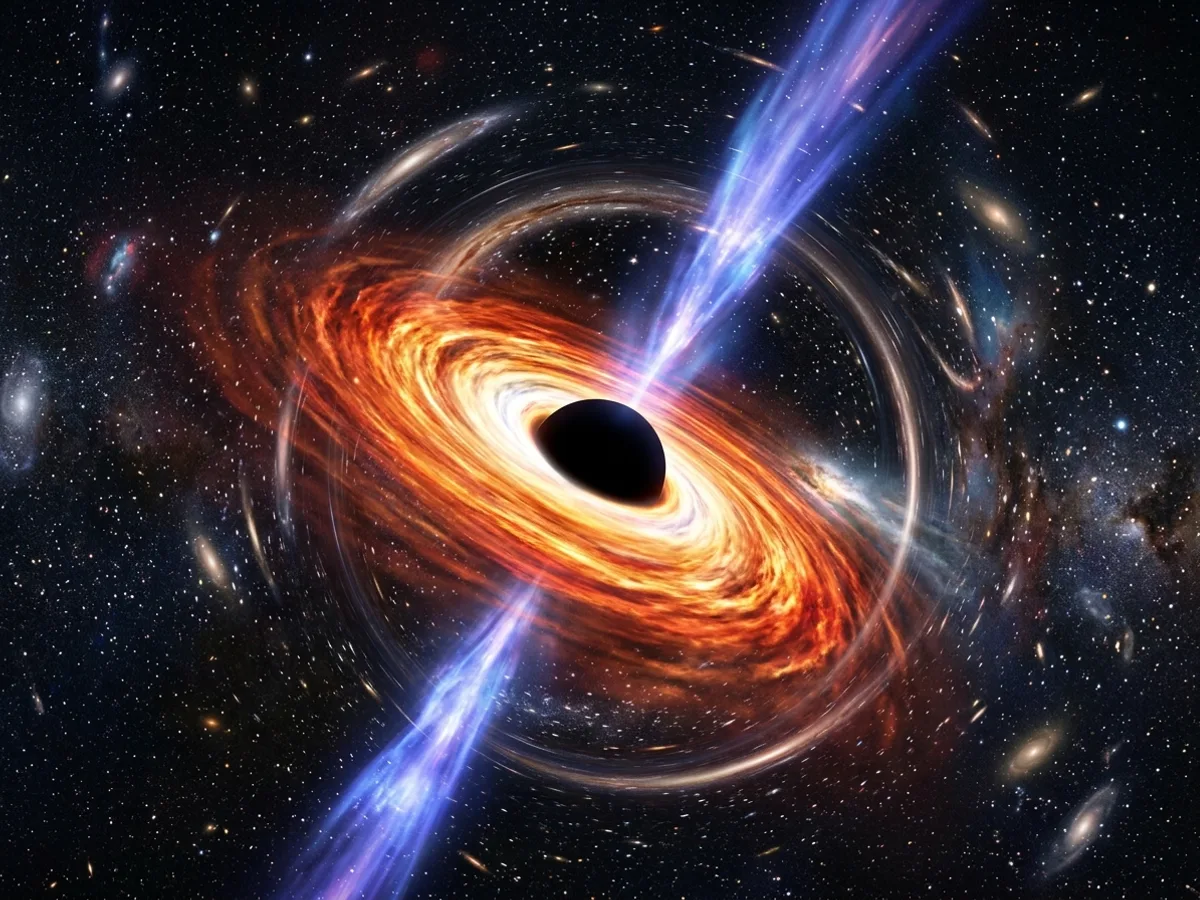
The Gaia Astrometric Detective Story: Uncovering a 70,000-Year Orbit
The discovery crystallized from a meticulous re-examination of astrometric data collected by the European Space Agency’s Gaia space observatory, which measures the precise positions, parallaxes, and proper motions of billions of Milky Way stars. While analyzing the immediate cosmic surroundings of V404 Cygni, MIT physicist Kevin Burdge identified a faint optical companion separated by merely 1.4 arcseconds.
Initially, this faint star appeared to be a chance line-of-sight alignment — an unrelated background star situated thousands of light-years behind or in front of the microquasar. However, rigorous vector analysis of their proper motions across three-dimensional space revealed an undeniable match: both objects share an identical common proper motion across the celestial sphere, aligning down to fractions of a milliarcsecond per year. Statistical calculations placed the probability of an accidental alignment at less than one in ten billion.
The derived physical separation between the central binary and the outer star is staggeringly vast: 3,500 astronomical units (AU), which is 3,500 times the distance from the Earth to the Sun and nearly one hundred times the orbital radius of Pluto. At this expansive distance, the tertiary star requires an astonishing 70,000 years to execute a single orbital revolution around the central black hole. This definitively establishes V404 Cygni as the first confirmed hierarchical triple system containing a black hole.
V404 Cygni is officially validated as the premier hierarchical triple system containing a stellar-mass black hole.
The distant third star orbits 3,500 AU away from the black hole, requiring 70 millennia to complete a single orbital circuit.
The fragile gravitational bond proves the progenitor avoided a violent supernova kick that would have severed the system.
The discovery provides direct empirical evidence that massive stars can implode completely into black holes without exploding.
Theoretical Shockwaves: Why a Supernova Would Have Obliterated the System
The astrophysical implications of this tertiary companion extend far beyond the taxonomy of multi-star systems. Orbital dynamics dictate a fundamental principle formulated by Adriaan Blaauw: if an exploding star in a binary or multiple system instantaneously sheds more than half of its total mass during a supernova explosion, the remaining gravitationally bound components inevitably unbind and disperse.
Furthermore, core-collapse supernovae are inherently turbulent and hydrodynamically asymmetrical. This asymmetry imparts an energetic “natal kick” to the newly born compact remnant, frequently launching neutron stars and black holes through the galaxy at velocities exceeding hundreds of kilometers per second. This mechanism accounts for the observed population of runaway hypervelocity pulsars.
In the V404 Cygni architecture, the gravitational binding energy connecting the central black hole to the outer star at 3,500 AU is exceptionally fragile. Supercomputer orbital simulations demonstrated that even a modest natal kick velocity of merely 5 kilometers per second would have instantly severed the gravitational tether, sending the tertiary star hurtling into interstellar space.
The inescapable fact that the tertiary star remains serenely bound on its 70,000-year orbit serves as airtight empirical proof: the black hole formed without an explosive mass-ejection event, gently imploding directly into a gravitational singularity.
«Finding a third star gravitationally bound at such an enormous orbital separation from V404 Cygni was a genuine shock. Had the progenitor star undergone an energetic, mass-shedding supernova explosion, the resultant kick would have instantly detached this loosely bound companion. The system survived intact only because the black hole formed via complete, gentle direct collapse.»
Dr. Kevin Burdge, Astrophysicist in the Department of Physics at the Massachusetts Institute of Technology (MIT)
Rewriting Stellar Evolution: The Mechanism of Direct Gravitational Collapse
Published in the prestigious journal Nature by the MIT research consortium, this discovery confirms the long-postulated hypothesis of “failed supernovae” or “unnovae.” Under specific chemical and evolutionary conditions, massive progenitor stars (spanning 20 to 40 solar masses) undergo rapid gravitational collapse wherein the collapsing core forms an event horizon before the outward-moving shockwave can decouple and blow off the stellar mantle.
Rather than producing a brilliant supernova outburst that outshines an entire galaxy, the star effectively blinks out of existence in optical wavelengths, releasing its binding energy nearly exclusively through an immense burst of neutrinos and gravitational radiation. Similar disappearances have been witnessed by the Hubble Space Telescope when observing massive red supergiants in distant galaxies.
Now, the V404 Cygni system delivers the premier archaeological footprint of direct collapse preserved inside our home galaxy, fundamentally revolutionizing theoretical models concerning the generation of relativistic plasma jets and compact objects.
- V404 Cygni is located 8,000 light-years away in Cygnus and houses a black hole of 9 solar masses.
- MIT researchers identified the tertiary companion star using precision astrometric kinematics from ESA’s Gaia satellite.
- The finding substantiates the “failed supernova” hypothesis, where a star collapses silently without optical flares.
- Triple-star dynamical interactions via the Lidov-Kozai mechanism explain massive black hole mergers detected by LIGO.
Implications for LIGO Gravitational Wave Detectors and Compact Mergers
The confirmation of hierarchical triple systems harboring black holes provides transformative insights into the gravitational-wave detections recorded by the LIGO-Virgo-KAGRA network. For years, gravitational-wave physicists have puzzled over the genesis of massive binary black hole mergers exhibiting unexpected primary masses and unaligned spin vectors.
Hierarchical triple architectures provide an elegant dynamical pathway known as the Lidov-Kozai mechanism. Gravitational perturbations exerted by the distant third star induce long-term secular oscillations between the eccentricity and inclination of the inner binary orbit. This dynamical driving periodically drives the inner black hole and companion into ultra-tight periastron encounters, accelerating gravitational radiation loss and precipitating compact mergers.
Astrophysicists now suspect that a significant fraction of stellar-mass black holes throughout the universe originate within multiple-star hierarchies inside dense open clusters. As ongoing astrometric surveys from Gaia and next-generation spectroscopy unlock further candidate systems, astronomers stand on the cusp of rewriting the definitive textbooks on gravitational astrophysics and stellar death.