

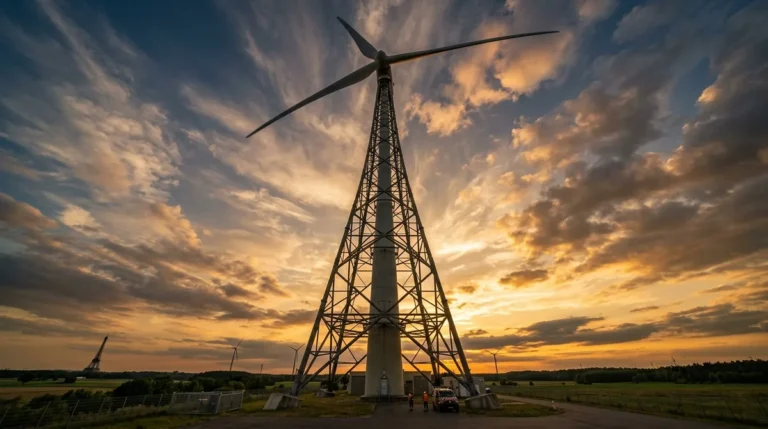

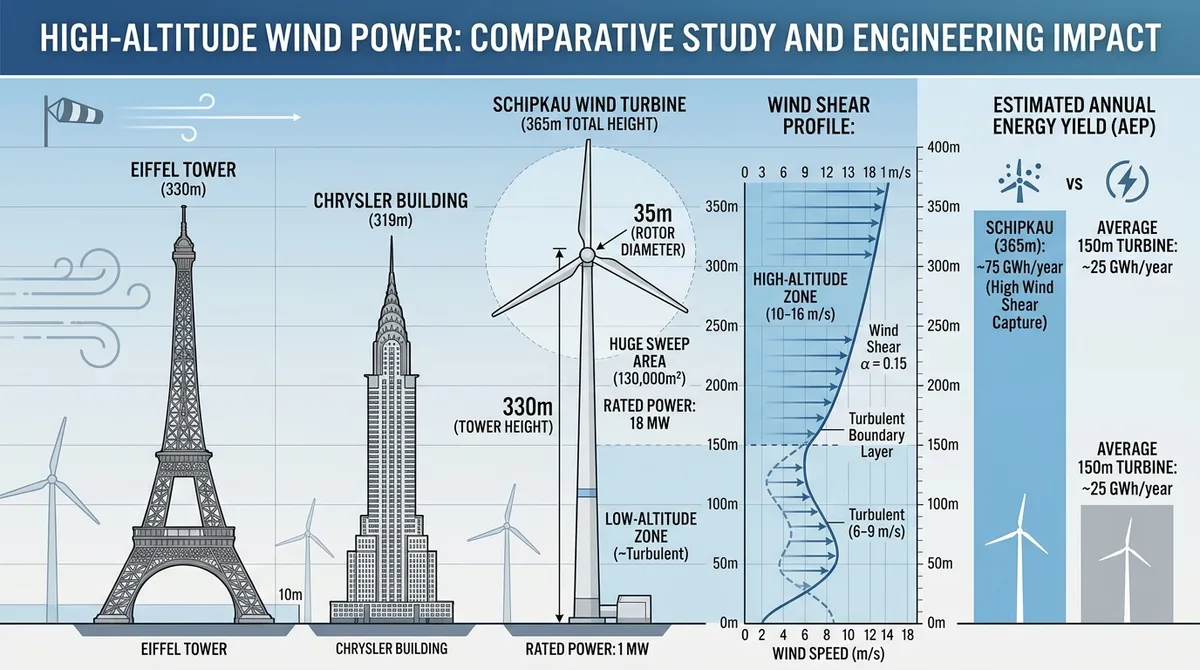
Surpassing architectural icons across the globe, the tallest wind turbine in Schipkau 365 meters is set to revolutionize terrestrial renewable energy generation. In the German state of Brandenburg, engineering pioneer GICON has initiated construction of a colossal high-altitude wind turbine that exceeds the Eiffel Tower in Paris (330 meters) and New York City iconic Chrysler Building (319 meters). Engineered upon an advanced modular lattice tower, the turbine elevates its massive rotor hub to an altitude of 300 meters, tapping into persistent, laminar high-altitude wind streams. This engineering milestone effectively doubles the clean electricity output compared to conventional onshore turbines.
Architectural Innovation: Why the Schipkau Tower Reaches 365 Meters
For decades, onshore wind turbine engineering faced an unavoidable physical bottleneck: traditional cylindrical steel tube masts rarely surpass 150 to 180 meters in hub height. Transporting prefabricated tubular sections of immense diameter along public highways creates severe logistical blockades, while tower mass escalates at an uneconomic exponential rate.
To overcome this ceiling, German engineering firm GICON, in collaboration with Beventum and the Dresden University of Technology, engineered an innovative telescopic lattice tower system (Höhenwindturm). The flagship installation is situated in the municipality of Schipkau, Brandenburg, repurposing a former lignite coal mining basin in Lusatia.
With rotor blade tips reaching a peak elevation of 365 meters and a hub height of 300 meters, this installation represents the tallest wind turbine structure ever attempted. Rather than relying on monolithic rolled steel cylinders, engineers utilize a four-chord space-frame lattice crafted from high-tensile steel members that can be transported in standard shipping containers and assembled directly on-site.
Atmospheric Physics: Harvesting Laminar Airflows Over Surface Friction
The fundamental motivation behind climbing into the upper troposphere stems from the physics of atmospheric boundary layer dynamics. Near the surface, air masses experience intense aerodynamic shear and friction caused by topological obstacles, urban structures, and dense woodlands, which generates severe mechanical turbulence that robs turbines of efficiency.
At heights exceeding 250 to 300 meters, surface roughness factors attenuate dramatically, yielding steady, laminar air streams. Because the kinetic power of wind scales with the cube of its velocity ($P \sim v^3$), modest increases in wind speed yield massive surges in harvestable kinetic power.
Climatological assessments indicate the Schipkau high-altitude turbine will log more than 6,000 full-load equivalent operational hours annually. This performance matches elite offshore wind farms deployed across the tempestuous North Sea, yet avoids the astronomical capital expenditures associated with maritime installation and submarine cabling.
Exceeding the Eiffel Tower (330 m) and Chrysler Building (319 m), elevating the rotor hub to 300 meters.
Stable laminar winds at 300 m elevation provide over 6,000 full-load equivalent operating hours per year.
Reduces wind resistance by 40% while enabling telescopic crane-free modular hydraulic assembly.
Allows standard 150m turbines to operate directly underneath, doubling power yield per hectare of land.
The Wind-on-Wind Paradigm: Two-Tiered Land-Use Energy Generation
Beyond sheer scale, the Schipkau demonstration site introduces the revolutionary Wind-on-Wind multi-altitude land deployment strategy. Because the wide-base four-legged lattice tower footprint spans an open area, developers can co-locate standard 120-meter to 150-meter wind turbines directly underneath or adjacent to the high-altitude giant.
Because the rotor sweeps of the lower and upper installations operate within entirely distinct atmospheric strata, their turbulent wake shadows do not aerodynamically interact or induce parasitic drag on one another. This unlocks an unprecedented doubling of renewable power density per hectare of geographical land.
This spatial optimization is vital for densely populated European nations where strict zoning codes restrict expansion into untouched nature. Rather than industrializing pristine environments, high-altitude masts pioneer a vertical second tier of energy infrastructure, establishing a sustainable blueprint for global environmental transitions.
«At altitudes exceeding three hundred meters, the atmosphere behaves under completely different physical dynamics than near the ground. Surface terrain friction and forest canopy turbulence vanish, while median wind velocity increases by 30 to 40 percent. By elevating the hub to this tier, we essentially double our energy harvest from the exact same footprint of land.»
Jochen Grossmann, Professor, founder and CEO of the GICON engineering group
Structural Resilience: Overcoming Gale-Force Loads via Self-Erecting Lattice
Engineering a 365-meter freestanding kinetic tower required sophisticated solutions to dynamic aeroelastic resonance. During severe North Atlantic winter cyclones, wind speeds at 300 meters altitude can surge beyond 180 km/h (112 mph), subjecting conventional solid towers to catastrophic bending moments.
The permeable geometric design of the GICON lattice permits a significant portion of the airflow to pass straight through the structural frame, diminishing global aerodynamic drag loads by over 40 percent. An internal telescopic hydraulic jacking apparatus allows the upper tower mast, nacelle, and rotor to be preassembled near ground level and hoisted into position without mobilizing the world’s rarest 300-meter mobile crawler cranes.
The installation rests upon a reinforced concrete gravity foundation exceeding 3,500 cubic meters, anchored by deep bored piles driven into the sandy strata of Lusatia. Real-time fiber-optic strain sensors monitor micro-deflections continuously, fine-tuning individual blade pitch angles to suppress cyclic fatigue.
- Developed by GICON in Brandenburg, Germany, on reclaimed former open-cast coal mining terrain.
- Wind speeds at 300 meters altitude are 30–40% faster, multiplying harvestable kinetic power cubically.
- The innovative telescopic jacking system eliminates reliance on colossal, expensive mobile cranes.
- Unlocks high-efficiency wind harvesting in inland continental regions historically deemed unviable.
Economic Viability and Future Global Scalability
Preliminary financial projections indicate that a single 6-megawatt high-altitude wind turbine can reliably supply clean electricity to more than 4,000 households annually. The levelized cost of energy (LCOE) is remarkably competitive compared to offshore assets due to standard road access and straightforward maintenance.
Following operational certification in Schipkau, the consortium aims to replicate the high-altitude lattice architecture across low-wind continental interiors worldwide. Comprehensive scientific coverage of the project is detailed in reports published by IFLScience.
The GICON Schipkau milestone proves that the frontier of clean energy does not solely lie in constructing larger single components, but in conquering the untamed, laminar winds of our planet upper atmosphere.