

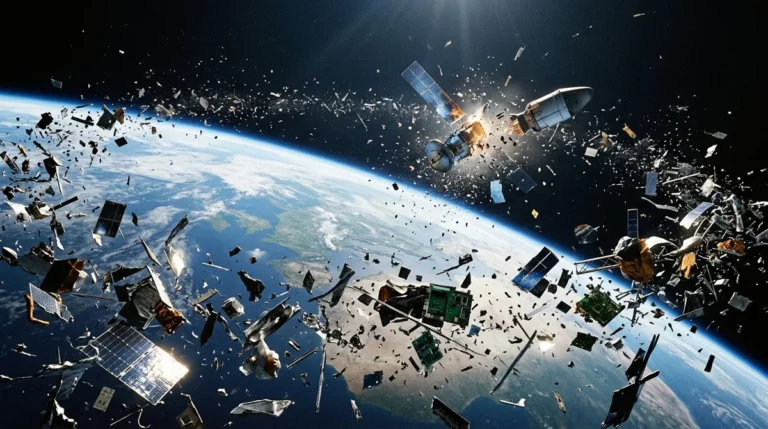

A cascading nightmare known as the Kessler Syndrome space debris crisis is rapidly advancing toward an irreversible tipping point in Low Earth Orbit (LEO). According to leading orbital dynamicists, the escalating density of defunct satellites, discarded rocket stages, and fragmented metallic shards has reached saturation levels. A single hypervelocity collision between two major orbital objects could ignite an uncontrollable chain reaction of fragmentation. Within weeks, millions of high-velocity debris bullets could shred modern telecommunications, weather tracking, and orbital navigation infrastructure, surrounding our planet in an impenetrable ring of kinetic shrapnel and locking humanity out of space for centuries.
Understanding Kessler Syndrome: The Physics of Cascading Orbital Shrapnel
In 1978, NASA astrophysicist Donald J. Kessler alongside Burton Cour-Palais published a seminal scientific paper establishing that artificial orbital debris accumulation would eventually supersede micrometeoroids as the dominant operational hazard for spacecraft. Their mathematical models demonstrated that once object density crosses a defined mathematical threshold, collision probability transitions from linear growth into an exponential cascade.
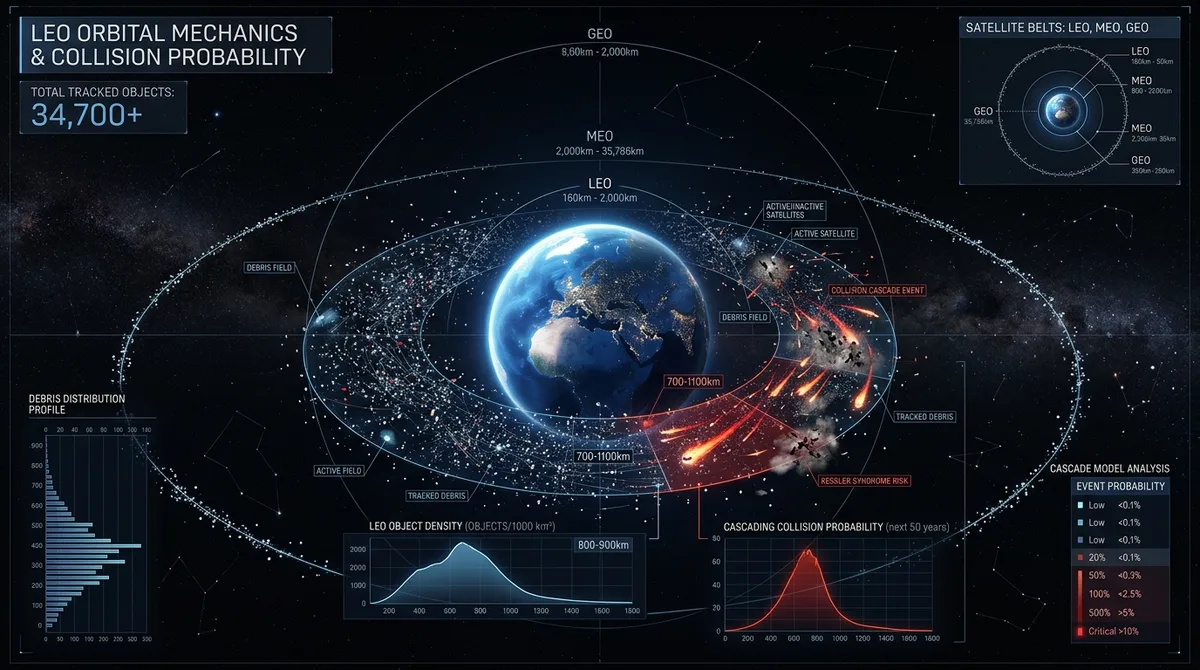
Between 600 and 1,000 kilometers above the Earth, objects travel at orbital velocities averaging 7.8 kilometers per second (approximately 28,000 km/h or 17,500 mph). In head-on or oblique orbital intersections, closing velocities regularly exceed 14 kilometers per second. At these kinetic energy regimes, a common two-centimeter aluminum fastener possesses the explosive energy equivalent of a hand grenade detonation.
Upon impact, rigid satellite structures do not simply deform; they undergo catastrophic kinetic spallation, disintegrating into clouds of hypervelocity fragments. Each newly generated projectile assumes an independent eccentric orbit, cutting across thousands of operational flight paths and triggering subsequent impacts in a self-perpetuating domino effect.
Historical Catalysts: The 2009 Iridium Collision and Cold War Legacies
The orbital environment has already witnessed terrifying previews of Kessler mechanics. On February 10, 2009, over the Taymyr Peninsula in Siberia, the defunct Russian military satellite Kosmos-2251 collided with the operational American communications satellite Iridium 33 at an altitude of 789 kilometers.
The impact instantly generated over 2,000 trackable fragments larger than ten centimeters and hundreds of thousands of lethal millimeter-scale fragments, many of which remain in persistent orbit today, frequently forcing the International Space Station into avoidance maneuvers. In 2007, an intentional Chinese anti-satellite missile test targeting the Fengyun-1C meteorological satellite produced the largest single debris cloud in human history.
Adding to this baseline hazard are hundreds of derelict rocket upper stages abandoned during the Cold War. Residual propellants and aging pressurized batteries frequently undergo thermal and structural failure after decades of cyclic solar roasting, triggering violent on-orbit explosions that spray dense clusters of shrapnel across vital satellite corridors.
At hypervelocity, a millimeter-scale fleck of paint delivers the kinetic impact energy of a high-caliber bullet.
The Kosmos-Iridium collision created thousands of long-lived debris projectiles that threaten orbital missions today.
With over 100,000 satellites planned, the statistical likelihood of cascading chain collisions increases exponentially.
New regulatory rules mandate active atmospheric deorbiting within five years of operational mission retirement.
The Mega-Constellation Epoch: Starlink and LEO Congestion
While earlier space eras were defined by modest operational fleets, the commercial space sector has fundamentally altered orbital demographics. Driven by mega-constellations like SpaceX Starlink, Eutelsat OneWeb, and upcoming fleets such as Amazon Project Kuiper, the population of active commercial satellites has surged past 10,000 and is projected to surpass 100,000 within the decade.
Although modern satellites are outfitted with automated collision-avoidance algorithms and ion propulsion thrusters, the geometric density of near-miss encounters is climbing exponentially. Tracking telemetry indicates that orbital operators must execute thousands of burn maneuvers each month to evade lethal conjunctions.
The systemic risk emerges during anomalous solar storms or hardware failures. If a batch of satellites suffers uncommanded tumbling or loss of telemetry, they become silent kinetic threats. In an overcrowded environment, a small cluster of dead satellites could ignite an unstoppable domino reaction, imperiling not only commercial communications but irreplaceable scientific flagships such as orbital space telescopes.
«We are rapidly approaching the critical threshold where debris collisions in Low Earth Orbit will generate new fragments faster than natural atmospheric drag can remove them. This is not speculative science fiction; it is fundamental orbital mechanics and statistical inevitability unless orbital stewardship fundamentally changes.»
Donald J. Kessler, NASA astrophysicist and former head of the NASA Orbital Debris Program Office
Planetary Imprisonment: The Civilizational Repercussions
The full manifestation of the Kessler Syndrome would permanently degrade global civilization. Modern infrastructure relies on space assets for financial timestamping, maritime shipping navigation, meteorological storm early-warning, and military surveillance. The loss of LEO would trigger trillions in economic devastation.
More profoundly, it would sever humanity from the cosmos. A dense cloud of hypervelocity debris encasing the globe would make orbital insertion fatal for crewed spacecraft. Missions to the Moon, Mars, and interplanetary trajectories would become impossible suicide runs through a storm of orbital shrapnel.
Because atmospheric drag is negligible above 700 kilometers, natural orbital decay requires centuries or even millennia. The reckless accumulation of space debris could turn Earth into a self-imposed prison planet, extinguishing our spacefaring future before it truly begins.
- The cascading collision theory was formulated in 1978 by NASA scientists Donald Kessler and Burton Cour-Palais.
- The most vulnerable orbital danger zone lies between 700 and 1,000 kilometers in Low Earth Orbit.
- Atmospheric drag is virtually absent above 700 km, meaning debris persists for hundreds or thousands of years.
- Active debris remediation missions utilizing nets, harpoons, and lasers are critical to preserving human spaceflight.
Remediation Technologies: Harpoons, Lasers, and 5-Year Deorbit Rules
To avert this catastrophic fate, space agencies including NASA, ESA, and JAXA are pioneering Active Debris Removal (ADR) technologies. Robotic servicing vessels equipped with biomimetic grippers, capture nets, and magnetic harpoons are being tested to grapple derelict upper stages and drag them into controlled atmospheric incineration.
Simultaneously, directed-energy researchers are investigating ground-based pulsed lasers capable of laser ablation — vaporizing micro-layers of orbital fragments to generate plasma jets that impart retrograde thrust, hastening reentry. Rigorous space science analyses are regularly featured on IFLScience.
On the policy front, international regulators have shortened the permissible post-mission disposal window from 25 years down to 5 years. Enforcing rigorous orbital compliance is our only insurance against sealing humanity under an inescapable ceiling of kinetic destruction.