

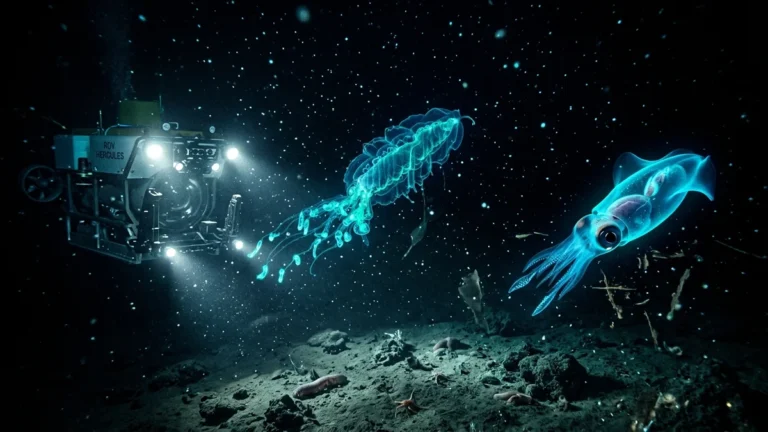

At depths exceeding 4,000 meters, the global ocean is enshrouded in eternal darkness, near-freezing temperatures, and crushing hydrostatic pressure surpassing 400 atmospheres. For decades, marine biologists assumed that abyssal plains were barren ecological wastelands receiving only refractory, indigestible debris that survived the long descent from the sunlit photic zone. However, a landmark oceanographic study has overturned long-held assumptions regarding Earth’s biological carbon pump. Researchers discovered that extreme hydrostatic pressure functions as a colossal planetary juicer: by mechanically compressing sinking aggregates of “marine snow,” the abyss squeezes out rich plumes of dissolved organic carbon and nitrogen, fueling a thriving, hidden deep-sea biosphere.
The Biological Carbon Pump: The Phenomenon of Marine Snow
Within the sun-drenched epipelagic zone, marine phytoplankton assimilate gigatons of atmospheric carbon dioxide annually. Following senescence, algal remains, zooplankton fecal pellets, and sticky transparent exopolymer particles coalesce into macroscopic flocculent flakes termed “marine snow.”
This continuous biological shower sinks through the water column at velocities ranging from tens to hundreds of meters per day. Scientists historically believed that midwater heterotrophic bacteria stripped all labile carbohydrates and amino acids during transit, leaving only refractory silica and chitin for the seafloor.
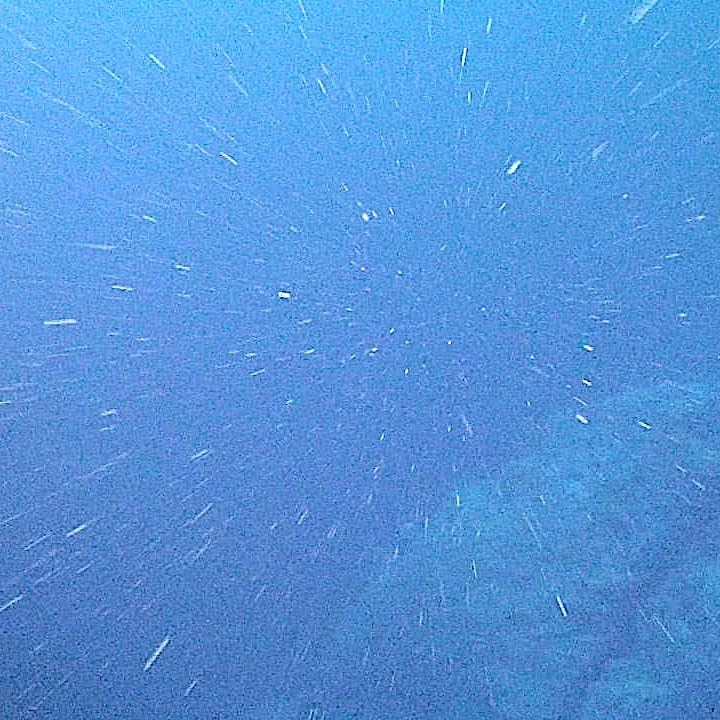
The Abyssal Juicer Effect: Physics of Mega-Pressure
Deploying isobaric in-situ sampling landers equipped with titanium pressure-retention chambers revealed a startling physical mechanism. Between 2,000 and 6,000 meters deep, hydrostatic pressure ascends from 20 to over 60 megapascals (MPa).
Under these extreme thermodynamic regimes, the molar volume of bulk water contracts, driving structural conformational changes in hydrated organic gels. Particulate matrices compress like porous sponges, causing high-molecular-weight dissolved organic carbon (DOC) and bioavailable nitrogen to leak into surrounding waters, cloaking each aggregate in a nutrient-rich plume.
Organic flocs transport gigatons of surface carbon down into the dark abyss.
400+ atmospheres compress gels, releasing rich dissolved carbon and amino acids.
Specialized deep-sea bacteria thrive by feeding on pressure-liberated nutrient plumes.
Deep-ocean carbon cycling is vastly more dynamic and active than previously modeled.
Piezophilic Extremophiles: Thriving Beneath 400 Atmospheres
This liberated dissolved organic carbon is rapidly scavenged by obligate piezophilic bacteria. These extremophiles possess cell membranes enriched in polyunsaturated fatty acids that maintain homeoviscous fluidity despite intense mechanical compression.
Their metabolic enzymes feature rigid molecular conformations that resist pressure-induced denaturation. These microbial consortia anchor deep-sea trophic webs, supporting ghostly gossamer worms (Tomopteris), bioluminescent ctenophores, and benthic xenophyophores across the abyss.
«We historically viewed bathypelagic pressure merely as a physical stressor that inhibited biological metabolism. In reality, abyssal thermodynamics acts as an active biochemical catalyst: pressurized water molecules force their way into the matrix of organic aggregates, disrupting hydrogen bonds and literally squeezing out a nutrient-dense broth directly to piezophilic deep-sea microbes.»
Dr. Morgan Lee, Lead Marine Biogeochemist at Scripps Institution of Oceanography
Revising Planetary Climate Models: Deep Carbon Sequestration
This discovery requires geophysicists to recalibrate global biogeochemical climate models. Existing models assumed that organic carbon traversing below 2,000 meters was definitively locked away into seafloor sediments for millennia.
In truth, substantial carbon fractions are continuously recycled and respired within deep water masses via this pressure-driven microbial loop. Consequently, the ocean’s buffer capacity for anthropogenic CO2 storage is governed by dynamic biochemical feedback loops previously omitted from IPCC projections.
- Hydrostatic pressures exceeding 40 MPa mechanically squeeze dissolved organic carbon (DOC) out of sinking flocs.
- Abyssal microbial communities metabolize organic nutrients at rates far higher than prior laboratory estimates.
- Compels the recalibration of long-term global climate and oceanic carbon sequestration models.
- Expeditions by research vessels like R/V Falkor (too) continue to uncover dozens of undocumented abyssal species.
Next-Generation Deep-Ocean Exploration Technologies
Deciphering the abyss has been unlocked by modern oceanographic flagships such as R/V Falkor (too) operated by the Schmidt Ocean Institute, paired with ROV SuBastian and hyperbaric imaging suites.
For the first time, oceanographers can observe delicate pelagic organisms in their pristine thermodynamic habitats without triggering explosive decompression trauma during ascent to surface laboratories.