

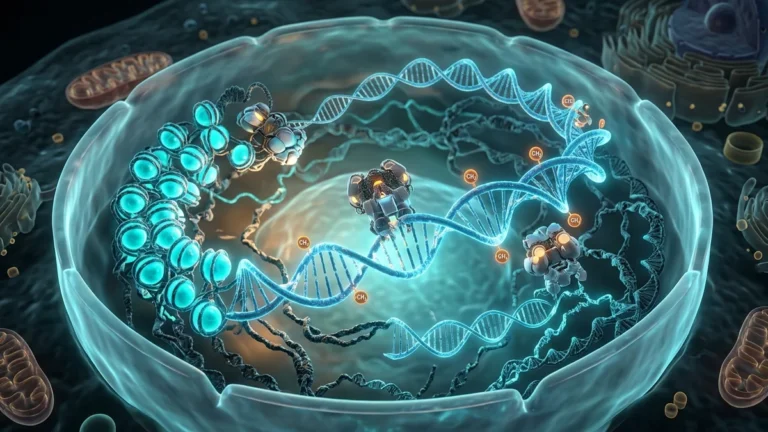

For centuries, biology viewed biological aging as an inexorable thermodynamic entropy: DNA damage accumulation, telomere shortening, and systemic tissue degeneration were deemed completely permanent. However, groundbreaking discoveries over the past decade have upended conventional biomedical paradigms. Geneticists have demonstrated that aging is not a fatal hardware crash of the genome, but a progressive degradation of the cellular epigenetic software — cells simply forget which genes to express. Partial epigenetic reprogramming using Yamanaka factors resets cellular biological age back to youth while fully preserving mature tissue identity.
The Information Theory of Aging: Genetic Hardware vs Epigenetic Software
Historical gerontology attributed senescence primarily to an irreversible accumulation of somatic DNA mutations. However, the paradigm-shifting Information Theory of Aging proved that somatic cells in an 80-year-old individual still harbor the complete genetic blueprint of a newborn.
The fundamental pathology resides within the epigenome — the complex apparatus of chemical annotations (DNA methylation, post-translational histone modifications) that choreographs cell-type-specific gene expression. Over decades, DNA breaks and metabolic stress scramble this epigenetic landscape, leading to cellular identity drift.
The Yamanaka Legacy: Decoding Embryonic Pluripotency
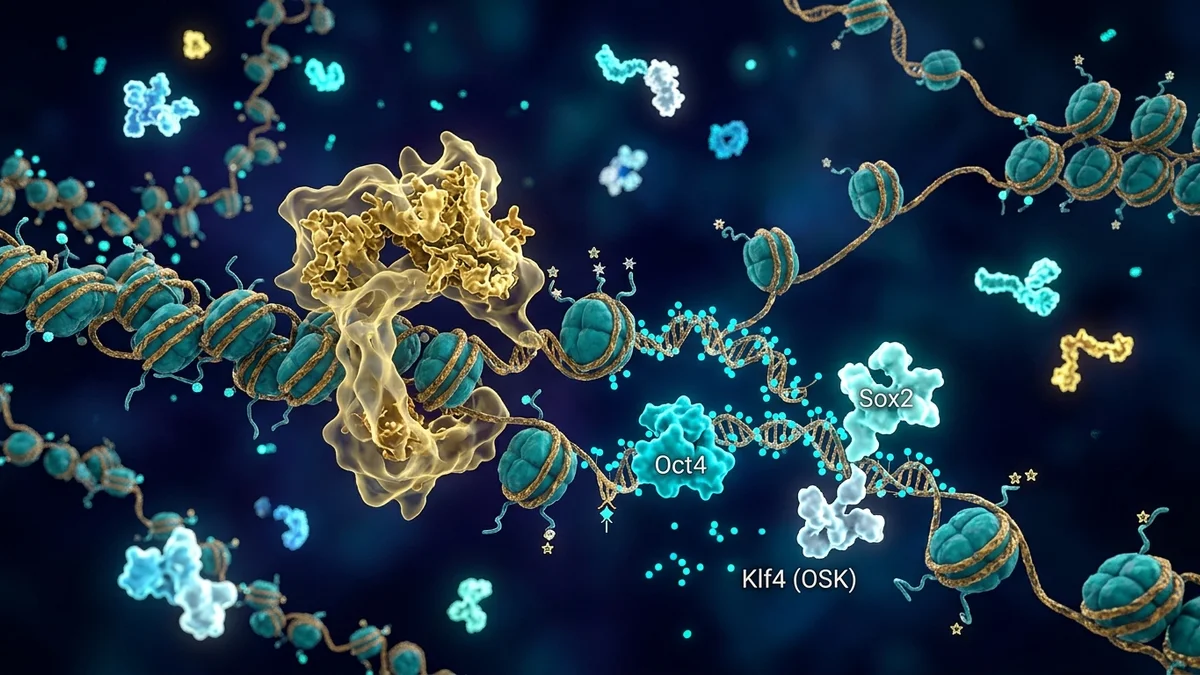
In 2006, Japanese stem-cell biologist Shinya Yamanaka made a Nobel Prize-winning discovery: retroviral expression of just four transcription factors — Oct4, Sox2, Klf4, and c-Myc (OSKM cocktail) — can reprogram any terminally differentiated somatic cell into an induced pluripotent stem cell (iPSC).
Early whole-body attempts in vivo caused teratomas due to complete erasure of cell identity. The transformative breakthrough came with cyclical, partial reprogramming: short pulses of factor expression reset epigenetic age without triggering tissue dedifferentiation.
Aging results from scrambled epigenetic regulatory markers rather than genetic code loss.
Three transcription factors reset cellular biological age while preserving tissue identity.
DNA methylation profiling proves a genuine 50%+ reversal of biological tissue age.
First FDA-cleared clinical trials using partial reprogramming gene therapy are now active.
The OSK Triad: Restoring Vision and Myocardial Function
By eliminating the oncogenic c-Myc factor, researchers engineered a safer tripartite vector comprising Oct4, Sox2, and Klf4 (OSK). In landmark Harvard preclinical trials, adeno-associated virus (AAV) delivery of OSK into retinal ganglion cells of aged and glaucomatous mice regenerated damaged optic axons and restored lost visual acuity.
Steve Horvath’s DNA methylation clock, measuring biological age via hundreds of conserved CpG sites, confirmed that the treated retinas were rejuvenated by over 50%. Comparable systemic rejuvenation has since been documented in cardiac myocytes, renal podocytes, and cortical neurons.
«Aging is analogous to scratches on a compact disc: the digital genetic code underneath remains pristine, but the cell’s optical reader stumbles upon accumulated epigenetic noise. Partial reprogramming gently polishes the disc surface, restoring youth-like transcription profiles. Aging is no longer an immutable fate; it is an engineerable biological program.»
Dr. David Sinclair, Co-Director of the Paul F. Glenn Center for Biology of Aging Research at Harvard Medical School
Clinical Translation: Human Trials Enter the Clinic
Between 2025 and 2026, partial cellular reprogramming crossed the frontier into human clinical trials. Longevity biotech leaders received landmark regulatory clearance from the FDA to initiate Phase 1/2a trials for vision-loss conditions including non-arteritic anterior ischemic optic neuropathy (NAION).
Simultaneously, next-generation non-viral epigenome editors using catalytically inactive Cas9 (dCas9) fused with TET demethylases have emerged. These molecular scalpels directly prune hypermethylated promoter sites without inflicting double-stranded DNA cuts.
- Partial reprogramming specifically resets DNA methylation landscapes without compromising cellular specialization.
- Eliminating oncogenic c-Myc established in vivo safety across preclinical mammalian models.
- Rejuvenation restores youthful mitochondrial ultrastructure, bioenergetic ATP output, and proteostasis.
- Ophthalmic trials serve as the beachhead for future whole-organ and systemic longevity therapies.
The Future of Regenerative Medicine: Whole-Body Rejuvenation
The ultimate frontier over the coming decade lies in targeted systemic delivery architectures. Advanced lipid nanoparticles (LNPs) and bioengineered exosomes hold the promise of periodic systemic “reboots” of the vascular endothelium, liver parenchyma, and hematopoietic stem cell niches.
Rather than treating individual late-stage degenerative diseases in isolation, epigenetic reprogramming targets the universal biological root cause of chronic human pathology: tissue senescence itself.