

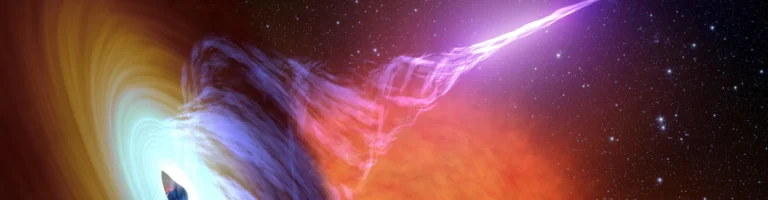

Astrophysicists have spent decades scouring the Milky Way for one of the most elusive compact objects in high-energy astronomy: a galactic microblazar. While standard blazars are supermassive black holes anchoring active galactic nuclei billions of light-years away whose relativistic plasma jets point directly along Earth’s line of sight, microblazars are their stellar-mass counterparts right within our Galaxy. Coordinated observations by NASA’s Chandra X-ray Observatory, the MAGIC ground-based telescope array, and the Large High Altitude Air Shower Observatory (LHAASO) have confirmed the detection of a galactic microblazar functioning as a natural PeVatron particle accelerator.
From Microquasars to Microblazars: Relativistic Doppler Beaming
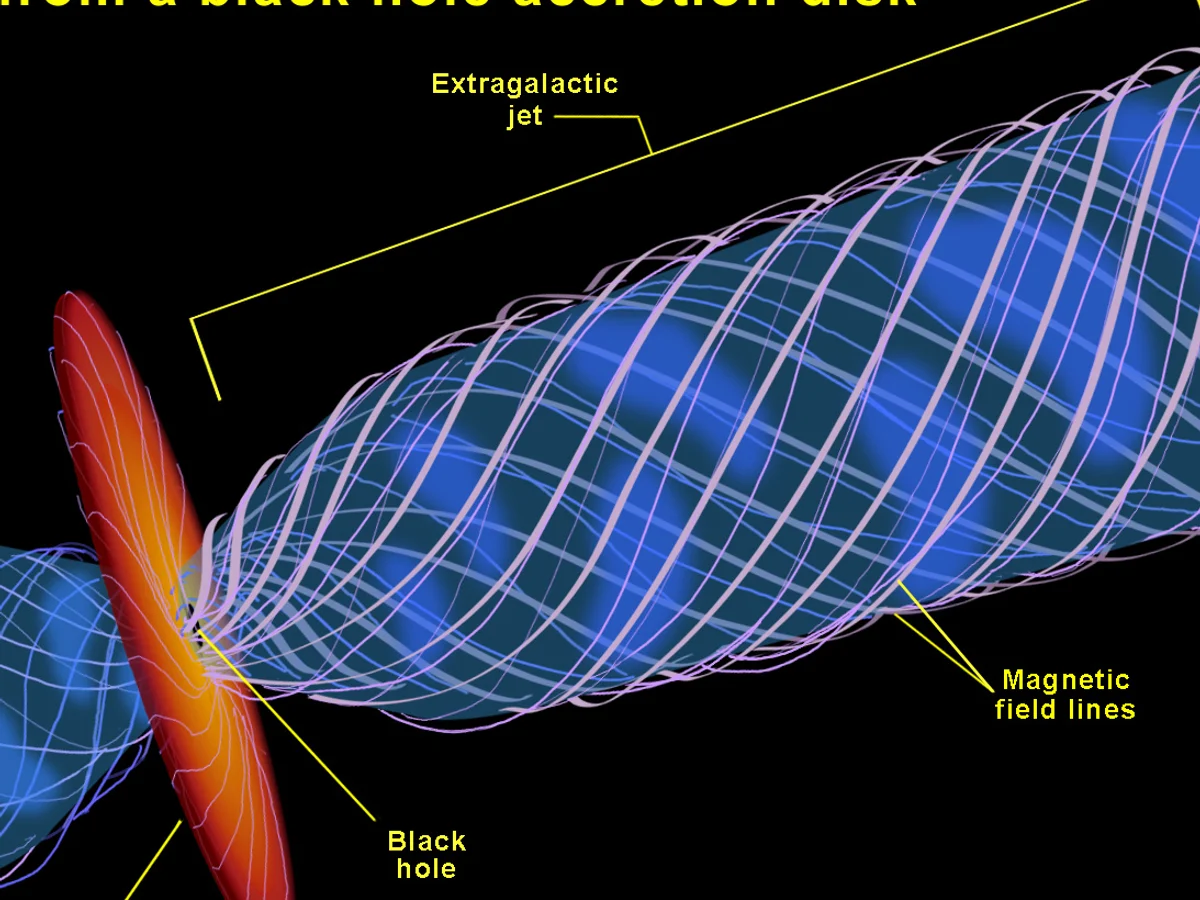
A microquasar consists of a stellar-mass black hole or neutron star gravitationally accreting gas from a binary companion star. Falling matter assembles into an incandescent accretion disk, while a fraction of the plasma is funneled outward along the spin axis into two opposed relativistic jets moving at over 90% the speed of light.
When orbital dynamics and jet precession align one of these collimated jets directly toward Earth (with an alignment angle less than a few degrees), special relativistic Doppler beaming takes over. The apparent luminosity is boosted by orders of magnitude, shifting the emission dramatically into hard X-rays and tera-electronvolt (TeV) gamma rays—transforming a microquasar into a microblazar.
- Line-of-Sight Alignment: Jet opening angle oriented within 2 to 5 degrees of Earth’s observational axis.
- PeV-Scale Acceleration: Shock acceleration driving cosmic-ray protons and electrons up to peta-electronvolt (PeV) energies.
- Compact Dynamic Timescales: Evolutionary flare cycles occurring over days or weeks rather than millions of years.
LHAASO Detection: Direct Evidence of a Galactic PeVatron
The definitive breakthrough arrived through ultra-high-energy observations by the LHAASO observatory in Daocheng, China. LHAASO’s wide-field air shower arrays detected ultra-hard gamma-ray photons with energies surpassing 100 TeV (tera-electronvolts), with extended cascade events approaching 1 PeV (10^15 eV).
Photons of such extraordinary energies require particle acceleration at magnetic shock fronts inside the relativistic jet, confirming the system operates as a genuine galactic “PeVatron.” Protons and leptons accelerated across shock discontinuities collide with low-energy disk photons, generating high-energy gamma rays through inverse Compton scattering and neutral pion decay.
Chandra and MAGIC Observations: Rapid Flaring & Jet Precession
Complementary measurements from NASA’s Chandra Observatory revealed ultra-fast X-ray variability on timescales of minutes, coupled with signatures of relativistic jet precession. As the black hole accretes unevenly, gravitational torque induces a slow precessional wobble in the jet cone.
Whenever this precession cone points precisely toward terrestrial telescopes, the observed flux spikes by orders of magnitude. Simultaneously, the MAGIC atmospheric Cherenkov telescopes detected rapid sub-TeV flaring, proving the compact emission zone is located near the black hole event horizon.
«Discovering a microblazar within our own Milky Way offers high-energy astrophysicists an unprecedented laboratory. We can study the physics of black hole jets in real time across days rather than eons,»
Dr. Zhen Cao, Chief Scientist and Spokesperson for the LHAASO Collaboration
Direct alignment of the plasma jet along Earth’s view amplifies observed luminosity by thousands of times.
Detection of gamma rays exceeding 100 TeV confirms powerful cosmic-ray particle acceleration in the Milky Way.
Because of lower black hole mass, disk accretion and jet flaring cycles unfold over days rather than millennia.
Microblazars explain the persistent mystery of cosmic-ray origin at the multi-PeV “knee” of the energy spectrum.
Video Exploration: The Astounding Physics of Black Holes
This animated feature by Kurzgesagt delves into the intense gravitational physics of black holes and the immense energetics of relativistic jets:
Cracking the Century-Old Mystery of Cosmic Rays
For more than a century, astronomers have debated the precise origin of the highest-energy galactic cosmic rays. While supernova remnant shockwaves can accelerate particles up to hundreds of TeV, they fail to reproduce cosmic rays around the “knee” feature at ~3 PeV.
The confirmation of microblazars functioning as active PeVatrons provides the missing astrophysical link. Future campaigns linking radio interferometers like the VLBA with next-generation observatories such as the Cherenkov Telescope Array (CTA) will resolve the internal magnetic topology of microblazar jets with unprecedented fidelity.