

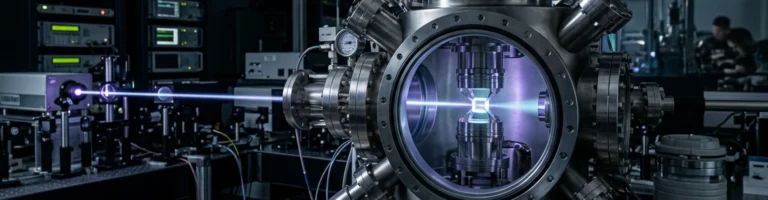

A monumental breakthrough has redefined the frontiers of chronometry and fundamental metrology: an international collaboration of physicists from JILA (NIST and the University of Colorado Boulder), TU Wien, and the Physikalisch-Technische Bundesanstalt (PTB) has successfully coupled an optical frequency comb laser to the nuclear transition of thorium-229. This milestone marks the experimental realization of the world’s first prototype nuclear optical clock—an instrument engineered to exceed the accuracy of today’s best atomic clocks by orders of magnitude and detect variations in nature’s fundamental constants with unprecedented precision.
The Atomic Clock Frontier: Moving Beyond Valence Electrons
State-of-the-art optical atomic lattice clocks based on strontium-87 and ytterbium-171 achieve staggering precision, losing less than a single second over 30 to 40 billion years (a fractional frequency uncertainty of 10^-18). However, atomic clocks rely on electronic transitions in the atom’s outer electron cloud. Being situated at the atom’s periphery, valence electrons are susceptible to environmental blackbody radiation, stray electrostatic potentials, and magnetic field fluctuations.
An atomic nucleus, by contrast, is roughly 100,000 times smaller than the atom itself and is enveloped by dense shielding electron shells. Nuclear energy levels are inherently immune to ambient thermal and electromagnetic perturbations. Yet nuclear clocks were long considered technologically impossible: nearly all nuclear isomer transitions demand mega-electronvolt (MeV) gamma-ray photons, vastly exceeding the reach of coherent lasers.
- Ultralow Excitation Energy: An isomer transition at ~8.355 eV (wavelength ~148.4 nm in the vacuum ultraviolet), accessible by optical lasers.
- Immunity to Environmental Noise: Nuclear shielding reduces blackbody radiation shift vulnerability by over a factor of 10,000.
- Solid-State Implementation: Ability to embed billions of thorium nuclei inside transparent calcium fluoride (CaF2) crystals for compact deployment.
Thorium-229: Nature’s Unique Nuclear Anomaly
Across the entire periodic table, exactly one isotope possesses an excited nuclear state within the optical spectrum: thorium-229 (229Th). Through an extraordinary cancellation between the strong nuclear force and repulsive Coulomb electrostatic forces among protons, the energy gap between its ground state and first isomer state is a mere 8.355 electronvolts.
This corresponds to vacuum ultraviolet (VUV) photons at a wavelength of approximately 148.4 nanometers. For over forty years, researchers struggled to measure this transition frequency directly. In 2024, Jun Ye’s team at JILA, alongside Thorsten Schumm’s group at TU Wien, engineered a specialized VUV frequency comb laser, directly exciting thorium-229 nuclei embedded within a high-purity calcium fluoride crystal.
Bridging the Gap: Frequency Comb Synchronization
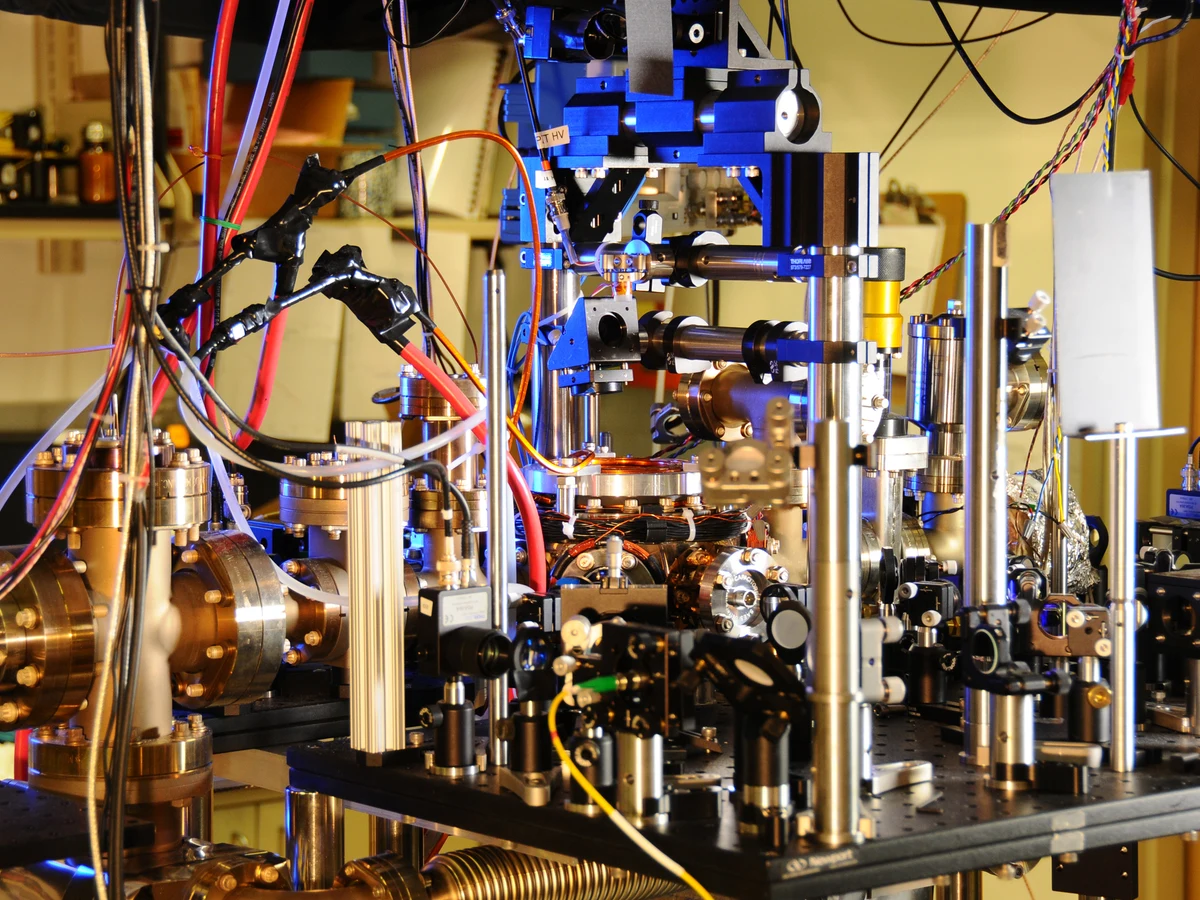
The research team utilized high-harmonic generation driven by an infrared femtosecond laser to create an ultraviolet frequency comb—a spectrum of millions of equally spaced laser lines acting as an ultra-precise optical ruler. This allowed them to link the nuclear transition of thorium-229 directly to JILA’s world-leading strontium optical atomic clock.
The precision of the nuclear resonance measurement improved upon earlier indirect estimates by more than five orders of magnitude (100,000 times). This achievement establishes the first robust, operational bridge linking laser quantum optics to nuclear physics.
«We are inaugurating a new paradigm in precision measurement. Until now, coherent lasers only manipulated electrons orbiting outside the nucleus. Now, we are using laser light to control internal nuclear quantum states,»
Prof. Jun Ye, JILA / NIST Fellow and Breakthrough Prize Laureate
The only known nuclear excitation in nature residing in the vacuum UV regime, accessible by coherent laser excitation.
Directly synchronizes millions of ultraviolet laser frequencies with a primary strontium optical standard.
Dense inner electron shells shield the thorium nucleus from stray ambient thermal, electrical, and magnetic fields.
Extraordinary sensitivity to temporal drifts in the fine-structure constant (alpha) and strong force interactions.
Video Exploration: Cosmic Time and the Scale of the Universe
This cinematic exploration by melodysheep examines the cosmic scale of deep time and the scientific quest to quantify the fabric of reality:
Looking Forward: Dark Matter Detection and Relativistic Geodesy
The realization of nuclear clocks opens profound possibilities beyond timekeeping. Due to the delicate balance of strong force and electrostatic potentials in thorium-229, its transition frequency is roughly five to six orders of magnitude more sensitive to hypothetical changes in the fine-structure constant (alpha) than atomic transitions. Simultaneously comparing nuclear clocks against atomic standards will allow physicists to search for ultralight scalar dark matter particles passing through Earth.
Furthermore, because billions of thorium nuclei can be trapped in a single solid-state crystal, future nuclear clocks can be engineered into compact, rugged field devices. Deployed on satellites or exploration probes, these clocks will measure Earth’s gravitational redshift with millimeter-level altitude precision, transforming relativistic geodesy and earthquake monitoring.