

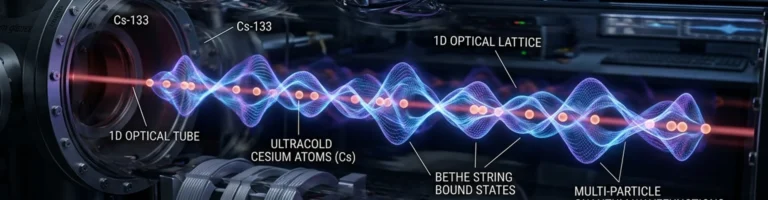

Nearly a century ago, at the dawn of modern quantum mechanics, German-American physicist Hans Bethe formulated an exact mathematical solution for one-dimensional quantum spin chains, predicting the existence of exotic multi-particle bound states known as “Bethe strings.” For 93 years, Bethe’s groundbreaking prediction remained a celebrated yet unproven mathematical milestone. Now, an international team of experimental physicists from the Max Planck Institute of Quantum Optics and Heidelberg University has accomplished a historic breakthrough: using ultracold cesium atoms trapped in one-dimensional optical lattices, researchers have directly observed and mapped the dispersion relations of quantum Bethe strings for the first time.
The 1931 Bethe Ansatz: Quantum Spin Strings Revealed
In 1931, Hans Bethe set out to solve the quantum Heisenberg spin-1/2 chain model. His analytical framework, which became universally known as the “Bethe ansatz,” revolutionized theoretical physics. Bethe demonstrated that when spins in an isolated 1D chain flip, the resulting collective excitations—termed magnons—do not merely collide and scatter elastically. Under specific interaction parameters, two, three, or more flipped spins bind together, propagating through the lattice as a coherent, indivisible multi-particle quantum entity: a Bethe string.
Why did it take almost a century to observe these exotic quantum strings? In real three-dimensional crystalline solids, thermal lattice vibrations (phonons) and interchain couplings rapidly destroy the fragile quantum entanglement required to sustain Bethe strings. To isolate the phenomenon, physicists needed a completely clean, defect-free, and precisely tunable one-dimensional quantum environment.
- Validation of a Quantum Pillar: Experimental confirmation of Bethe’s 1931 ansatz after nearly a century of theoretical speculation.
- Pristine Quantum Simulation: Flawless simulation of strongly correlated 1D quantum fluids free from crystal lattice impurities.
- Multi-Particle Entanglement Engineering: Foundation for creating decoherence-resistant quantum memory architectures and topological qubits.
Experimental Architecture: Nanokelvin Cesium in Optical Tubes
To overcome real-world solid-state noise, the researchers deployed an advanced optical lattice simulator. A cloud of cesium-133 atoms was cooled inside an ultra-high vacuum chamber via laser cooling and evaporative cooling techniques to temperatures below 50 nanokelvin above absolute zero. At this sub-microscopic regime, thermal motion ceases and quantum wavefunctions dictate particle behavior.
By intersecting orthogonal laser beams, the team created a two-dimensional optical lattice that partitioned the atomic gas into thousands of independent, strictly one-dimensional optical tubes. Transverse atomic motion was suppressed by prohibitive potential energy barriers, forcing the atoms to behave as an ideal Tomonaga-Luttinger quantum liquid. By fine-tuning an external magnetic field across a Feshbach resonance, the researchers precisely adjusted the interatomic interaction strength, tuning the system into the strongly coupled Heisenberg-Ising spin regime.

Quench Spectroscopy: Capturing 2-Strings and 3-Strings
To detect the elusive Bethe strings, the team applied high-precision radio-frequency spectroscopy combined with quantum quench protocols. By injecting carefully calibrated RF pulses with controlled energy and momentum, the researchers induced spin excitations and recorded the system’s dynamic structure factor.
The resulting spectral data demonstrated pristine agreement with Bethe’s theoretical predictions. Prominent, narrow dispersion bands emerged distinctly beneath the broad continuum of independent magnons, representing 2-magnon (2-string) and 3-magnon (3-string) bound states. This distinct energetic separation confirmed that the flipped spins remained tightly bound and traveled coherently as stable multi-particle composite objects.
«Observing Bethe strings in a pristine atomic gas transforms a 90-year-old mathematical ansatz into an actionable quantum technology platform. We can now study multi-particle quantum entanglement with unprecedented resolution,»
Dr. Zhe Wang, lead investigator in quantum dynamics
Exact mathematical solution of the 1D quantum spin chain that founded the theory of quantum integrable systems.
Laser traps segment nanokelvin cesium atoms into thousands of isolated 1D channels, eliminating solid-state decoherence.
Spectroscopic isolation of 2- and 3-string spin complexes propagating coherently beneath the continuum threshold.
A revolutionary sandbox for exploring non-equilibrium thermalization, high-Tc superconductivity, and robust qubits.
Video Exploration: How Atoms Behave at the Quantum Limit
This breakdown from MinutePhysics illustrates the wave-particle duality of atoms and the counterintuitive physics governing subatomic matter:
Future Horizons: From Soliton Dynamics to Quantum Computing
The direct observation of Bethe strings has profound ramifications across condensed matter physics and quantum information science. One-dimensional spin interactions underpin the mechanisms of unconventional cuprate superconductors, carbon nanotube conductance, and topological spin liquids. Because bound spin strings exhibit remarkable structural stability, they offer potential avenues for encoding quantum information shielded against environmental thermal perturbations.
Future research will explore collisional dynamics between different string excitations and test non-equilibrium thermalization in isolated quantum systems. Ultracold quantum simulators have officially transitioned from mathematical curiosities into peerless engines of scientific discovery.