



NASA astrophysicists have released an extraordinary time-lapse movie capturing the multi-year evolution of a colossal plasma beam launched by a gravitational giant. At the center of the investigation lies the M87 black hole jet — a relativistic plasma outflow emanating from the core of the giant elliptical galaxy Messier 87. By compiling 13 years of archival data from NASA’s Chandra X-ray Observatory, scientists have directly tracked structural changes across a cosmic beam that seemingly defies the cosmic speed limit.
Located roughly 54 million light-years away in the constellation Virgo, M87 harbors a supermassive black hole containing 6.5 billion solar masses — the first ever to have its event horizon shadow resolved by the Event Horizon Telescope (EHT) in 2019. While the shadow portrait captures a static central ring, the particle jet extends across thousands of light-years into the intergalactic medium, operating under mechanisms comparable to how an elusive microblazar unleashes extreme relativistic particle beams.
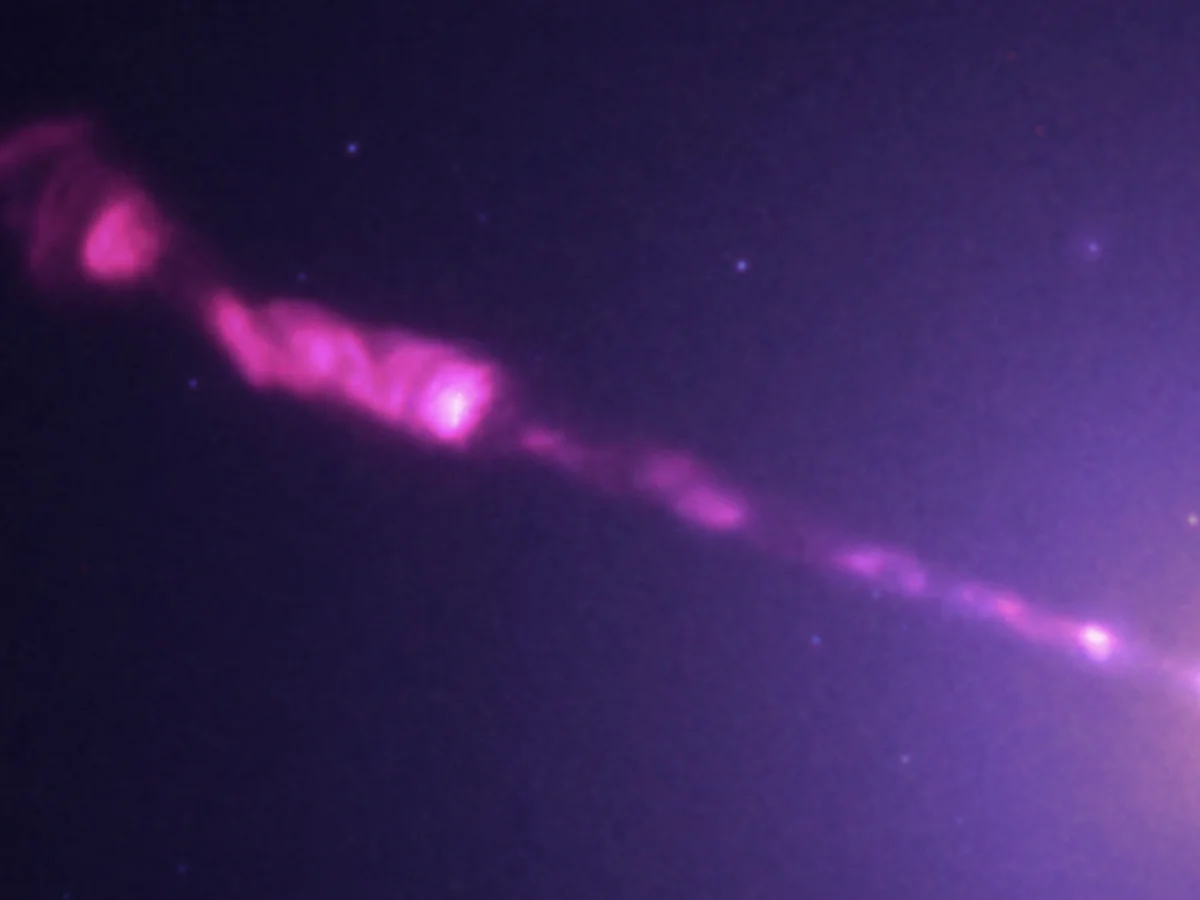
Analyzing X-ray observations between 2012 and 2025 required advanced image-deconvolution algorithms. This analytical breakthrough enabled researchers to resolve previously blended plasma structures into discrete knots, tracking their morphology and brightening events in real time.
Superluminal Motion Illusion and the M87 Black Hole Jet
The most striking result from the multi-epoch data is the kinematics of bright plasma concentrations, such as HST-1 and Knot A. Chandra tracked features traveling at apparent speeds exceeding five times the speed of light. Physicists emphasize that Einstein’s special relativity remains unviolated: this is a textbook relativistic projection effect termed apparent superluminal motion.
Because the jet is directed toward Earth at an angle of roughly 17 degrees and plasma flows at over 99% of light speed, emitted X-ray photons nearly keep pace with the moving material itself. This compresses the observed arrival times, generating the optical illusion of superluminal velocity.
«The 13-year X-ray movie unveiled remarkable structural contrast: while several compact knots tear through space at near-light speeds, adjacent regions remain stationary shock barriers where plasma slams into ambient gas».
Camille Poitras, Lead Researcher and Astrophysicist at Laval University
Energetic Impact: The kinetic power channeled through M87’s jet dwarfs the combined luminosity of every star in the Milky Way, excavating vast cavities in the intergalactic medium and regulating galactic star formation for millions of years.
Multi-Wavelength Synergy from X-Rays to Radio
To unravel the magnetic launch mechanics, researchers correlated Chandra’s data with optical views from Hubble, infrared imaging from the James Webb Space Telescope (JWST), and radio maps from the Very Large Array (VLA), yielding three key insights:
- Synchrotron Acceleration: Intense X-ray emissions originate from relativistic electrons accelerated along helical magnetic field lines.
- Plasma Shock Waves: Variability in knot HST-1 reflects stationary internal shock fronts rather than discrete episodic ejections from the central engine.
- Collimation Stability: External gas pressure confines the high-energy stream into a narrow collimated beam across thousands of parsecs.
Presented at the 248th meeting of the American Astronomical Society, the complete analysis is published in the Chandra X-ray Center archive. The study provides vital empirical constraints on how supermassive black holes reshape galactic environments across cosmic time.