


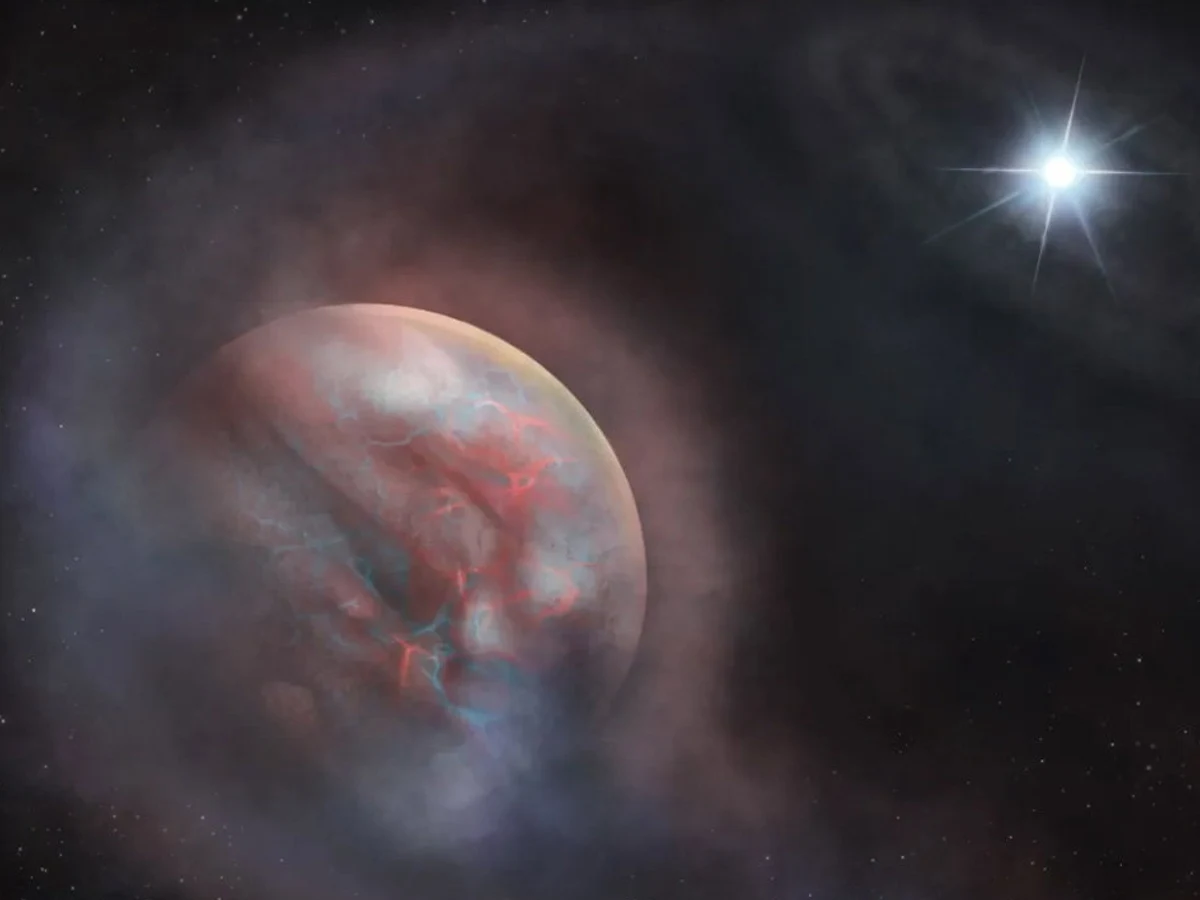
An international team of astronomers has made a discovery that could reshape our understanding of planetary evolution. At the center of this breakthrough is an astonishing phoenix planet orbiting the dead white dwarf HS 0209+0832. Unlike typical exoplanets that formed billions of years ago in circumstellar protoplanetary disks, this gas giant was forged directly from the debris and expelled layers of its deceased host star.
Astrophysicists long believed that the red giant expansion phase would incinerate and pulverize any inner planets. However, the new discovery demonstrates that stellar ejecta can re-collapse after a cataclysm, initiating a true second generation of planet formation. Just as modern observatories probe cosmic frontiers, such as when the James Webb Space Telescope unveiled ancient cosmic giants, studying white dwarfs opens an unprecedented chapter of post-apocalyptic astrophysics.
The HS 0209+0832 system is located approximately 260 light-years away in the constellation Cetus. The progenitor star exhausted its nuclear core fuel and shed its outer envelopes roughly five million years ago, shrinking into an ultra-dense Earth-sized white dwarf. While surveying archived observations of this stellar remnant, astronomers uncovered spectral anomalies that pointed to an active nearby companion.
Niobium Anomalies and Gravitational Capture
White dwarfs possess intense surface gravities that cause heavy elements to sink toward their cores in a matter of days, leaving pure hydrogen or helium on the surface. Yet spectroscopic data from the Hubble Space Telescope revealed abundant deposits of copper, zinc, and notably niobium—concentrated at over 1,000 times the solar ratio.
«Niobium at these concentrations is an unmistakable signature: it is manufactured deep within the nucleosynthetic shells of late-stage stars and ejected during the red giant phase. Its detection on the surface indicates that the white dwarf is actively accreting material raining down from a close-in companion».
Jamie Williams, astrophysicist at the University of Warwick
To verify the source of this accretion, astronomers analyzed photometric time-series data from NASA’s TESS (Transiting Exoplanet Survey Satellite). The readings detected a periodic transit dip recurring every 4.4 days, establishing the presence of a gas giant orbiting at a distance equal to just 4% of the separation between Earth and the Sun.
Core Discovery Finding: The newly detected companion is a hot gas giant with a mass comparable to Jupiter. Intense stellar ultraviolet radiation continuously strips its upper atmosphere, channeling heavy elements directly onto the white dwarf’s surface.
Why the Phoenix Planet Is Second-Generation
A central question was whether this body could be a first-generation survivor. Hydrodynamic simulations ruled out survival through three clear mechanisms:
- Red Giant Expansion Radius: The progenitor star expanded far beyond the current 4.4-day orbital radius, meaning any primordial planet at this location would have been swallowed and destroyed.
- Enriched Isotopic Signatures: The detected elements perfectly match the nucleosynthetic ashes of the slow neutron capture process (s-process).
- Secondary Disk Condensation: Material expelled during the star’s demise formed a dense accretion ring around the newborn white dwarf, enabling gravitational accretion into a full second-generation giant planet.
The landmark study by researchers at the University of Warwick has been published in the journal Nature Astronomy, co-authored by Professor Boris T. Gänsicke, Dr. Snehalata Sahu, and Professor Jay Farihi.
Previously, pulsar planets were the only known examples of second-generation worlds. The discovery of a phoenix planet around a white dwarf indicates that planetary rebirth may occur across our galaxy with far greater frequency than previously recognized.