


Cosmic transients typically flare and vanish within milliseconds, days, or months, governed by the predictable dynamics of supernovae, magnetar bursts, or relativistic shockwaves. However, an unexplained radio source Milky Way has quietly harbored for more than two decades breaks every conventional astrophysical mold. Designated VT J1906+0849, this enigmatic object has been continuously producing intense synchrotron radio signals for at least 20 years without expanding. A research team led by the California Institute of Technology (Caltech) published their breakthrough analysis in The Astrophysical Journal, presenting compelling evidence of a rare, heavily obscured galactic microquasar.
Discovery in the Archives: How the VLA Uncovered a Cosmic Long-Hauler
Radio astronomy is accustomed to fast-paced, ephemeral phenomena. Fast Radio Bursts (FRBs) flash across the cosmos in milliseconds, pulsars tick like precision clocks, and the radio afterglows of core-collapse supernovae or neutron star mergers fade predictably over months. When astrophysicists survey the sky for transient sources, they anticipate rapid rise-and-decay light curves. VT J1906+0849 completely shattered these expectations.
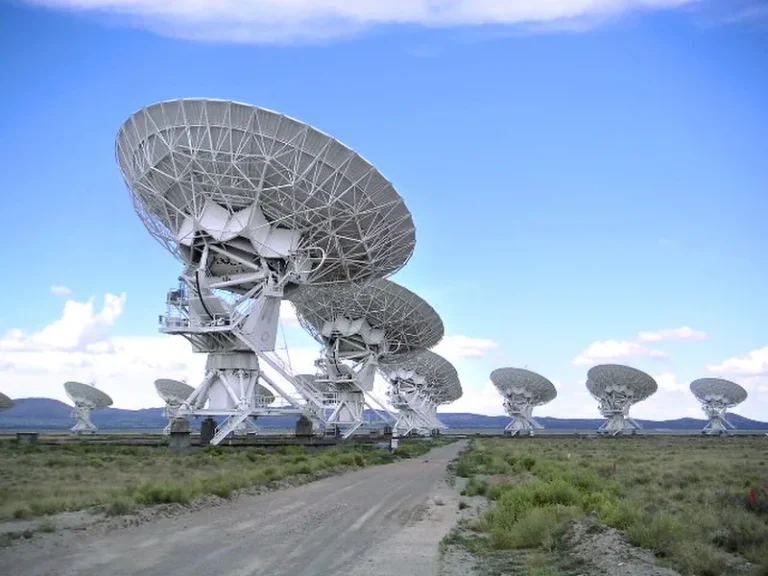
The source was initially uncovered during the Very Large Array Sky Survey (VLASS), an ongoing high-resolution multi-epoch survey conducted by the National Radio Astronomy Observatory (NRAO) in New Mexico. By cross-referencing modern VLASS data with historic sky maps from the NVSS and FIRST surveys conducted in the mid-1990s, astronomers spotted a blinding radio transient precisely where no emission existed in 1996. The object ignited between 1996 and 2005, blazing intensely across frequencies from 1 to 10 GHz.
Subsequent monitoring in 2014, 2017, and the early 2020s revealed extraordinary persistence: after a modest decadal decline, the source rebrightened significantly. Such continuous, multi-decade radio output from a compact source is virtually unprecedented among known galactic transients.
Distances and Physical Scales: Probing the Galaxy’s Outer Rim
Determining the true nature of this mystery required establishing its spatial location. Through neutral hydrogen absorption and dispersion measurements, researchers established that VT J1906+0849 lies roughly 15 kiloparsecs (approximately 49,000 light-years) from our solar system. This places it far on the other side of the Galactic Center, deep in the distant Norma-Cygnus spiral arm near the outer boundary of the Milky Way’s disk.
At such a tremendous distance, its apparent flux translates to immense intrinsic power. The radio spectrum is dominated by synchrotron emission—radiation produced when relativistic electrons spiral through intense magnetic fields at near-light speeds. Typically, such synchrotron bubbles arise from explosive blast waves plowing through interstellar gas at thousands of kilometers per second.
However, high-resolution radio interferometry conducted with the Very Long Baseline Array (VLBA) yielded an astonishing result: the source is not expanding. It remains constrained to an ultra-compact region smaller than 0.1 parsecs, proving that the emission is continuously replenished by an engine rather than an expanding, cooling remnant.
Unlike short-lived supernovae or pulsar bursts, VT J1906+0849 has maintained sustained high-luminosity radio emission since 2005.
Very Long Baseline Array (VLBA) high-resolution imaging reveals that the radio plasma remains compact rather than dissipating outward.
NASA’s Chandra and Swift space telescopes detected no significant X-rays, pointing to an extremely dense absorbing gas cocoon.
The leading hypothesis models the system as a stellar-mass black hole or neutron star undergoing supercritical accretion from a massive donor.
The Mystery of X-Ray Silence: The Obscured Microquasar Paradigm
To identify the underlying engine, astronomers turned NASA’s premier X-ray telescopes—the Chandra X-ray Observatory and the Neil Gehrels Swift Observatory—toward the coordinates. If VT J1906+0849 were a typical accreting black hole or magnetar, infalling matter should heat up to tens of millions of degrees, generating intense high-energy X-ray emission.
Yet the observations revealed stark silence: VT J1906+0849 was virtually undetectable in both soft and hard X-rays. Its radio-to-X-ray luminosity ratio surpassed that of conventional X-ray binaries by several orders of magnitude, suggesting that the central engine was shielded behind a colossal absorption barrier.
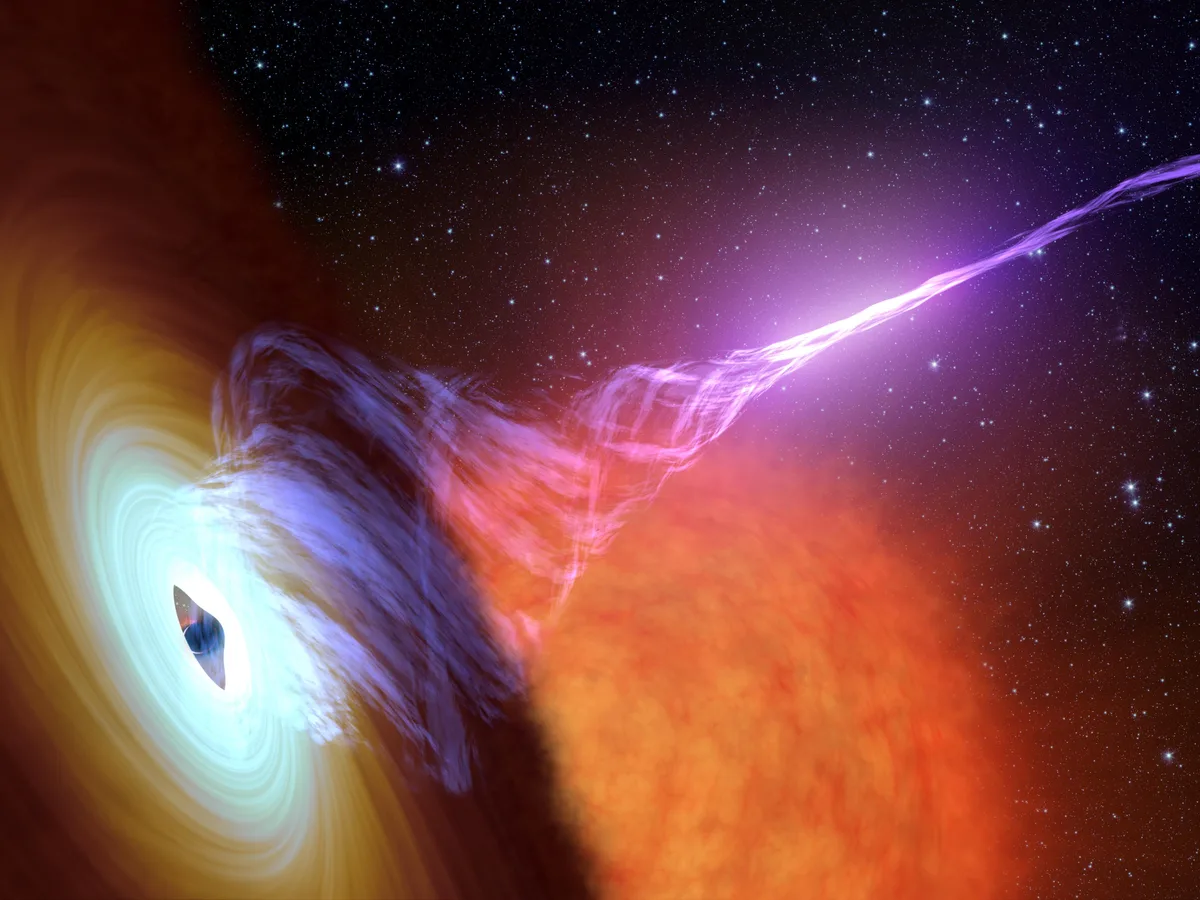
The Caltech team led by Jessie Miller formulated an elegant solution inspired by the extreme galactic microquasar SS 433. In this scenario, a stellar-mass black hole or neutron star feeds aggressively on matter pulled from a companion star in a regime of supercritical, or super-Eddington, accretion. Under such extreme accretion rates, radiation pressure drives massive, dense winds that envelop the binary in a thick, optically opaque gas cocoon.
This circum-binary shell completely absorbs the thermal X-rays produced near the compact object. Meanwhile, collimated relativistic jets punch clean channels through the outer envelope, creating durable internal shocks that generate synchrotron radio emission far outside the absorption zone.
«There are no known direct analogs to VT J1906+0849 in the radio transient archives. The source turned on between 1996 and 2005, peaked, faded slightly, and then exhibited a renewed brightening. Crucially, its spatial size shows no signs of expansion, and its X-ray emission is completely suffocated by a dense circumstellar wind.»
Jessie Miller, Astrophysicist at the California Institute of Technology (Caltech)
A New Class of Galactic Engines and Future Research Horizons
The identification of VT J1906+0849 strongly suggests that the Milky Way hosts an undiscovered population of persistent, obscured microquasars that have remained hidden from optical and X-ray surveys due to heavy interstellar extinction and self-shielding winds.
These extreme objects represent invaluable laboratories for studying how relativistic jets form and maintain stability under sustained supercritical accretion. Identifying the companion star with deep near-infrared observations via the James Webb Space Telescope could definitively confirm the orbital parameters of this extraordinary binary system.
Continued radio monitoring with the global array of radio telescopes will determine whether VT J1906+0849 will eventually transition into an open, unshielded phase or slowly subside, cementing our understanding of this newfound class of persistent galactic engines.
- Situated at an estimated distance of 49,000 light-years (15 kpc) from Earth near the outer Norma-Cygnus spiral arm.
- Discovered by cross-matching the Very Large Array Sky Survey (VLASS) with archival 1990s NVSS data.
- Exhibits a synchrotron radio luminosity equivalent to hundreds of thousands of solar luminosities.
- Proposed as a young, obscured progenitor analog to the famous galactic microquasar SS 433.
Comparison with SS 433: Relativistic Jet Outflows and Orbital Physics
To comprehend the physical engine powering VT J1906+0849, astrophysicists turned to the benchmark galactic microquasar SS 433 in Aquila. In SS 433, collimated jets launch at 26% the speed of light, precessing across a 162-day cycle. Crucially, SS 433 is embedded within the massive, mature radio nebula W50, excavated across tens of thousands of years of continuous mechanical feedback.
In contrast, VT J1906+0849 lacks an extended shock nebula, signifying an exceptionally young evolutionary phase. This provides a rare empirical snapshot of the earliest decades of supercritical accretion onto a compact stellar remnant.
Next-Generation Observatories: ngVLA and the Nancy Grace Roman Telescope
Unraveling the deep interior of VT J1906+0849 will rely on upcoming flagship facilities. The Next Generation Very Large Array (ngVLA) will offer unprecedented angular resolution, capable of directly resolving the jet collimation zone within the circumstellar wind.
Concurrently, NASA’s Nancy Grace Roman Space Telescope will deploy wide-field infrared imaging to pierce through the dense dust lane of the galactic disk, identifying the companion donor star and establishing precise binary orbital constraints.