

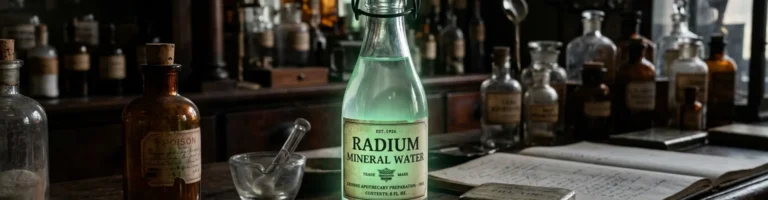

During the Roaring Twenties, Western society was swept up in the perilous hysteria of “radium mania.” Following Marie Curie’s discovery of radium, the public became convinced that its faint luminescence harbored an inexhaustible spring of vitality, capable of curing all diseases and restoring perpetual youth. The premier commercial embodiment of this craze was Radithor—a patented mixture of distilled water infused with radium-226 and radium-228 isotopes, marketed as a luxury panacea. Yet beneath the veneer of modern science lay a lethal poison: the grotesque demise of prominent American industrialist and athlete Eben Byers shattered the radioactive illusion forever, forging modern pharmaceutical regulation.
Radium Mania: When Ionizing Radiation Became a Consumer Trend
Following the isolation of radium salts by Pierre and Marie Curie at the close of the nineteenth century, popular imagination seized upon radioactivity not merely as a scientific marvel, but as an elixir of life. Biological understanding of ionizing radiation and cellular mutation was virtually nonexistent. Observing that radioactive emissions destroyed malignant tumors, popular media hastily concluded that micro-doses of radium must invigorate healthy cells.
Commercial markets swiftly exploited the hype. European and American pharmacies stocked radium-laced consumer goods: Doramad radioactive toothpaste for “radiant teeth,” Tho-Radia beauty cold creams, radium chocolate bars, radioactive soaps, and curative heating pads. Well-heeled households purchased Revigators—ceramic crocks lined with pitchblende ore designed to irradiate household drinking water with radon gas.
Amid this plethora of radioactive quackery, Radithor occupied the luxury echelon. Manufactured by Bailey Radium Laboratories in East Orange, New Jersey, it was packaged in refined glass vials and marketed as an elite scientific patent medicine priced at $1 per bottle—a substantial sum equivalent to roughly $15 to $20 today.
William J. A. Bailey: The Architect of Lethal Charlatanism
Radithor was formulated by William John Aloysius Bailey, a notorious Harvard dropout who masqueraded as a medical doctor. Exploiting loopholes in the Pure Food and Drugs Act of 1906—which penalized mislabeled ingredients but required no pre-market safety demonstrations—Bailey established a lucrative empire.
Unlike many fraudulent tonics of the era that contained mere trace amounts of radioactive materials, Radithor was legitimately potent. Every two-ounce phial contained a certified minimum of one microcurie of radium-226 and radium-228 dissolved in triple-distilled water. Bailey boldly advertised Radithor as a cure for over 150 conditions, ranging from gout and chronic fatigue to locomotor ataxia and erectile dysfunction.
To cultivate clinical legitimacy, Bailey instituted a lucrative kickback scheme, providing prescribing physicians with a 17 percent commission on every carton of Radithor purchased by their patients. Trusting doctors routinely directed affluent patients toward the fatal nostrum.
Radithor was marketed in the 1920s as a miracle cure for 150 ailments, promising renewed vitality and youth.
Industrialist Eben Byers consumed over 1,400 vials, accumulating a lethal radioactive payload in his skeleton.
Radium substituted for calcium in bone tissue: alpha particles destroyed Byers’ jaw and skull from within.
The public outrage spurred the 1938 FD&C Act, legally requiring pre-market safety testing for pharmaceuticals.
Eben Byers: From Socialite Athlete to a Living Skeleton
The most prominent victim of Bailey’s toxic enterprise was Ebenezer McBurney Byers, the charismatic scion of a Pittsburgh steel magnate. A Yale graduate, industrial executive, and the 1906 U.S. Amateur golf champion, Byers embodied the apex of American high society: wealthy, athletic, and socially prominent.
In November 1927, while returning on a sleeper train from the Yale-Harvard football match, Byers fell and injured his arm. Seeking relief from persistent discomfort and fatigue, his physician recommended Radithor. Experiencing an immediate sense of invigoration—a textbook combination of the placebo effect and temporary endocrine stimulation—Byers became a devoted evangelist for the product.
Consuming up to three bottles of Radithor daily, Byers went so far as to send crates of the elixir to business associates, social acquaintances, and even his racehorses. Over three and a half years, Byers ingested more than 1,400 vials of Radithor, absorbing a cumulative radiation dose hundreds of times greater than the lethal threshold.
«The Radium Water worked fine until his jaw came off. This tragic episode laid bare the complete vulnerability of the public before pseudoscientific charlatans.»
The Wall Street Journal, headline commemorating the death of Eben Byers in 1932
Bone Disintegration: The Radiotoxic Mechanism of Radium
The lethality of ingested radium stems from its biochemical mimicry of calcium; both occupy the alkaline earth metal group on the periodic table. When absorbed through the gastrointestinal tract, the human skeletal system mistakes radium for calcium, incorporating it permanently into the crystalline lattice of bones and teeth.
Sequestered within cortical bone, radium-226 (possessing a half-life of 1,600 years) continually emits energetic alpha particles—heavy helium nuclei with immense linear energy transfer. Alpha particles relentlessly bombarded Byers’ bone marrow and osteocytes, shattering double-stranded DNA and destroying regenerative osteoblasts.
By 1930, Byers’ health collapsed precipitously. He suffered agonizing headaches and severe weight loss as his skeletal framework disintegrated. Incurable osteonecrosis devoured his jawbones; his lower mandible disintegrated, holes eroded through his skull, and radiation-induced bone cancer took root. Weighing under 40 kilograms and unable to speak, Byers died in March 1932. His body was so profoundly radioactive that he was interred in a lead-lined coffin at Allegheny Cemetery.
- Each bottle contained certified radium-226 and radium-228 dissolved in triple-distilled water.
- Quack promoter William Bailey paid physicians a 17% kickback commission on prescriptions.
- Eben Byers was buried inside a sealed lead-lined coffin in Pittsburgh’s Allegheny Cemetery.
- Exhumation of Byers’ body in 1965 revealed radiation levels still hundreds of times above background.
The Birth of the FDA: A Legacy of Pharmaceutical Regulation
The gruesome death of a figure as prominent as Eben Byers, heralded by The Wall Street Journal’s grim epitaph, shocked the American public and catalyzed decisive regulatory reform. The Federal Trade Commission issued a permanent cease-and-desist order against Bailey Radium Laboratories in 1931, ending the commercial distribution of Radithor.
Coupled with the contemporaneous outrage surrounding the “Radium Girls,” Byers’ tragic demise galvanized the U.S. Congress to draft and pass the landmark Federal Food, Drug, and Cosmetic Act of 1938 (FD&C Act). The legislation revolutionized consumer protection by mandating that pharmaceutical manufacturers conduct rigorous pre-market safety testing verified by the Food and Drug Administration (FDA).
The cautionary saga of Radithor endures as an essential cornerstone of biomedical ethics. It remains an indelible testament to how commercial greed and unchecked pseudoscience can weaponize fundamental scientific discoveries, underscoring the indispensable necessity of rigorous clinical oversight in modern medicine.