

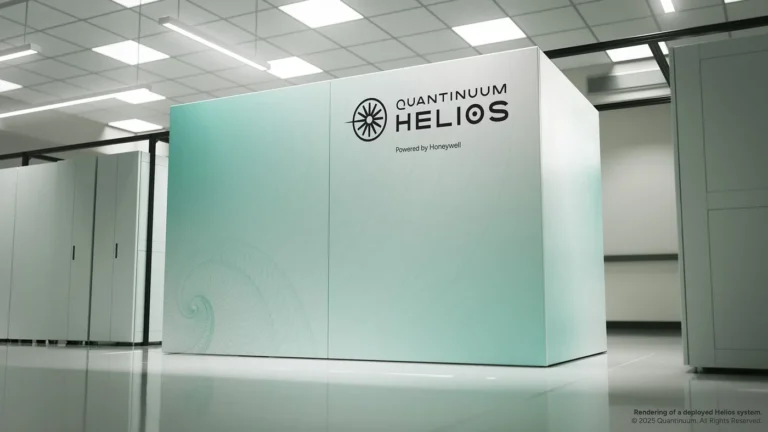

Scientists at Quantinuum have achieved a landmark milestone in quantum error correction, demonstrating a failure rate of just 0.0005% on their 98-qubit Helios system — roughly five uncorrectable errors per million rounds of checking — bringing practical, fault-tolerant quantum computers significantly closer.
A Historic Milestone: Why the Helios Record Changes the Trajectory
In experiments detailed in a preprint uploaded on October 16, 2026 to arXiv, a research team including A. Lavasani and A. C. Potter showed that Helios could preserve quantum memory across a million rounds of syndrome checking with an estimated failure rate of just five uncorrectable errors per million rounds.
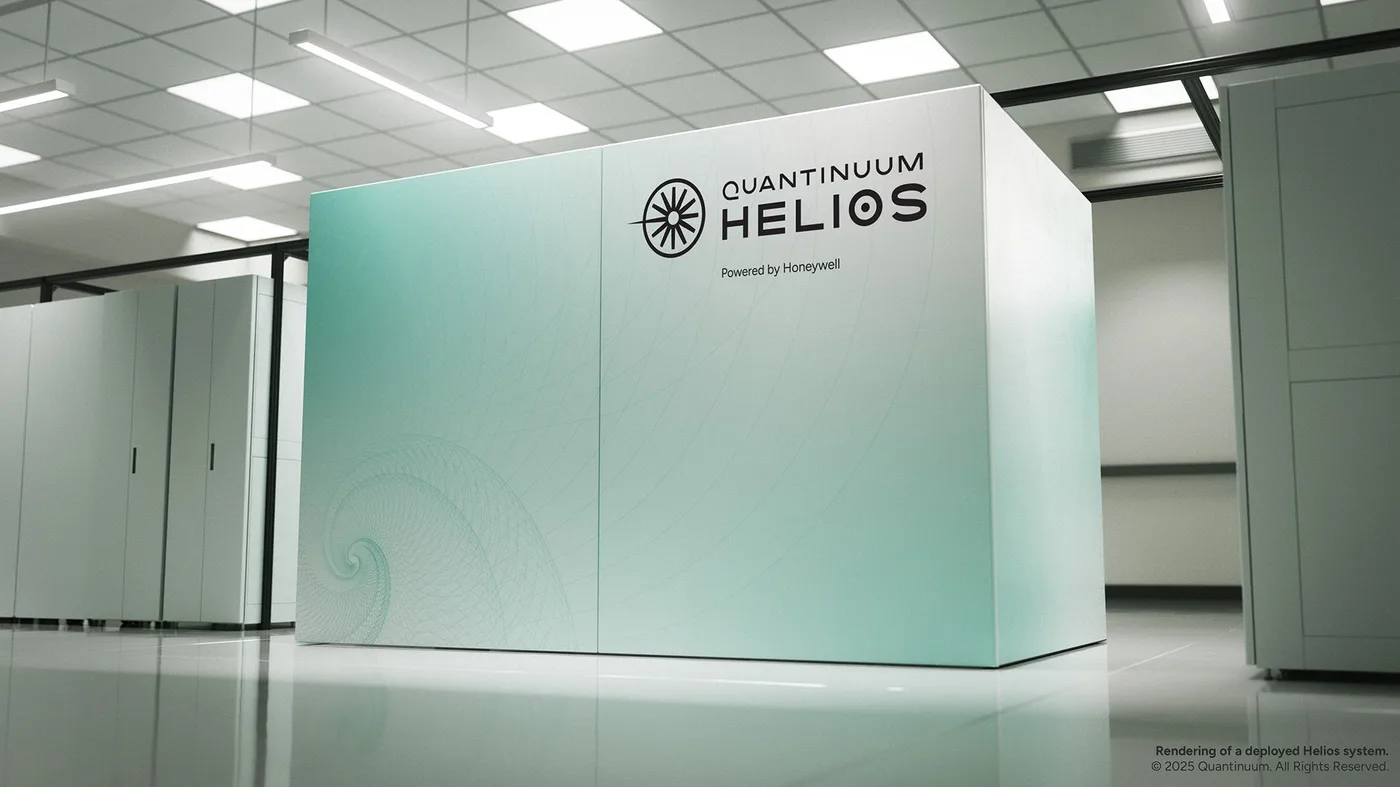
The achievement surpasses the previous industry benchmark held by Google’s 105-qubit Willow superconducting processor. In comparable quantum memory tests, Willow recorded an estimated 772 uncorrectable errors per million rounds, corresponding to an error rate of 0.0772%. Quantinuum’s trapped-ion platform therefore improved reliability by more than two orders of magnitude.
According to the researchers, this performance pushes quantum hardware toward the long-sought “megaquop regime,” in which a quantum computer can execute over a million operations without encountering an uncorrectable error — a threshold widely viewed as essential for tackling real-world problems in chemistry, materials discovery, and cryptography.
Why Qubits Fail and How Quantum Error Correction Protects Data
Preserving delicate quantum information remains one of the toughest engineering challenges in modern computing. Unlike classical silicon bits, which reliably hold a zero or one despite minor voltage fluctuations, qubits are extraordinarily sensitive to heat, mechanical vibrations, and ambient electromagnetic “noise.”
If environmental interference disrupts a qubit mid-calculation, the entire output can collapse into meaningless noise. Quantum error correction solves this vulnerability through redundancy: spreading a single “logical” qubit’s information across multiple physical qubits so that local faults can be detected and repaired without destroying the underlying computation.
However, scaling redundancy introduces a classic catch-22. Adding more physical qubits provides stronger protection for longer algorithms, yet every extra qubit and control line creates new opportunities for crosstalk and hardware errors. Overcoming physical limits with clever system architecture is a recurring theme in modern physics and engineering, seen also in experiments that transmit unblockable signals through solid walls using gravity and in sub-millimeter UWB wireless positioning systems.
«A scaled-up version of this system could reach the reliability required for useful fault-tolerant computation at a feasible size — less than a million physical qubits — which improves the outlook for practical quantum computing.»
Robin Blume-Kohout, Co-Director of Sandia National Laboratories’ Quantum Performance Lab
Shuttling Barium Ions and Laser “Leakage Repumping”
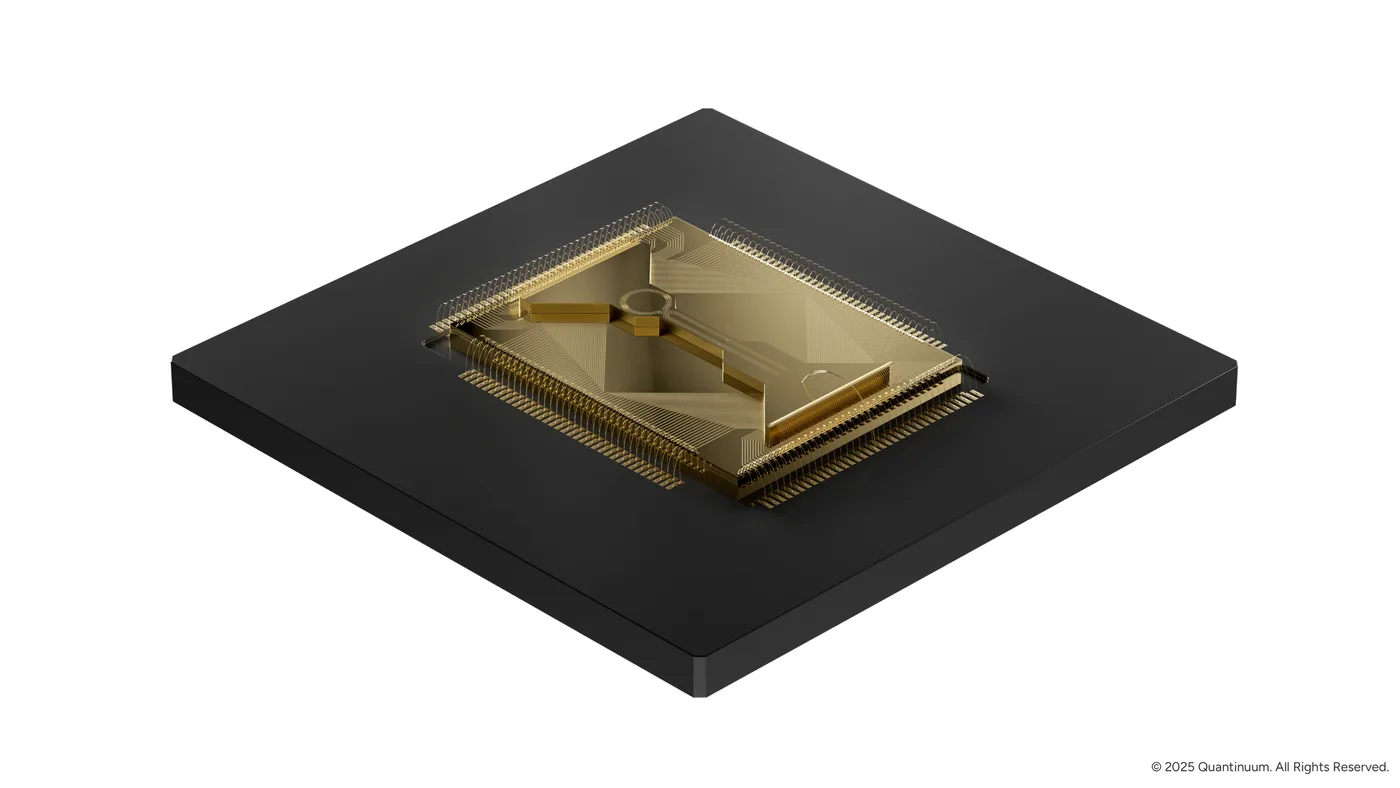
Unlike Google’s Willow chip, which relies on fixed superconducting circuits, Helios is built around electrically charged barium ions suspended in electromagnetic traps. Using a quantum charge-coupled device (QCCD) architecture, scientists can dynamically shuttle ions around the processor chip during computation.
By physically moving ions into proximity, Helios allows arbitrary pairs of qubits to interact directly. In static superconducting grids, quantum information must hop through chains of neighboring qubits, accumulating gate errors at each step. Direct ion shuttling eliminates that compounding overhead.
The team also introduced a technique called “leakage repumping.” Occasionally, noise knocks a trapped ion out of its two designated computational energy levels, rendering standard error-correction checks blind to it. Using split-second, precisely tuned laser pulses, engineers gently return leaked ions back into usable computational states without disturbing surrounding qubits.
To evaluate scaling, the researchers tested quantum error correction using topological color codes at distances 3, 5, and 7 — capable of correcting one, two, and three physical-qubit errors respectively. Each step up in code distance cut the uncorrectable error rate by roughly 12 times, culminating at distance 7 with a record failure rate of approximately one uncorrectable error per 200,000 rounds.
At color code distance 7, Helios averaged roughly 1 uncorrectable error per 200,000 error-checking rounds.
QCCD architecture physically rearranges barium ions for direct qubit pairing, avoiding multi-hop gate errors.
Split-second laser pulses restore escaped qubits back into valid computational states without disrupting neighbors.
Supporting 100 logical qubits is projected to need ~30,000 physical trapped-ion qubits versus ~900,000 superconducting.
A 30,000-Qubit Path to 100 Logical Qubits and Apollo in 2029
Although the arXiv study has not yet undergone formal peer review, its scaling metrics reshape hardware projections for universal quantum machines. Representatives from Quantinuum estimate that a future trapped-ion processor could support 100 fault-tolerant logical qubits using roughly 30,000 physical qubits.
By contrast, a competing superconducting architecture would require around 900,000 physical qubits to achieve comparable logical capacity — a thirty-fold hardware overhead that carries immense cryogenic and wiring complexity.
Quantinuum plans to integrate these adaptive syndrome extraction and leakage-repumping breakthroughs directly into Apollo, its upcoming universal fault-tolerant quantum computer targeted for commercial deployment by 2029.
- Quantum error correction crossed a major reliability threshold, dropping memory failure rates well below 0.001%.
- Stepping up color code distance (3 → 5 → 7) slashed error rates by roughly 12x per step, validating exponential suppression.
- These methods will power Quantinuum’s upcoming universal fault-tolerant Apollo system targeted for 2029.
Real-World Applications and Remaining Engineering Hurdles
Crossing into reliable logical-qubit operation unlocks computational problems that remain out of reach for even the largest classical supercomputers. Among the earliest fields poised to benefit from scalable quantum error correction are quantum chemistry and materials science, where accurate simulation of complex molecular interactions could accelerate the discovery of new catalysts, battery chemistries, and pharmaceuticals.
Significant potential also lies in complex optimization across logistics, energy grids, and financial risk modeling, where the number of possible states grows exponentially. Developers are already building hybrid quantum-classical workflows on Quantinuum’s software stack to prepare industrial applications for fault-tolerant hardware.
Even so, formidable engineering hurdles remain before universal machines arrive. The October 2026 preprint has not yet completed peer review, and scaling from Helios’s 98 physical qubits to tens of thousands of qubits for Apollo requires expanding system size more than 300-fold while preserving two-qubit gate fidelity, real-time error decoding speed, and precise laser control.