

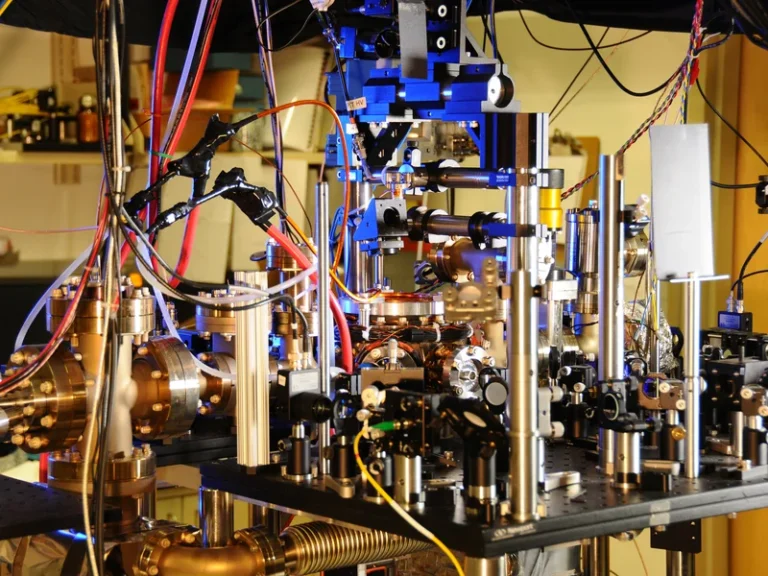

For decades, the undisputed gold standard of quantum computing has been superconducting circuits, which demand extreme refrigeration using liquid helium to within millikelvins of absolute zero (-273.15°C). Yet gigantic dilution refrigerators imposed an insurmountable physical barrier to scaling systems to millions of qubits. Today, quantum computers neutral atoms optical tweezers have propelled to the vanguard of global physics, proving that robust, fault-tolerant quantum processors can operate at ambient laboratory room temperatures through laser confinement of single atoms in ultra-high vacuum cells.
The Cryogenic Bottleneck: Why Absolute Zero Stalls Scalability
Commercial quantum flagships developed by IBM and Google rely on transmons—fabricated superconducting circuits engineered with Josephson junctions. The fatal flaw of these artificial qubits is their extreme vulnerability to thermal noise. Even minute thermal photon fluctuations at fractions of a kelvin cause immediate phase decoherence within microseconds.
Consequently, processors the size of a coin must be suspended within massive, multi-tiered gold-plated dilution refrigerators weighing thousands of kilograms. These systems draw tens of kilowatts of continuous power, and the mechanical routing of thousands of coaxial cables into the cold core presents an insurmountable heat-leak bottleneck.
This scaling roadblock has made building a fault-tolerant quantum computer with a million superconducting qubits economically and thermodynamically unviable within traditional cryogenic constraints.
Dilution refrigerators rely on the quantum endothermic mixing of Helium-3 into Helium-4 below 100 millikelvins. Helium-3 is an extraordinarily scarce and costly isotope, primarily harvested as a byproduct of nuclear tritium decay. The prospect of operating hundreds of industrial cryogenic refrigerators, each demanding kilograms of Helium-3, presents an untenable economic and logistical deadlock.
Moreover, thermal conductivity through thousands of semi-rigid coaxial control lines continuously leaks heat into the sub-Kelvin stages. Suppressing this blackbody radiation necessitates dense attenuation chains, compounding refrigeration loads and physically restricting the geometric volume of the processor core.

Harnessing Optical Tweezers: Trapping Single Atoms in Light
The neutral-atom paradigm builds upon the Nobel Prize-winning invention of optical tweezers by Arthur Ashkin. Optical tweezers leverage light gradient forces: tightly focused laser beams create localized electromagnetic potential wells that attract and securely trap individual neutral atoms at the beam waist.
Utilizing spatial light modulators (SLMs) and acousto-optic deflectors (AODs), quantum physicists project arrays of thousands of microscopic optical traps inside an ultra-high vacuum glass enclosure. Each trap captures precisely one neutral alkali or alkaline-earth atom, such as Rubidium-87 or Ytterbium-171.
Because neutral atoms possess zero net electric charge, they are virtually immune to stray thermal fields radiating from the vacuum chamber walls. The entire physical hardware sits at ambient room temperature (+20°C): the trapped atoms themselves are Doppler-cooled to microkelvins, but no bulky cryogenic infrastructure is required.
Optical molasses and magneto-optical trapping exploit Doppler cooling to arrest atomic motion. By red-detuning six orthogonal laser beams relative to atomic cycling transitions, atoms absorb momentum kicks exclusively in opposition to their trajectories, cooling the ensemble to microkelvin temperatures.
High-numerical-aperture objectives (NA > 0.5) focus laser tweezers down to sub-micron waists. Through the collisional blockade effect, the light-assisted collision of two atoms within a single microscopic potential well instantly ejects both, ensuring deterministic, Poissonian single-atom occupancy per focal site.
The glass vacuum cell operates at ambient room temperature (+20°C), eliminating liquid helium cryogenics.
Every atom of an isotope is identical in mass and energy, bypassing solid-state semiconductor defects.
Enormous dipole moments of highly excited atoms facilitate ultrafast, high-fidelity entanglement gates in nanoseconds.
Optical tweezers physically shuttle qubits mid-computation, dynamically reconfiguring the processor graph.
Rydberg Blockade: Engineering Ultrafast Entanglement Gates
Individual isolated neutral atoms boast phenomenal coherence times: their hyperfine ground and nuclear spin states persist for multiple seconds. However, performing universal quantum logic requires controlled, high-fidelity two-qubit interactions.
This is unlocked via the Rydberg blockade mechanism. Shining a resonant ultraviolet laser pulse excites outer electrons to colossal principle quantum shells (n > 70). In this Rydberg state, an atom’s physical radius expands thousands of times, magnifying its van der Waals dipole interactions by twelve orders of magnitude.
When one atom enters the Rydberg state, its dipole field shifts the energy levels of adjacent atoms, blockading their excitation by the same laser. This quantum exclusion principle enables ultrafast controlled-phase (CZ) and CNOT gates within tens of nanoseconds at fidelities exceeding 99.5%.
The physics of Rydberg interactions stems from the monumental electric dipole moment of states with high principal quantum numbers (n > 70). The atomic orbital radius scales as n-squared, expanding electron clouds to hundreds of nanometers and magnifying van der Waals C6 coefficients by twelve orders of magnitude.
This colossal interaction energy dramatically shifts the resonant frequency of neighboring atoms within a 5-10 micrometer Rydberg blockade radius, forbidding dual excitation and facilitating ultra-high-fidelity controlled-phase (CZ) gates in under 50 nanoseconds.
«Neutral atoms trapped in optical tweezers offer what solid-state engineers could only dream of: identical, nature-perfect qubits devoid of manufacturing flaws, scalable in three dimensions without cryogenic overhead.»
Mikhail Lukin, Professor of Physics at Harvard University and Co-Director of the Harvard Quantum Initiative
Dynamical Reconfiguration: Qubits That Move in Flight
A decisive advantage of neutral atoms over static chip architectures is dynamical reconfigurability. In solid-state chips, qubit connectivity is permanently hardwired on silicon, demanding hundreds of disruptive SWAP operations to entangle distant elements.
In neutral-atom platforms, optical tweezers can physically transport individual atoms across the array mid-computation without collapsing their delicate quantum superposition. Physicists can bring arbitrary pairs together, execute an entanglement gate, and shuttle them back.
This elevates the processor into a quantum field-programmable gate array (FPGA), flexibly adapting its geometric connectivity graph to match specific algorithms in chemistry, optimization, or cryptography.
Dynamic atomic shuttling is orchestrated via 2D acousto-optic deflectors driven by high-speed RF arbitrary waveform generators. Modulating acoustic acoustic wave frequencies in tellurium dioxide crystals alters light diffraction angles, smoothly translating optical trap minima across millimeters per second.
During transport, quantum information resides securely within hyperfine ground-state spin manifolds (e.g., F=1 and F=2 in Rubidium-87). This spatial mobility enables all-to-all connectivity graphs, bypassing the planar routing constraints of static superconducting circuits.
- Power Consumption: Elimination of 25 kW cryogenic compressors slashes operating costs by orders of magnitude.
- High Density: Inter-trap spacing of 3-5 micrometers enables hundreds of thousands of qubits in a compact cell.
- Coherence Duration: Nuclear spin retains superposition for seconds, compared to microseconds in transmons.
- 3D Stacking: Optical trapping geometry enables multi-layered volumetric qubit lattices.
Fault Tolerance and the Horizon of a Million Qubits
Between 2024 and 2026, research teams from Harvard, MIT, and QuEra demonstrated scalable fault-tolerant quantum error correction on 48 logical qubits using hundreds of physical neutral atoms. Surface codes and color codes demonstrated orders-of-magnitude error suppression.
Free from cryogenic constraints, the optical hardware—semiconductor laser diodes, fiber switches, and spatial modulators—integrates smoothly into standard 19-inch datacenter server racks. Projections target commercial systems with 100,000 physical qubits by 2027–2028.
Neutral-atom quantum computers decisively prove that quantum computing does not require sub-zero cryogenics, paving the fast track toward transformative quantum supremacy.
In fault-tolerant quantum error correction, neutral atom arrays naturally support 2D and 3D surface and color codes. Spatial trap reconfigurability allows ancilla qubits to entangle dynamically with data qubits for non-demolition (QND) stabilizer measurements.
Free from bulky cryogenic vessels, modular neutral-atom quantum engines fit seamlessly into standard 19-inch datacenter racks, heralding an era of accessible, massively scalable room-temperature quantum computing. Also read our related investigative feature on groundbreaking investigations into room-temperature quantum entanglement.